
Beacon Basingstoke Roofing

Roofers in Bagshot

Bagshot is 21.5 road miles east of Basingstoke, beside junction 3 of the M3, and its roofs sit under the planning rules of three conservation areas and the shade of heathland trees. We survey with photographs of your own roof, then send the price as a fixed quote on paper.

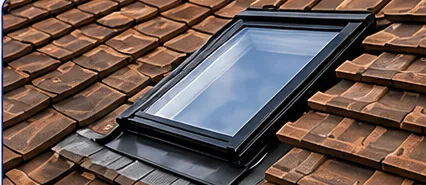
Roof window fitted in a tiled pitched roof

Roofs we see in Bagshot

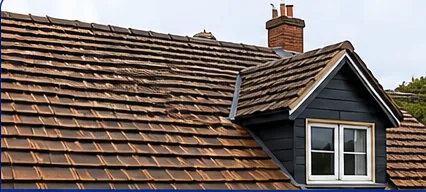
  • 1930s semi-detached houses with hipped clay tile roofs and bay windows on a suburban road

    Slate and clay near St Anne's

    Surrey Heath has three conservation areas in Bagshot: the village, Church Road and Bagshot Park. St Anne's Church, Grade II listed, is red brick with stone detail under a slate roof, and older houses around it are often covered in natural slate or small plain clay tiles as well. Both are hooked or nailed to timber battens, so slipped courses, rusted nails and failed lead at the chimney are the usual faults.

  • House roof stripped to battens during a roof replacement

    Tree-shaded roofs on the heath edge

    Bagshot grew up on sandy heathland, and plenty of gardens still back onto pine, birch and open heath. Needles, catkins and seed fall straight onto the roof and into the gutters, and a shaded slope dries slowly, so moss builds along the lower courses and in the valleys. On those roofs the surface is rarely the problem. The blocked gutter and the soaked fascia beneath it are.

  • A row of Victorian terraced houses with Welsh slate roofs and brick chimneys in Reading

    Later houses, garages and extensions

    Away from the old centre, later houses commonly carry concrete interlocking tile, with garages, porches and kitchen extensions under flat roofs of felt or a single-ply membrane. Because the village sits right beside the M3 and A30, many owners extend rather than move, which adds new roof junctions, flashings and sometimes roof windows. Every junction between old and new roof is a place a leak can start.

21.5 road miles east of Basingstoke

Planning and building control in Bagshot

Surrey Heath Borough Council handles both planning and building control for Bagshot. The council lists three conservation areas inside the village, Bagshot Village, Bagshot Church Road and Bagshot Park, and sets out how it treats them on its conservation pages. Bagshot Park on the northern edge of the village was a royal hunting lodge site from at least Tudor and Stuart times, and it is one of the village's three conservation areas, where the council looks closely at changes to how buildings appear. St Anne's Church is Grade II listed, and any other listed house here needs the same care.

For re-roofing, like-for-like repair in a conservation area is normally fine: matching slate for slate, clay for clay, lead for lead. If you want a different material or finish, consent could be required, so ask the council's conservation officer before ordering anything. Outside the conservation areas the question is usually building control, because stripping and re-covering a big area may be notifiable, and the paperwork is ours to handle. If you are weighing a roof window, our planning guide for roof windows explains where the limits fall, and conservation rooflights covers the slim-framed option for older roofs.

What we find on Bagshot roofs

Bagshot has a varied mix of roofs: slate and clay roofs inside protected areas, pine-shaded roofs along the heath, and ordinary concrete-tiled houses near the main roads. Each group fails in its own way.

Chapter 1: Why do slates keep slipping on our older Bagshot house, and can they be refixed?

What we find

A natural slate roof can last a very long time, but the slates are only as secure as the nails holding them. Each slate hangs from one or two nails driven into a timber batten, and the nail head is the only thing stopping it sliding out. Where the nails were ordinary iron or steel, damp air and rain have rusted the shanks thin over the years, and the slate slips an inch or two, or drops into the gutter. Roofers call this nail sickness.

The signs are slates sitting lower than their neighbours, a gap showing a darker strip of batten, or broken pieces in the border below. In the loft you may see a line of daylight, or staining on the sarking (the boards or felt laid over the rafters beneath the slate). The slates themselves are often perfectly sound.

What we fix

We take photographs of the whole slope first, so you can see where the slipping is concentrated. Where it is only a few slates, we lift the course above, remove the failed nails and fix each slate back with a copper or stainless nail, adding a clip or tingle strip if the slate has lost its hole. Cracked slates are swapped for reclaimed ones that match in thickness and colour, which matters in a conservation area.

A single slate repair is typically priced at £100 to £250 labour, plus the slate, and scaffold or a tower adds £300 to £800; your fixed quote follows the survey. If nail sickness has spread across the whole slope, re-laying the roof on new battens is the honest answer, and our slate roofing page explains how that is done.

Chapter 2: Why is the gutter on our Bagshot house always full of pine needles and moss?

What we find

Houses on the heath edge live among Scots pine, birch and oak, and everything those trees drop ends up on the roof. Pine needles are the worst of it. They slide down the slope, jam in the gutter and pack tightly around the outlet, so the gutter fills, overflows over the fascia and soaks the board behind it. Needles lodged in the valleys, where two slopes meet, also hold water against the tiles and the lead lining underneath.

Moss follows where the sun does not reach. It grows on the north-facing and tree-shaded slopes, holds moisture against concrete tiles and spreads into the joints between them. Over the years the damp rots the fascia and soffit (the board under the overhang) and can lift the tiles along the lower edge. A damp patch on an upstairs ceiling below a valley often traces back to this build-up.

What we fix

We clear the gutters and valleys by hand, then remove the moss with a scraper and treat the surface with a biocide, rather than blasting it with a pressure washer that can strip the face of older concrete tiles. Rotten sections of fascia and soffit are cut out and replaced, and the gutter is re-set to a true fall so that it drains toward the outlet. Where trees overhang the roof, a mesh guard on the gutter and a valley cover can cut the clearing needed.

Typical UK prices for hand moss removal with biocide come to £748 to £978 from small to large roofs. Your fixed quote follows the survey. Our roof cleaning service covers the clearing, and guttering, soffits and fascias for the repair side.

Chapter 3: What causes the damp patch around our chimney in a Bagshot conservation area?

What we find

A chimney is the point on a roof where a vertical masonry stack meets a sloping surface, and sealing that junction takes metalwork. A strip of lead flashing is dressed up the side of the stack, and small lead pieces called soakers are interleaved with the slates or tiles to carry water out. Over time the lead splits where it has expanded and contracted, the mortar that holds its upper edge in the brickwork crumbles, and rain finds a way in behind it.

Inside the house the clue is a brown stain on the ceiling or the chimney breast, often only after wind-driven rain. On older Bagshot houses the stack itself may be soft brick laid in lime mortar, which weathers faster than modern pointing, and a cracked cement render can trap water against it. The cause is usually the lead and the pointing rather than the roof covering.

What we fix

We check the whole stack from the roof, photographing the flashings, soakers, pointing and chimney pot bedding. Failed lead is replaced with new, cut into a fresh chase (a groove) in the brickwork and pointed. On a house in a conservation area we use lime mortar for the repointing so that the soft brick can keep breathing, and the lead matches the existing detailing, which keeps the repair within like-for-like.

Typical UK prices for chimney leadwork come to between £350 and £920 in published guides. Our chimney repairs page covers pointing, pots and flaunching, and lead roofing and lead work explains why lead is still the right metal for these joints.

Chapter 4: Why do the ridge and verge tiles keep loosening on our Bagshot house next to open heath?

What we find

Open ground on the heath side of the village means wind arrives with little to slow it. The ridge, the capping along the top of the roof, and the verge, the sloping edge at a gable end, are the parts of a pitched roof that catch the most uplift. On many houses of the last century both were bedded in sand and cement mortar. Mortar shrinks as it ages and the bond between mortar and concrete tile breaks, so a tile can rock before it lifts.

The first signs are mortar crumbs in the gutter, a ridge tile out of line, or a gap along a verge where daylight shows from the loft. Tiles that come off in a gale land in the garden or on a neighbour's car, which makes it worth acting before the wind does.

What we fix

We lift a few ridge tiles to see whether the tiles themselves are sound and just the bedding has gone, a common finding. The standard, BS 5534, now looks for mechanical fixing along ridges, hips and verges instead of mortar by itself. We refit the ridge tiles to a continuous batten with clips or screws over a breathable roll, a dry-fix system covered by BS 8612, and finish the verge with dry verge units that grip the tile ends.

Published guides put dry-ridge work on a semi at £900 to £1,600, with scaffold extra. Heath edges attract nesting birds and bats, which are protected, so we check before we disturb a ridge or verge. Details are on our ridge tile repairs page.

Bagshot roofing questions

Why do pine needles block the valleys on roofs along the heath?

Needles are fine and sharp, and they pack into valleys and gutters where the flow is narrow. Once packed, they hold water and moss against the roof and can push rain up under the tiles. Clearing them is a routine job, and a valley that has been choked for years may also need its lining checked. We photograph the valley before and after so you can see the condition.

Do I need consent to repair a roof in one of Bagshot's conservation areas?

Like-for-like repair, with matching slate, clay tile and lead, is usually straightforward. Changing materials or the look of the roof may need consent from Surrey Heath Borough Council, so check with its conservation officer before ordering. We photograph the existing roof in detail, which gives you a clear record to show the council.

The M3 is nearby. Can you get to a leaking Bagshot roof quickly?

We prioritise emergency calls, and our first job is to make a leaking roof safe, with a tarpaulin or a temporary repair, before anything permanent. We do not promise an arrival time, because it depends on where our team is and on the weather. Ring 01256 213956 or message us on WhatsApp with a photo of the leak.

Can the old slates on a Bagshot house be reused when you repair the roof?

Often, yes. Sound slates can be taken off, sorted and refixed with new nails on the same battens, and we make up any shortfall with reclaimed slate of the same size and colour. Cracked or delaminated slates, which flake into layers, are discarded. After the survey we tell you what the roof still has in it before we recommend replacing anything.

Will bats or nesting birds stop work on a house near Bagshot heath?

They can. The law protects bats and nesting birds, and roofs that back onto heathland and old trees are more likely to hold them. Work may need to be timed around a nesting season or checked by a specialist first. We look for signs during the survey and talk through any delay with you before a start date is fixed.

Get your free roof survey in Bagshot

Tell us what’s happening and we’ll call you back to arrange a visit. You’ll get photos of your roof and a fixed written quote.

  • No obligation
  • Photo report of your roof
  • 10-year workmanship guarantee

Rather talk? 01256 213956

Call Free survey