


Chapter 1: Why do the gable-end tiles on our heath-edge house keep lifting in the wind?
What we find
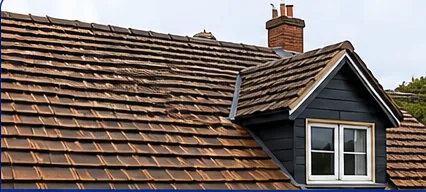
A house on the western side of Bisley has open heath upwind of it, so gusts reach the roof without anything to break them. The roof edges suffer most. At a gable the verge tiles stick out past the wall, and wind gets underneath and tries to peel them upward. If those tiles were bedded in mortar when the house was built, the bed gradually cracks, and each storm loosens it a little more.
From the ground you may notice a verge tile sitting proud of its neighbours, a pale line where mortar has fallen away, or fragments on a path under the gable. Inside the loft there may be a draught across the gable end. A strong gust can then pull a whole run off, and a tile landing on a drive or a car is a real hazard.
What we fix
We take down the loose verge tiles, rake out the failed bed and look at what is underneath: sound battens, a clean edge, an undamaged undercloak. Then we refix the verge with a mechanical system. A dry verge uses plastic or metal units that clip or screw over the tile ends, so the edge is held by fixings and not by cement. The ridge gets the same treatment, with a continuous batten and vented ridge roll, as British Standard BS 5534 expects.
This is usually a day or two's work on a typical house, and it needs scaffold at the gable. Our ridge tile repairs page gives more detail. Dry ridge work on a semi has a typical UK range of £900 to £1,600, and scaffold at the gable comes on top at £300 to £900. The survey photographs show you the loose tiles on your own roof, and your fixed quote follows from them.
