Beacon Basingstoke Roofing

Roofers in Winchester

Winchester is 20.7 road miles south-west of Basingstoke, down the M3, and its roofs are described closely in the council's conservation area appraisal: plain clay tiles on Georgian and Victorian terraces, slate on stuccoed villas, flint and brick below. We photograph your roof as it is, and the quote we write afterwards is fixed.

Brick estate houses with concrete tile roofs among pine trees

Roofs we see in Winchester

  • 1930s semi-detached houses with hipped clay tile roofs and bay windows on a suburban road

    Plain clay tile in the old streets

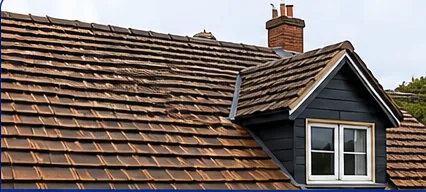
    The city's conservation area appraisal describes Canon Street and College Street as lined with Georgian and Victorian houses, with undulating rooflines clad in plain clay tiles. Those waves are the age of the timbers underneath, not a fault in themselves. Small tiles, hung double-lapped on battens, bend with the roof and can be lifted and refixed one section at a time.

  • House roof stripped to battens during a roof replacement

    Slate on stuccoed brick villas

    In the Christchurch Road character area the appraisal records brick or stuccoed brick houses, generally with slate roofs. Slate is thin, hard and long-lived, but its fixings are not: the nails rust through long before the stone gives out. Slipped slates, cracked corners and tired leadwork are the faults to look for on these houses.

  • A row of Victorian terraced houses with Welsh slate roofs and brick chimneys in Reading

    Flint, brick and chalk cob walls

    Flint and brick walls are a recurring feature of frontages across the conservation area, and some houses have chalk cob walls (rammed chalk and straw, built up in layers). Those walls are soft where they meet the roof, so what sits above them matters: a sound verge, a working gutter and chimney flashings that shed water away from the wall, not into it.

20.7 road miles south-west of Basingstoke

Planning and building control in Winchester

Winchester City Council handles planning and building control here, and it takes the city's historic fabric seriously. The Town Centre (1967), Hyde Abbey (1967) and St Cross (1969) conservation areas were among the first designated anywhere in the country, and were extended and united in 1981. The council's conservation area appraisal sets out what it regards as characteristic, from plain clay tile and slate to flint and brick walls, so read the relevant section before you order any material for an older house.

Repairing a roof like for like, with matching tile or slate, is normally treated as maintenance. A change of material or a visibly different roof may need consent, and listed buildings carry stricter rules again, so put the question to the council's conservation officer first. Away from the conservation areas, building control tends to matter more: a big re-cover may need notifying, and we handle that paperwork. If you are weighing up a roof window on a period house, our planning guide for roof windows explains where the limits sit.

What we find on Winchester roofs

Winchester's conservation areas hold a great many old roofs, and they repay careful handling. The same few faults come up again and again: fixings that have corroded after generations of weather, lead that has split, chimneys built of soft local materials, and walls that suffer when a gutter fails.

Chapter 1: Why are tiles slipping on our Georgian terrace near College Street?

What we find

On the older clay roofs in the city, each plain tile hangs from the batten (the timber lath running across the rafters) by two small nibs and is held by a nail or a wooden peg. Over a couple of centuries the iron nails rust and thin, and the pegs soften. The tile then drops a little in its course, which roofers call nail sickness. Frost makes it worse, because water that gets behind a tile freezes and pushes it further out of line.

You will usually spot a single tile sitting low, a gap showing a dark strip of underlay, or broken pieces on a path or in a rear light well. In the loft, look for pale stains on the underside of the roof boards and for daylight at the line of the slipped tile. A wavy roof is not the same thing as a failing roof, and the undulation alone is no cause for alarm.

What we fix

We lift the affected area and check what is left of the fixings, then re-hang the sound tiles on new stainless or copper nails and replace the broken ones with reclaimed plain tiles of matching colour and camber (the slight curve across each tile). Where the battens have rotted, they are renewed in the same section. Breathable underlay goes under the work if the old felt has perished. The rest of the roof is left alone, so the character the appraisal values stays in place.

If slipping is widespread across a whole slope, patching stops making sense and a strip and re-lay of that slope is the sensible repair, reusing as many tiles as survive. Our nail sickness guide explains the fault in detail, and the pitched roofing page shows how a larger job runs.

Chapter 2: How do you repair slipped slates on a stuccoed villa in the Christchurch Road area?

What we find

Slate roofs on stuccoed brick houses tend to last well, but they fail in a pattern. Each slate is held by two nails through its upper section, and when those rust away the slate slides down until it hangs on its neighbour. A single cracked slate, a missing one at the eaves, or a slate that has split along its grain lets water onto the felt or boards below. Slates that have gone chalky and flaky on the surface are reaching the end of their life.

On villas with parapet walls or a boxed gutter at the front, the leadwork is the other weak point. Lead sheet laid in a valley or behind a parapet can split with repeated warming and cooling. Inside, the signs are a stain that creeps down the wall near the top of the stucco, or a bubbling patch of paint on a ceiling beneath the roof edge.

What we fix

A single slate is replaced without disturbing the ones around it, using a copper tingle (a small strap) or a hook tucked under the course above to hold the new slate. Cracked and loose slates across a slope are replaced the same way, using reclaimed slate where we can match the size and tone. Where the surface of the slate is going, we tell you honestly if a slope has had its day and quote separately for a re-slate in natural slate.

Leadwork is renewed in code-weight sheet lapped and fixed to allow for movement, so the new lead does not split in the same way. Our guide to slipped and cracked slates covers the signs, and the lead roofing page explains what the work involves.

Chapter 3: Can the chimney on a flint and brick house in Winchester be repaired without spoiling it?

What we find

Older chimneys in the city are commonly built in brick and bedded in a lime mortar that is softer than the bricks around it. That is deliberate: lime lets moisture escape through the joints instead of through the brick faces. When a past repair has been done in hard cement mortar, the trapped water has nowhere to go but through the brick, and the faces start to crumble and flake away.

At the roof line, the flashings that seal the stack to the tiles or slates (strips of lead, with small soakers interleaved up each side) fail through age and movement. A damp patch on a chimney breast, brown streaks on the wallpaper, or a stack that leans slightly are the usual signs. Pots and the flaunching (the mortar crown that holds them) can crack too.

What we fix

We repoint in lime putty mortar matched to the original in colour and texture, raking out only the loose joints to preserve as much old pointing as possible. Crumbled bricks are cut out and replaced with reclaimed ones, and flint panels are consolidated rather than rebuilt. New lead flashings, back gutter and soakers are cut and dressed into the joints, not sealed with mastic, which fails within a few seasons.

Where the pot is cracked, we reflaunch (re-form the mortar crown) and rebed it. If the stack is leaning or shows deep cracks, we explain whether it needs rebuilding from the roof line, which is a bigger job. Our guide to lime and cement mortar for chimneys sets out why the mortar choice matters so much, and the chimney repairs page covers the rest.

Chapter 4: Why does a leaking gutter matter more on a house with chalk cob walls?

What we find

Chalk cob is made from chalk, clay and straw, rammed or built up in lifts and left to dry. It is strong while it stays dry and weak when it does not. The appraisal notes that some houses in the Christchurch Road area have chalk cob walls, and a wall like that relies on its roof, its overhang and its gutter to keep rain well away from it. A cracked gutter joint or a blocked downpipe can pour water down the same patch of wall season after season.

Look for a green stain beneath a gutter joint, a darker band at the foot of a wall, or a soft, powdery patch where the render has blown. Rotten fascia boards (the board running along the eaves, which the gutter hangs from) are also a sign that water has been getting in at the edge for a long time. Cob does not give a loud warning before it deteriorates.

What we fix

We start by finding where the water comes from. That often means re-aligning the gutter to the correct fall, replacing failed joint seals or sections, and fitting a downpipe with a shoe that discharges clear of the wall, not against it. Rotten fascia boards are cut out and replaced, and the eaves are checked so that water running off the bottom course of tiles reaches the gutter and does not slip behind it.

If the wall itself has been wetted for years, we say so in the survey and suggest you have a specialist look at the cob once the roof edge is sound, since drying out takes time. Our leaking gutter joints guide explains the common faults, and the guttering and fascias page shows the full range of work.

Winchester roofing questions

Why does an old Winchester wall stay damp below the roof edge?

Walls that stay wet below the eaves are often being soaked by a gutter that leaks at its joints or overflows. Soft brick and cob take up water and then dry slowly, so staining can persist long after the leak starts. We trace where the water is escaping, repair or realign the gutter or fascia, and note anything in the wall itself that needs another trade.

My house is in one of Winchester's conservation areas. What should I check before roof work?

Start with the council's conservation area appraisal, then call the planning team at Winchester City Council. Matching repairs in the same tile or slate are normally straightforward, but a change in material may need consent. We photograph the roof so you have a clear record to show them, and we keep the repair like for like wherever we can.

Can old clay tiles from my Winchester roof be reused?

Often, yes. Sound plain tiles are lifted, cleaned and re-hung, and any that have split or flaked are replaced with reclaimed tiles of a matching colour. Tiles with soft, laminating faces are the ones that fail first. We sort them as we strip, so the roof keeps its mixed, weathered look instead of being patched with bright new tiles.

Do you work on slate roofs on Victorian villas near the city centre?

Yes. Slipped, cracked and missing slates are replaced individually, and lead gutters and parapet linings are renewed where they have split. Large villas can need scaffold to reach safely, which we price separately and show in the quote. See our slate roofing page for how re-slating is done.

Will you check the loft as well as the outside of a Winchester roof?

Yes. On older houses the loft tells you more than the street does: daylight through the tiles, stained roof boards, damp rafter ends and the state of the underlay. We photograph it with the outside, and you receive both sets of pictures with the written quote, so you can see what we saw before deciding on anything.

Get your free roof survey in Winchester

Tell us what’s happening and we’ll call you back to arrange a visit. You’ll get photos of your roof and a fixed written quote.

  • No obligation
  • Photo report of your roof
  • 10-year workmanship guarantee

Rather talk? 01256 213956

Call Free survey