

Beacon Basingstoke Roofing

Emergency and general roof repairs in Basingstoke

When water is coming through a ceiling or tiles have come down in the wind, we make the roof safe first and repair it properly after. Once it is dry, a free survey follows, with photographs of the fault on your own roof and one fixed written price for the lasting repair. If a repair will hold, that is what we recommend, and the written price names the tiles, flashings or boards it covers.

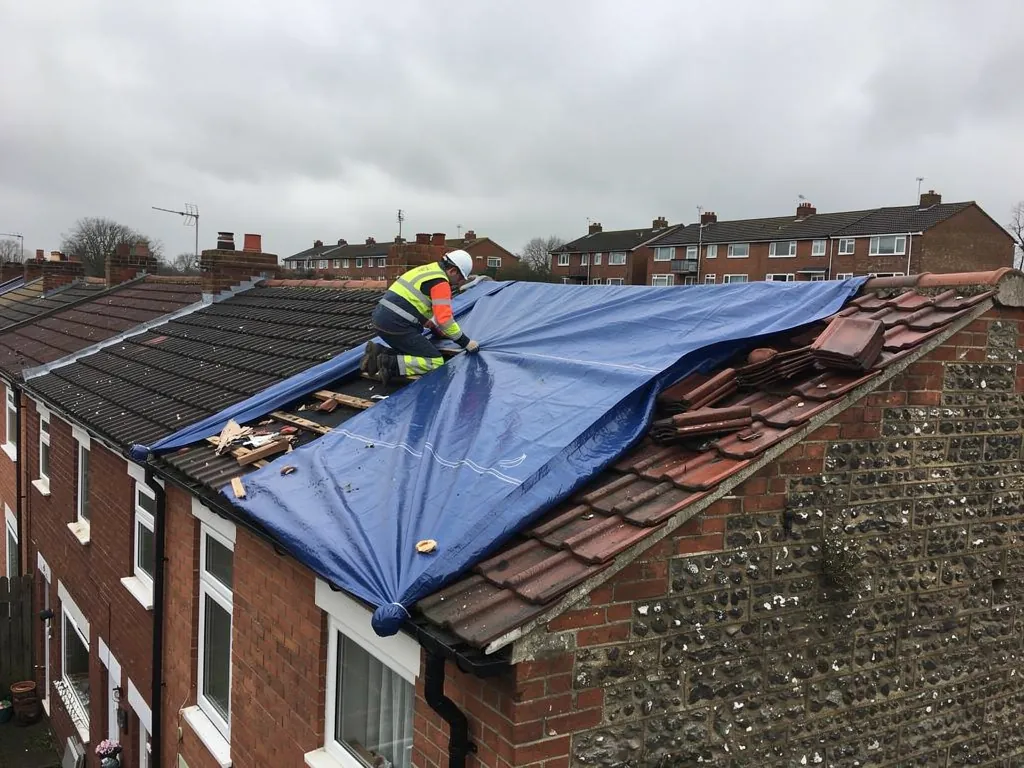
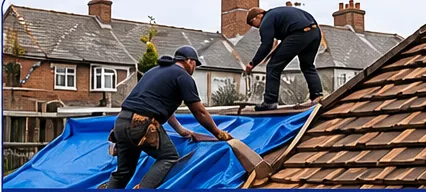
A roofer securing a heavy blue tarpaulin over storm-damaged roof tiles on a terraced house, grey sky

What we deal with on a repair call

  • A gap of missing tiles on a pitched roof after a storm, broken tiles in the gutter

    Leaks and storm damage

    Water through the ceiling, tiles or slates blown off, lifted ridges and torn felt. We stop the water getting in, then trace where it entered and repair that point.

  • Roofers securing a tarpaulin over a damaged roof

    Temporary make-safe work

    A tarpaulin battened down, a cracked tile swapped for a spare, a hole boarded over. These hold the weather off until the permanent repair can be done in dry conditions.

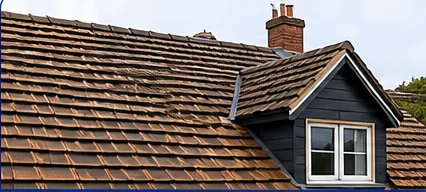
  • Slipped and cracked clay roof tiles

    General repairs and upkeep

    Cracked and slipped tiles, crumbling ridge mortar, worn flashings, loose verges and broken pointing. Small faults put right before they reach the timber and the ceiling below.

Signs your roof needs a repair before the next storm

  • A damp patch on an upstairs ceiling that darkens after each shower
  • Pieces of broken tile or slate lying in the garden or on the path
  • A tile that sits lower than its neighbours, leaving a visible gap
  • Daylight showing through the roof timbers when you look up in the loft
  • Crumbs of old mortar in the gutter or on the ground below the ridge

What happens once you call about a leaking roof

  1. 1Make it safeWe stop water coming in first, with a temporary cover or a quick fix, and say what we have done.
  2. 2Free surveyWe trace the real entry point on the roof and from the loft, with photographs of each fault.
  3. 3Cause and written priceYou are shown what failed and why, then handed a single written price for the permanent repair.
  4. 4Repair and handoverWe refit the lasting repair, check it against the original leak path, and photograph the finished work.

The roof repair long read

Leaks and storm damage on Basingstoke roofs, and the repair that stops each one

A roof that lets water in is rarely failing everywhere at once. Nearly every leak comes from one small fault: a tile that has slipped, a band of mortar that has crumbled, a flashing that has lifted, a valley that has split. The skill is in finding that one place, because the stain on your ceiling is seldom directly beneath it. These chapters cover the repairs we are called to on houses in Basingstoke and the villages beyond it, from storm damage on the day to slow leaks that have been building for years. Each chapter matches a fault to its repair and says when a repair is the honest answer. Should the covering be finished altogether, our roof replacement page covers the next step, and flat roofs have their own page under flat roofing.

Chapter 1: Tiles have blown off my roof in the wind. What happens next?

What we find

A tile loses its grip in two ways. Either the nail or clip holding it has rusted through or pulled out of the batten, or the tile itself has cracked along a frost line and the wind has finished the job. Concrete interlocking tiles from the 1960s to 1990s, which cover a great deal of Basingstoke's estates, are held mainly by their own weight and a few clips along the edge, so a strong gust from the south-west can lift a run of them at once. Older clay plain tiles hang on small nibs and a nail every few courses, and they fail one at a time.

Once a gap opens, rain reaches the underlay, the sheet of felt or membrane under the tiles. Underlay is a second line of defence, not a roof. Where it has aged and split, or been nicked by the falling tile, water passes straight through to the battens, the timber strips the tiles hang from, and on to the rafters and ceiling. A few missing tiles after a storm can let a surprising amount of water into the house over one wet night.

What we fix

The first job is to stop the water. If tiles are down and the weather is still bad, we fit a temporary cover or lay spare tiles loose and secure them, so the opening is closed while the rain lasts. Our guide to temporary roof repairs and tarpaulins explains what is sensible and what only looks sensible.

The permanent repair comes once the roof is dry and we can see properly. We lift the tiles around the gap, check the underlay for tears and the battens for splits or rot, and replace anything damaged. Tiles are matched by profile, size and colour to the originals where we can, which matters on a visible slope and on streets where the roofs look alike. Each replacement is fixed with the right nail or clip for the position, and the courses at the edges and eaves are fixed more heavily because that is where wind pulls hardest.

Where a whole slope has lost its fixings, the answer may be a re-fix of the entire face. We show you the photographs of the rusted clips and the pulled nails, so the decision rests on what is up there.
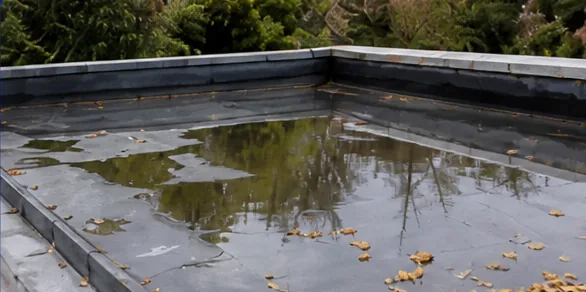
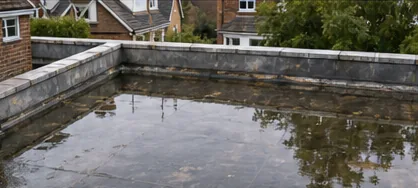
Before: Water ponding on a domestic flat roofBefore
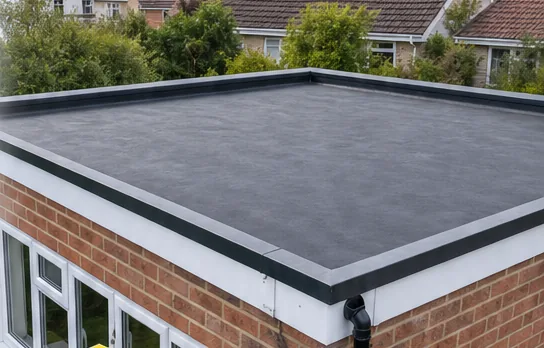
After: New EPDM flat roof on a brick extensionAfter
Typical of what we find and what we leave behind. Every survey includes photos of your own roof.

Chapter 2: The stain is in my bedroom, so why can't anyone find the hole in the roof?

What we find

Water does not fall straight down through a roof. It enters at the fault, then runs along whatever it meets first: the top of a rafter, a batten, the face of the underlay, a ceiling joist. It can travel a metre or more sideways before it finds a place to drip. By the time a brown ring spreads on the ceiling, the entry point may be on the other side of a chimney breast, further up the slope or at the wall of the next-door extension.

On a pitched roof the underlay is often the culprit that hides the real source. A tile fault lets water onto the underlay, the underlay channels it down and sideways, and it only comes through where the felt is torn or has been lapped badly. In a loft we look for tide marks on the timber, which are rings left as damp dries out and gets wet again, and for dark patches on the sarking boards in older houses. Sarking is boarding laid under the tiles on some older roofs.

What we fix

We work from inside and out. In the loft we trace the wet timber back up the slope, then go onto the roof or look from a ladder or tower to see what sits at the top of that trail. A slipped tile, a lifted flashing, a crack in a valley or a missing piece of ridge is usually there. Where it is not obvious, a hose test works in sections, starting low and working upwards, with someone inside watching. Starting high would tell you nothing, because water at the top runs over everything beneath it.

Once we know the source, the repair is specific to it: the tile replaced, the flashing re-dressed, the underlay patched and lapped under the tile above. We photograph the fault and the repair, and mark the loft timber where the wet showed so you can see whether it dries out. Our guide to finding and fixing a roof leak goes through the tracing steps in more depth.

If the timber has been wet for a long time, we check it for rot before closing it up.

Chapter 3: Why is mortar falling out of the ridge, and does it need attention?

What we find

The ridge is the line along the top of the roof where two slopes meet, and the hips are the sloping lines at the ends of a hipped roof. Ridge and hip tiles are bedded on mortar, a mix of sand and cement laid in a bed under each tile. Over many winters the mortar cracks along the bond, picks up moss and frost and slowly crumbles. You see it as grit in the gutter, a ridge tile that rocks when touched from a ladder, or pale lines where the pointing has gone.

On houses built before the 1990s the ridge was often bedded and pointed with nothing else holding it. Once the bed fails, a gust can lift a tile, and a loose ridge tile is a danger to anyone walking below. Water that gets under it runs straight into the top of the roof where the two slopes meet, a spot with no gutter or valley to carry it away. A ridge that has been failing for several seasons is a common cause of a first stain on a bedroom ceiling.

What we fix

The standard for new work is that ridge, hip and verge components are mechanically fixed. BS 5534:2014 expects this, and mortar alone is no longer relied on. So when we repair a ridge we take off the loose tiles, rake out the failed bed, and rebed or replace the tiles, then secure them with mechanical fixings as well as mortar. Where the whole ridge has failed, a dry-fix system is a long-term answer. Dry-fix means ridge tiles held by clips, brackets and screws on a ventilated strip with no mortar bed, and it is covered by BS 8612:2018. Our ridge tile repairs page goes into the options in more detail.

A short run of loose tiles is a repair, and we will price it as one. A ridge that has failed along the whole roof, with tile cracks and moss packed beneath it, usually costs less to redo in one go than to patch twice.

Scaffold or a tower may be needed, and where it is, it appears as a line in your fixed quote so you can see it.

Chapter 4: Why does my chimney breast stain after heavy rain?

What we find

Where a chimney comes through a roof, water has three places to get in: the flashing, the mortar flaunching on top of the stack, and the brickwork itself. A flashing is a strip of lead or other metal worked into the chimney and dressed over the tiles. Over the years it lifts at the edge, splits where it was folded, or comes away from the joint it was tucked into. Flaunching is the sloping bed of mortar that holds the pot and sheds water; when it cracks and drops away, rain runs down inside the stack.

On older houses built with lime mortar, the pointing between the bricks weathers faster than the bricks and can let water in sideways. A stain on the chimney breast inside, or a damp patch on the loft side of the stack, is usually the first visible sign. Unused flues with no cap collect rain too, and the water has to go somewhere. Because the chimney is a point where roof and wall meet, a small failure here can wet a large area of ceiling and wall.

What we fix

We start by looking closely at all three: the lead, the top of the stack and the joints. Often the cure is a combination of re-dressing or replacing the flashing, rebuilding the flaunching and repointing the worst joints. We cut the lead into the mortar course rather than relying on sealant, then point it in, so the upper edge sheds water over the top instead of letting it behind. Lead flashings follow the same detailing as our lead roofing work, and larger stack faults sit under chimney repairs.

Typical UK guides report chimney leadwork at an average of about £570, within a range of £350 to £920, and the figure rises when scaffold is needed. A stack is priced only once we have seen it, and the written figure comes after the survey.

If the chimney is leaning, the bricks are spalling or the mortar has gone badly, we recommend the larger repair rather than a patch. On a listed house or one in a conservation area, a like-for-like stack repair is usually fine, but a change of brick, pot or flashing material may need consent, so ask the council's conservation officer before booking.

Before: Flat roof with standing water before repairBefore
After: Flat roof re-laid in EPDM rubber membraneAfter
Typical of what we find and what we leave behind. Every survey includes photos of your own roof.

Chapter 5: What causes a leak where two roof slopes meet in a valley?

What we find

A valley is the internal angle where two roof slopes meet, and it carries the run-off from both. That makes it the busiest drain on the roof. On many Basingstoke houses with a rear extension or a gabled front, the valley is lined with lead or a GRP trough, covered by tiles cut to follow the line. Older valleys may be open lead or mortar-bedded tile, and these wear fastest.

The faults we see are lead that has cracked from years of heating and cooling, a trough that has split under a falling branch, tiles cut too tight to the centre so water backs up under them, and valleys choked with moss and leaves that force water sideways. A valley carrying leaves on a roof near trees can overflow in a heavy shower, and the water shows up on a ceiling that looks nowhere near the roof edge. Valleys do not announce themselves with fallen tiles, so a leak that appears only in heavy rain, with no obvious damage, is worth a valley check.

What we fix

We open the valley, clear the debris and look at the lining from end to end. A short crack in lead can sometimes be repaired, but lead that has split in several places has usually fatigued and is better relaid. Where a GRP trough has cracked, a short section can be cut out and relaid or the whole run replaced. We refit the tiles with the correct margin each side so the channel is clear and water has room to run.

Where the valley meets a wall or another roof, we check the abutment is flashed and the underlay is lapped into the trough, because a leak can start there even when the valley itself looks sound.

This is the kind of fault where a tower or scaffold is often needed to work safely, and a patch applied from a ladder is no substitute. The best long-term repair is one that lasts as long as the tiles around it, so we match the lining to the age of the roof. If the roof is nearing the end of its life, a new valley can be done as part of a larger programme, and the survey tells you which route is sensible.

Chapter 6: Will my insurer treat my roof damage as a storm or as old age?

What we find

Roof damage falls into two groups in the eyes of most insurers. Sudden damage from a named event, such as a gale that lifts tiles or a tree that lands on a roof, is one. Gradual deterioration, such as tiles that have slipped over years, mortar that has crumbled and flashings that have corroded, is the other. Policy wording varies, so we cannot tell you how your insurer will treat a claim, but we can tell you what we find on the roof.

The physical evidence differs. Storm damage tends to be fresh and local: clean breaks on tile edges, debris in the garden, a pattern across one slope facing the wind, and marks where something struck the roof. Wear and tear is usually spread across the roof, shows weathered and mossy breaks, rusted nails and old staining in the loft. Many roofs show both, such as an old nail that finally gave way in a storm, which is why the explanation has to describe what is actually on the roof.

What we fix

Our job is to record the condition accurately, not to argue your claim. The survey photographs show each fault close up and in context, and the written report states what we found and what we believe caused it. You can pass that to your insurer, along with your own photographs of any debris and the date it happened. Our guide to storm damage or wear and tear sets out how the distinction is usually drawn.

Where you want to claim, keep the damaged tiles or other broken parts if it is safe, photograph the roof and the inside before anything is moved, and tell your insurer before permanent work if your policy asks you to. The temporary make-safe work is something you can normally do straight away to stop further damage, and we keep a record of it.

We do not handle the claim for you, and we do not promise an outcome. We give you the facts on your own roof, and you decide what to do with them.

Chapter 7: The roof looks fine from the road, so why is the loft damp?

What we find

Some of the worst roof leaks come from layers you cannot see from the ground. Underlay laid before the 1990s was commonly a bitumen-based felt, and over time it dries, cracks and tears at the nail holes. It also sags between the rafters, and in the sag it holds water that should have run down to the gutter. Battens, the timber strips that carry the tiles, can rot where that water sits, and then the tiles above lose their fixing.

You find it from the loft. The felt looks brittle and dark, with daylight at the laps. There are damp stains running down a rafter or a batten that crumbles when pressed with a screwdriver. A musty smell and damp insulation point the same way, and so do black spots of mould on the timber. Meanwhile the tiles on the outside look fine, because they are not the layer that failed.

Roofs that have had tiles replaced by someone who did not repair the felt beneath can also leak at the repair, since a replaced tile does not mend a hole under it.

What we fix

The repair depends on how far the damage runs. A small torn patch can be dealt with by lifting the tiles above it and sliding in a new section of breathable membrane, lapped up under the course above so water sheds over it. Rotten battens are cut out and replaced with treated timber, and the tiles are put back and fixed.

If the underlay has failed across a whole slope, patching is a short-term answer. The roof needs stripping, new membrane and battens, and the tiles relaid, which is often a sensible time to renew them where they are cracked. We keep sound tiles for reuse where we can, and only replace those that are broken or porous. Our roof replacement page covers the larger job.

The Planning Portal gives the building control thresholds, and a leak repair is normally far smaller than they are. Above that, approval is needed and the insulation may have to be upgraded. Where a repair grows into notifiable work, we deal with the paperwork for you.

Chapter 8: What does a roof repair cost, and when is a repair not worth doing?

What we find

Roof repair prices vary more than almost any other building work, because the range of faults is so wide. One replaced tile is a short visit. A leaking valley behind a chimney, with a tower needed to reach it, is a different job. What drives the price is the time on the roof, the height and access, the materials, and whether scaffold or a tower is needed to work safely.

Emergency work adds a call-out element. A repair in the middle of a storm or at the weekend is priced to reflect that, with the make-safe step separate from the permanent repair. We would rather explain this than surprise you with an invoice. Reported UK guides give an idea of the market, but they are not Beacon prices, and no guide knows your roof.

A repair makes sense when the rest of the roof has years in it. It makes less sense when the same fault keeps coming back, when tiles are crumbling across the slope, or when repeated repairs would add up to more than the next stage of work.

What we fix

Our free survey sorts repair from replacement before you spend anything. We go over the roof, photograph the faults, and tell you whether a repair will hold and for how long. If the roof has years left in it, we say so and price the repair. If several faults point to a tired roof, the report shows that too, with the alternatives side by side. Our guide to roof repair costs prices common jobs in more detail.

The fixed written quote lists the work, the materials and any access equipment, so there is nothing to add later. If we find another fault once the roof is open, we stop and show you before going further.

The table gives typical UK ranges for emergency call-outs, reported by two cost guides. They are guide figures from elsewhere, and the written figure we give you comes after the survey.

If water is coming in now, do three things: move what you can from under the stain, put a bucket beneath it, and photograph the ceiling before it dries. Then ring 01256 213956 or send those photographs on WhatsApp. We prioritise leaking roofs and make the roof safe first, then trace the cause once it is dry. The lasting repair is priced in writing from photographs of your own roof, and it carries a 10-year workmanship guarantee.

Areas we cover

Our emergency roof repairs service covers Hampshire, Berkshire, Surrey and south Oxfordshire, up to 30 road miles from Basingstoke. These are the main towns and some of the villages we reach; each town page shows the roofs we meet there and the local planning picture.

All 123 towns and villages we cover

Emergency roof repairs: questions we get asked

Can you come out to a leaking roof in the middle of the night?

We prioritise emergency calls and will make a leaking roof safe as the first step, but we do not promise a fixed arrival time, because it depends on the weather, how many roofs are affected and where we are. Phone 01256 213956 or message us on WhatsApp with photos of the ceiling and the damage, and we will tell you straight away what we can do and when.

Is a tarpaulin on my roof a proper repair?

No. A tarpaulin is a temporary measure to keep rain out until dry conditions allow a proper repair. It needs to be battened down properly, because a loose sheet can flap in the wind and damage tiles. Left in place too long, it traps moisture and hides further damage. We fit one when it is needed, then return to repair the roof itself.

Should I climb up to check which tile has slipped?

No. Roofs are slippery, and a fall from even a low roof can cause serious injury. From the ground, a pair of binoculars shows slipped tiles, missing ridge pieces and lifted flashings well enough to describe them. Take photographs from the garden and check the loft with a torch for daylight or damp timber. Then let us do the roof work with the right access equipment.

Will a repair stop my loft smelling damp and musty?

It stops new water coming in, but wet insulation and timber take time to dry. We check the loft timbers while we are there and tell you if any are soft enough to need replacing. Wet insulation is usually best replaced, and a ventilated roof space dries faster. If the smell remains after the repair, we look at ventilation and condensation rather than assuming the leak is still there.

Do I need building control approval for a small roof repair?

Not normally. A patch or a handful of replaced tiles does not normally call for a building control application. A much larger re-cover can, and the Planning Portal sets out where the line falls. Larger areas need approval and may trigger insulation upgrades. Where work is notifiable, we handle that side with your building control body, and you can also ask your council's building control team.

A neighbour's tree has dropped a branch on my roof. What should I do first?

Keep everyone clear of the area if the branch has damaged the roof structure, and look for ceiling bulges or sagging inside. Photograph the damage and the branch before it is moved, tell your insurer, and call us. We make the opening safe, record the damage for your claim, and repair the roof once the branch is removed. Our tree-on-roof guide has the full sequence.

Get your free roof survey

Tell us what’s happening and we’ll call you back to arrange a visit. You’ll get photos of your roof and a fixed written quote.

  • No obligation
  • Photo report of your roof
  • 10-year workmanship guarantee

Rather talk? 01256 213956

Call Free survey