





Chapter 1: Why is the mortar under my ridge tiles breaking up and falling into the gutter?
What we find
The ridge is the line along the very top of the roof where the two slopes meet. Ridge tiles are the curved or angled tiles that cap it, and on most older roofs they sit on a bed of mortar, a mix of sand and cement spread along the top of the slopes. That bed does the work of holding the tiles in place and keeping the wind out of the loft.
Mortar is hard but brittle. Through a Hampshire winter it soaks up rain, freezes, thaws and expands, and every cycle cracks it a little more. On roofs from the 1960s and 1970s the bed was often laid thin and in a hurry, with a strong cement mix that shrinks as it cures and pulls away from the tile edge. From the ground it looks like a grey line gone ragged. Up close we find the face of the mortar sanded away, grains of sand in the gutter, and gaps where you can slide a finger between tile and bed. Wind then gets under the ridge tile and works at it on every gust. Moss does not help, because it holds water against the joint and keeps it wet for weeks. Once the bed has lost its grip, the ridge tile is sitting on little more than its own weight.
What we fix
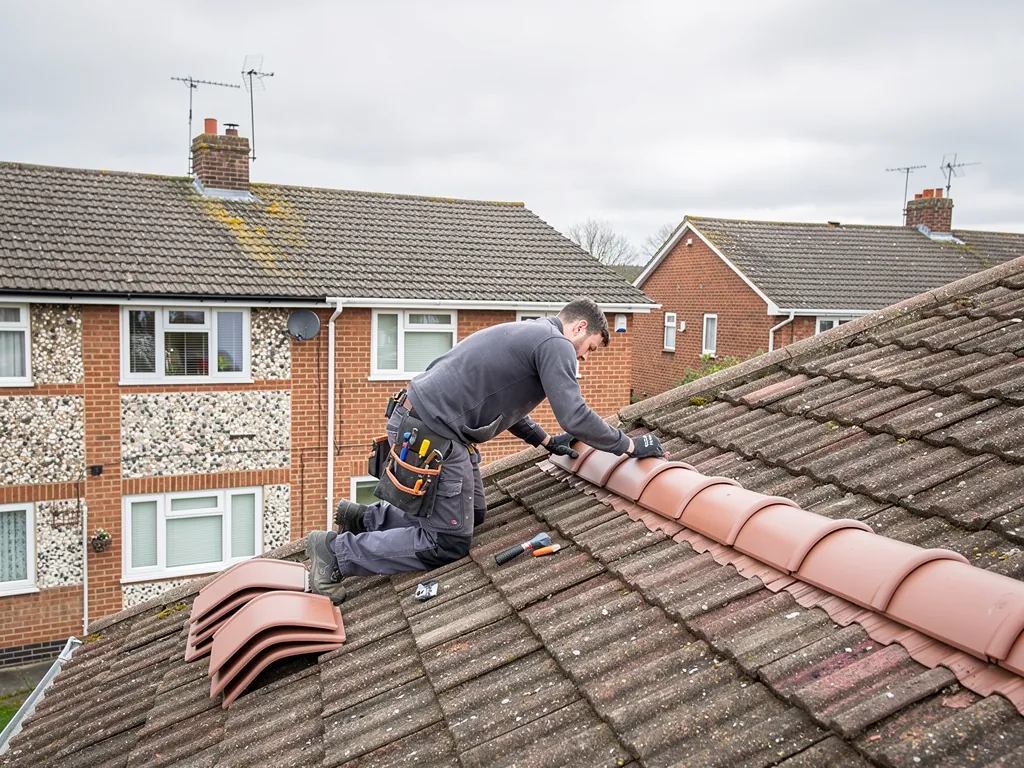
What we do depends on how deep the failure goes. If the tiles are sound and the bed is only cracked at the surface, raking out the loose mortar and pointing fresh is a modest repair. But a pointing job over a bed that has already let go underneath only hides the problem for a season. When we tap along the line and the tiles ring hollow or shift, we lift them, clear the old bed back to the top of the slopes and re-bed them on fresh mortar, set level and true.
The mix matters. We use a mortar matched to the tile and weather, not a bag of strong cement, and we include a bedding strip or ridge underlay where the roof needs one, to stop the new mortar sealing the loft ventilation shut. On a re-bedded ridge, each tile also gets a mechanical fixing, because BS 5534:2014 expects ridge components to be fixed, not left to mortar alone. Our guide to re-pointing versus re-bedding ridge tiles explains how we decide between the two.
Finished mortar is struck neatly and brushed back, so the line looks like it belongs to the roof rather than being smeared over it. The roof is swept down and any broken mortar is taken away with us.
 Before
 After
After