
Beacon Basingstoke Roofing

Roofers in Camberley

Camberley lies 19.2 road miles east of Basingstoke, on land that was open heath before the Royal Military College was built at Sandhurst in 1812. Its roofs run from stone churches and conservation area villas to 1950s estates and newer town-centre blocks, and a photographed survey of your own roof comes before any figure is named.

A row of Victorian terraced houses with Welsh slate roofs and brick chimneys in Reading

Roofs we see in Camberley

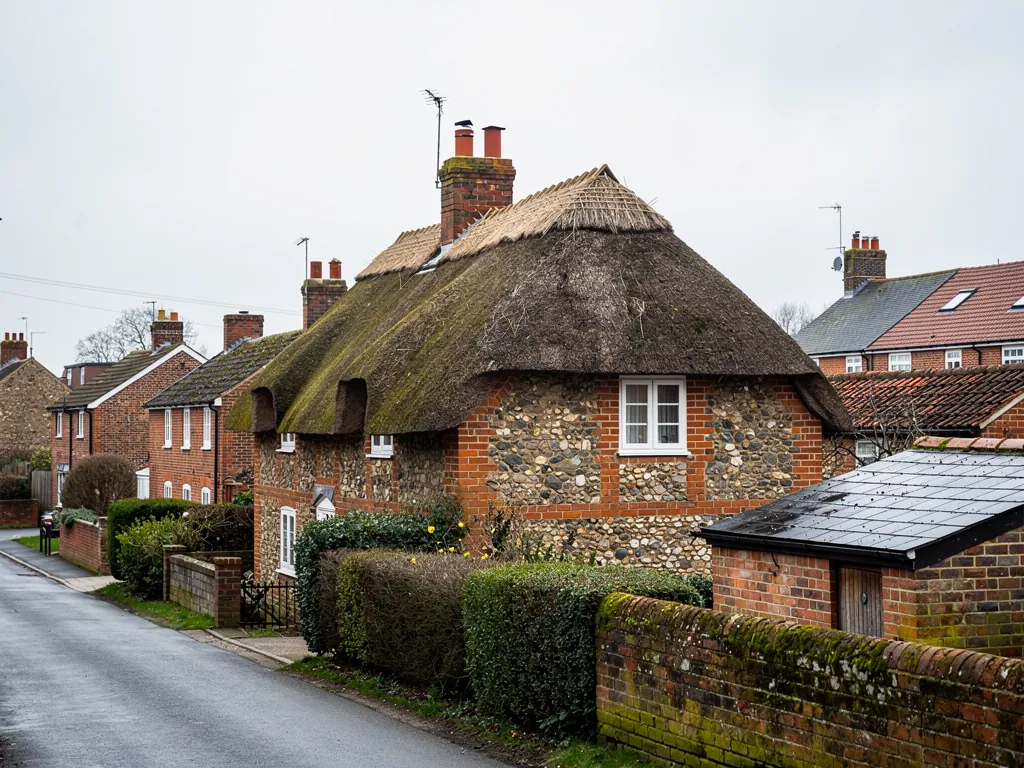
  • A thatched cottage in a Test Valley village with a brick chimney

    Old Dean estate houses

    The Old Dean estate was built in the 1950s, and its terraces and semis show the age of their roofs. These are tiled pitches with timber fascias, mortar-bedded ridges and, often, a chimney or two that has not been touched in decades. After seventy years or so the weak points are the mortar, the felt under the tiles and the lead round the stacks, not the tiles themselves.

  • Brick estate houses with concrete tile roofs among pine trees

    Villas in the conservation areas

    Camberley grew after 1812, and the roads between Upper Gordon Road and Church Hill carry the larger houses that followed. Pitches are steeper, there are often several gables and valleys, and chimney stacks are large and prominent. Natural slate or clay tile is common on this type of house, and valley gutters and lead flashings take most of the weather.

  • Brick chimney stack with clay pots

    Town centre and commercial roofs

    Much of Camberley's centre dates from the late 20th and early 21st centuries. That means flat roofs on shops, offices and flats, covered in single-ply membrane, built-up felt or asphalt, with outlets, parapets and plant fixings to keep watertight. Faults tend to sit at the drainage, the edges and the penetrations, and they are easy to miss from the ground.

19.2 road miles east of Basingstoke

Planning and building control in Camberley

Surrey Heath Borough Council looks after planning and building control for Camberley. The council has designated two conservation areas that fall in the town: Upper Gordon Road to Church Hill, and the former Staff College on London Road. Surrey Heath publishes the details on its conservation page, and it is worth reading before roof work on an older house.

Inside either area, like-for-like repair with matching slate or clay is normally straightforward, but changes to materials or the look of a roof may need consent. Speak to the council's conservation officer before ordering anything, and treat a listed building the same way. On the 1950s estates and in the newer centre the question is more often building control than planning: re-covering a whole roof can be notifiable work, and the application paperwork is ours to handle. For anything cut into the roof slope, read the skylight planning permission guide, because the limits are tighter inside a conservation area.

Faults we repair on Camberley roofs

The roofs of Camberley fall into clear groups by age and use. Tall Victorian and Edwardian houses sit alongside the 1950s Old Dean estate, and those in turn sit beside the flat roofs of a centre rebuilt in recent decades. Each group has its own habitual faults, and they are not the same ones.

Chapter 1: Why is the chimney on our Old Dean estate house leaking after only light rain?

What we find

The stacks on 1950s terraces and semis are often shared between neighbours and stand tall above the ridge, exposed to wind from every side. The brickwork has been weathering for seventy years, and two parts of it fail first. The mortar joints erode until rain can run into the stack itself. The flaunching, the sloping mortar fillet on top that holds the pots in place, cracks and lets water straight down the flue.

Inside, the signs are a brown stain on the chimney breast, damp wallpaper upstairs, or flaking paint on the breast in the loft. Staining that appears only after rain from one particular direction nearly always points to the stack, not the roof. Around the base, the lead flashing that seals the join between brick and tile may also have lifted or split, and that is a frequent leak on this age of house.

What we fix

We inspect the stack from a ladder or tower and photograph the joints, flaunching, pots and flashing, then repair what has actually failed. Failed mortar is raked out and repointed in a mortar that matches the brick, cracked flaunching is renewed, and loose pots are rebedded. A cowl or cap can be fitted if the flue is unused, keeping some ventilation so the chimney does not turn damp.

Where the lead has failed, we replace the flashing and the soakers, small lead tabs woven between the tile courses beside the stack. Typical UK prices reported for chimney repointing run from £450 to £1,200 and for chimney leadwork from £350 to £920; your fixed quote follows the survey. Our chimney repairs page covers the choices in more detail.

Chapter 2: Can a slate roof in the Upper Gordon Road conservation area be repaired rather than stripped?

What we find

Natural slate outlasts most roof coverings, yet the fixings do not. Many Victorian and Edwardian slate roofs were fixed with iron nails, and these rust until the slate slips out of its course. The slate is often perfectly sound, which is why a roof can look in good order from the road while losing a slate every few storms. Less obvious damage comes from slates that have cracked or delaminated in layers after frost.

Up close you may see gaps in the courses, a slate lying on a lower roof, or a line of small stains in the loft where water drips from a slipped slate onto the timbers. Valley gutters on these villas, lined with lead, can crack where the roof was walked on. In a conservation area, the quality of the repair matters twice over, once for the roof and once for the street.

What we fix

Repair is normally the right call. We strip the failed section, keep every sound slate, and refix with copper or stainless steel nails so they will not corrode again. Replacement slates are matched in size, colour and thickness, from the roof's own stock or reclaimed, so the repair does not show from the street. Cracked valley lead is replaced and the fall of the valley corrected.

If nail failure is spread across the whole slope, the honest answer may be to strip and re-fix the lot, reusing the slates, and we explain which after the survey. A single slate repair is typically £100 to £250 in labour plus £5 to £25 for the slate, with an access tower at £300 to £800; the quote you receive is fixed and follows the survey. See our slate roofing page for more.

Chapter 3: Why does the flat roof on our Camberley shop unit keep ponding after every storm?

What we find

Flat roofs on town-centre shops, offices and flats are meant to fall gently towards an outlet or gutter, but few stay that way. The deck settles, a membrane is laid over an old one, or insulation is added without the fall being corrected, and water begins to collect in shallow hollows. Standing water is heavy, it sits against laps and seams, and in winter it freezes and flexes the covering.

The signs are rings of dried dirt where puddles evaporate, blisters in the surface, weeds growing in debris around the outlets, and ceiling stains below. The outlets deserve a close look. A blocked or undersized outlet, or one set slightly above the surrounding membrane, will hold water however good the roof covering is. Parapet walls and rooftop plant add leak points of their own at every junction.

What we fix

We clear the outlets, then photograph the whole roof, checking for hollows, open laps and failed upstands around plant and parapets. Small splits and unbonded laps can be repaired and sealed, and a failing outlet can be replaced. If ponding comes from a deck that has dropped, we correct it with tapered insulation or by re-boarding, so the new membrane has a proper fall instead of simply covering the problem.

When a roof is near the end, a full strip and re-cover in single-ply or built-up felt is the answer, and we discuss working around trading hours. One informal trade source suggests £90 to £180 or more per square metre for commercial flat roofs, though that is low confidence; a fixed written price follows once the survey is done. Our commercial roofing page explains how we approach this.

Chapter 4: Why do the gutters on our Camberley house overflow even though they were cleaned?

What we find

Camberley's sandy heath soil, pines and mature gardens put a steady load of needles, leaves and moss onto roofs, so gutters clog quickly. But if they overflow soon after being cleaned, the cause is likely something else. Gutters may have dropped out of fall so water pools at one end, a joint may have opened and be spilling down the wall, or the downpipe may be blocked below ground.

On houses of 1950s age the timber fascia carrying the gutter often has rot at the ends or behind the brackets, so the whole gutter sags between fixings. Water then overshoots the front, or spills behind the gutter into the wall plate. Green staining down the brickwork below a joint, or a damp patch under the eaves inside, tells you water is escaping where it should not.

What we fix

We look at the gutter run as a whole: the fall, the brackets, the joints and the fascia behind it. Sagging runs are refixed on new brackets at the right spacing, leaking joints are resealed or replaced, and blocked downpipes are cleared and tested with running water. Rotten fascia board is cut out and replaced before the gutter goes back, because new brackets in soft timber will not hold.

Where the gutter and fascia are both tired, a new uPVC roofline is often the better value. A full uPVC roofline on a three-bed semi has a typical UK range of £1,800 to £3,500, with scaffold on top; the fixed quote arrives after the survey. Our guttering, soffits and fascias page explains the work.

Camberley roofing questions

Who pays for a roof repair on a leasehold unit in Camberley town centre?

That depends on the lease. The roof and structure are commonly the freeholder's or managing agent's responsibility, with the tenant covering their own fit-out, but the wording varies, so read the repairing clauses first. Our photographs of the roof and a fixed written quote give you something clear to send to the landlord, who may need to agree before work starts.

We live near St Michael's Church. Can you work on stone-built roofs and parapets?

We can repair the roof coverings, leadwork and gutters on buildings like this. St Michael's was designed by Henry Woodyer and built in local Frimley stone, with a Bargate stone tower added in 1891, and roofs on stone buildings often have lead valleys, parapet gutters and stone copings that need careful flashing. Check the building's status with Surrey Heath's conservation officer first, since any change of materials may need consent.

Is my house in one of Camberley's conservation areas, and does that affect the roof?

Surrey Heath has two conservation areas in Camberley: Upper Gordon Road to Church Hill, and the former Staff College on London Road. Check your address on the council's website. Inside the boundary, like-for-like repair is usually fine, but a change of tile, slate or style may need consent, so ask the conservation officer before work starts. We can supply a photo record of the existing roof for that conversation.

Our Old Dean estate roof is nearly seventy years old. Does it need replacing?

Not automatically. At that age the weak points are usually the ridge mortar, the underlay beneath the tiles, the chimney lead and the timber eaves, while the tiles often have life left. We check the underlay from the loft and lift a sample of tiles. If the main covering is sound, we repair it. If the felt has perished across the slope, we will say a re-roof makes more sense.

How do you get on with the M3 and A30 for materials and scaffold deliveries?

Camberley's position, with the M3 along its southern side, junction 4 at the south-western corner of the town and the A30 running roughly parallel, makes it easy to reach from Basingstoke, and deliveries rarely cause trouble. What takes planning is the town centre and narrower residential roads, where we agree scaffold, skip and delivery positions with you before the job starts. We tell you in advance if anything needs a parking suspension from the council.

Get your free roof survey in Camberley

Tell us what’s happening and we’ll call you back to arrange a visit. You’ll get photos of your roof and a fixed written quote.

  • No obligation
  • Photo report of your roof
  • 10-year workmanship guarantee

Rather talk? 01256 213956

Call Free survey