


Chapter 1: Why is water coming through the roof of our Victorian high street building in Theale?
What we find
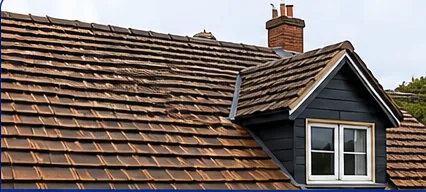
A Victorian terrace on a high street usually has a pitched roof in clay tile or slate behind a parapet or an eaves gutter, with party walls running up between each property. The chimneys on those party walls and the valleys between roofs are the places where leaks begin. Slates slip when their fixings corrode, and the lead flashings along the chimney or the parapet crack with age.
The gutters on the street frontage may be cast iron, built into the eaves, and when they rust through or fill with debris the water soaks the brickwork and the timber behind. Inside, it shows as damp on an upper wall or a ceiling stain close to the chimney breast, and the plaster may bubble or lift in sheets where it has been wet for a long time. In shops with a flat rear roof, the join between flat and pitched roof is another weak point.
What we fix
We inspect the slates, tiles, lead and gutters from the roof and photograph each fault. Slipped slates can be refixed or replaced with matching ones, flashings renewed in lead, and valleys relaid. Sound cast iron gutters are repaired and repainted; those beyond saving are replaced in a matching profile.
If a flat rear roof meets the pitched roof, we check that the flashing is sealed and the membrane is turned up properly. Reported UK prices for mending a single slate are £100 to £250 in labour, and the slate itself costs little, with scaffold on top, and you get the fixed figure after the survey. See our slate roofing page.
