Beacon Basingstoke Roofing

Roofers in Burghfield Common

Burghfield Common is a largely mid to late 20th-century village in West Berkshire, 12.3 road miles north of Basingstoke, among pine, woodland and gravel plateau. Housing estates built since the 1980s have nearly doubled the parish population, so many of its roofs are now middle-aged. We photograph the faults on your own roof and quote you a price that will not move.

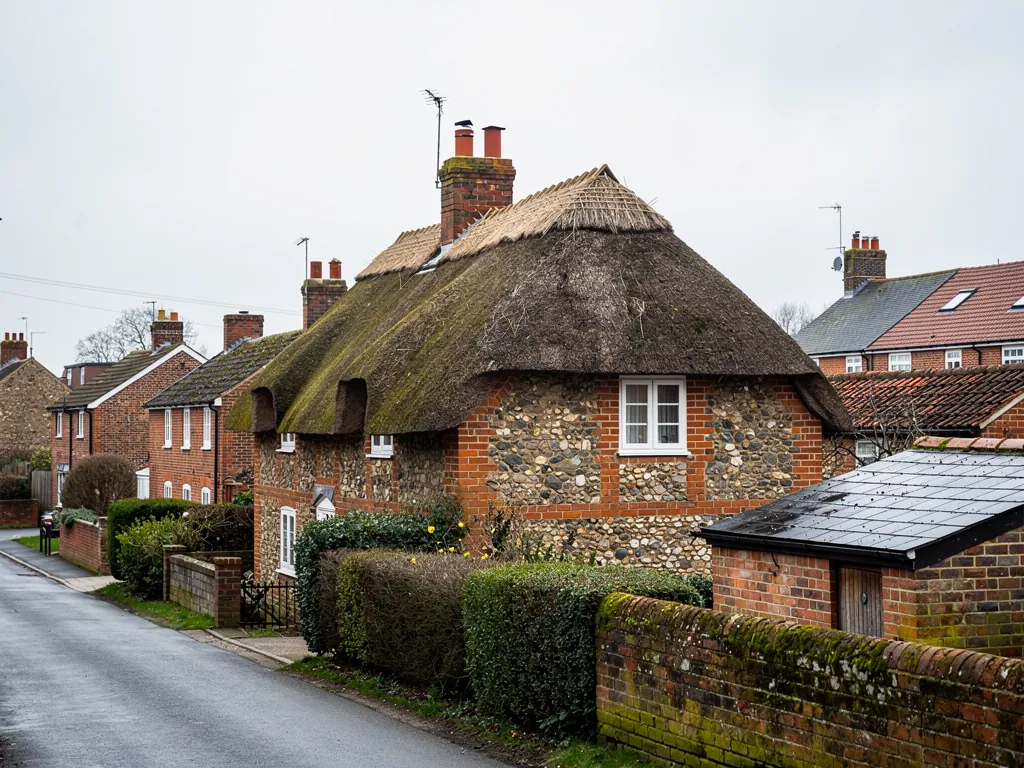
A Hampshire village cottage of flint and brick with a steep clay plain tile roof

Roofs we see in Burghfield Common

  • Slipped and cracked clay roof tiles

    Mid-century village houses

    Burghfield Common is largely a mid to late 20th-century settlement, so much of the older housing in the village dates from that period rather than from the Victorian era. Roofs from the middle of the century are now near the end of their first covering, and the repairs we are asked about are felt, ridge mortar, fascias and worn flashings at chimneys and porches.

  • A thatched cottage in a Test Valley village with a brick chimney

    Estates from the 1980s onwards

    Since the 1980s the population of Burghfield parish has nearly doubled as housing estates were built. Roofs of that generation are now roughly forty years old. Concrete tile on felt was a common covering for houses of that era, and the ageing shows as faded, mossy tiles, brittle ridge mortar, bowed fascias and flat-roofed extensions added since. Whole closes of the same design tend to age together.

  • Brick estate houses with concrete tile roofs among pine trees

    Roofs among pines and heath

    The plateau gravels around Burghfield carry grassland, deciduous woodland and Scots pine, and Wokefield Common's remaining heathland borders the village to the south. Roofs near the trees collect needles, leaves and seed, stay damp in shade and grow moss quickly. Gutters here need more attention than on an open estate, and a fallen branch is a real risk in a storm.

12.3 road miles north of Basingstoke

Planning and building control in Burghfield Common

Because the village lies in Berkshire, West Berkshire Council is the planning authority and runs building control, rather than Basingstoke and Deane. The council's guidance for householders is on its website. We have no conservation area or listing to quote for the village itself, so for a particular house ask the council's planning team to check by address, and treat any listed building as needing consent before a change of material.

For ordinary estate roofs the question is mainly building control. Provided a job is both below 25% of the envelope and below 50% of the roof, no application is normally needed. Bigger jobs need approval, and the insulation across the roof may have to be upgraded. We handle the notification where it applies, and the application goes to West Berkshire or to a registered building control approver, whichever you choose. If you are considering a roof window, the planning page on skylights sets out the rules.

What we find on Burghfield Common roofs

Burghfield Common roofs fall into two groups: the mid-century houses and bungalows that are approaching a second covering, and the 1980s estates that are reaching the point of repairs. Trees add a third factor on both. Here is what causes each fault and how we fix it, from the Basingstoke team behind roofers in Basingstoke, which covers the village as part of its 30-mile area.

Chapter 1: Why are pine needles and moss clogging the gutters and tiles on our Burghfield Common house?

What we find

Scots pine and other trees shed constantly, and what lands on a roof does not blow off a low pitch. Needles slide into the gutters and wedge at the outlets. Seeds and leaf litter settle in the valleys and at the foot of each slope, rotting into a soft mat that holds water. Shade prevents the tiles from drying, and moss takes hold, spreading from the damp lower courses upwards.

Moss grips concrete tiles, packs the overlaps between them and lifts the edges, which allows wind-driven rain to get under them. A gutter blocked by needles overflows down the wall and soaks the fascia. The warning signs are a green or black crust on the north-facing slope, water spilling over the gutter lip in rain and fascias with a dark, damp edge.

What we fix

We clear moss by hand and apply a biocide, which stops it growing back, rather than blasting the tiles with a jet wash that can strip the surface of older concrete. Gutters and outlets are cleared on the same visit, and loose or cracked tiles are replaced as we find them. Where overhanging branches are the cause, we suggest trimming them, but that is a job for a tree surgeon, not a roofer.

Hand removal with a biocide wash is priced in typical UK guides at £748 for a small roof, £863 for an average one and £978 for a large one; jet washing comes out at £553, £638 and £723 for the same three sizes. Your fixed quote follows the survey. Our roof cleaning and moss removal page explains the method, and our guttering page covers outlets and guards.

Chapter 2: Our 1980s Burghfield Common house has slipped and crumbling tiles. Is the whole roof at the end of its life?

What we find

A concrete tile roof from the 1980s is around forty years old, which is the middle of its working life rather than the end. The tiles wear on the surface, lose their colour coat and become more porous, so they absorb water and grow moss faster. The felt beneath them has often become brittle where it laps over the battens. Slipped tiles are a sign that the nails or clips that hold them have worked loose.

On an estate of similar houses, you can often see the pattern from the street: ridge lines that are slightly wavy, tiles that have dropped a little down the slope and a patchy colour from damp. Inside the loft, daylight at the ridge and damp stains on the felt are the signs we look for before saying whether a patch will hold.

What we fix

If the tiles are sound and the failures are local, we replace the slipped or broken ones, refix loose tiles with the right nails and clips, and renew any torn felt in the areas we have exposed. That brings the roof back to a sound state without replacing what still works. If the battens are rotten or the felt has failed across whole slopes, the sound answer is a strip and re-cover.

A concrete-tile re-roof on a three-bedroom semi is reported in typical UK guides at £6,500 to £10,500, with new roofs on semi-detached and detached houses reported across a wider band, £4,000 to £13,000; your fixed quote follows the survey. A re-roof is notifiable where it passes the thresholds, and we handle the building control side. Our roof inspections and surveys page describes what the photographs show.

Chapter 3: Why does the flat roof on our Burghfield Common extension leak where it meets the house wall?

What we find

Estates built in the 1980s have had many extensions added since, from kitchen and utility additions to garage conversions, and many have a flat or low-pitched roof against the original wall. The junction is the weak point. The membrane is turned up the wall as an upstand (the vertical lip of the roof covering), and a flashing seals the top of it. If either is thin, unsealed or cracked, water gets behind the lip.

The leak often appears inside as a damp mark on the wall just above the new ceiling, and it gets worse in wind-driven rain, because the water goes sideways into the junction. A felt roof that has blistered along the upstand, a mastic seal that has shrunk away from the brick and a flashing that rattles in the wind are other signs. The roof can look flat and sound in the middle while failing at the edge.

What we fix

We open up the junction, check the deck and the wall behind it, and rebuild the upstand with a taller lip than the old one, because a low upstand is often what caused the problem. The flashing is then replaced with lead dressed into a chase cut in the brickwork, so the seal does not depend on mastic. If the roof surface itself is exhausted, we re-cover it in EPDM or GRP as part of the same job.

Typical UK ranges per square metre are EPDM £80 to £120 and GRP £100 to £160, with felt at £60 to £100; your fixed quote follows the survey. Smaller junction repairs cost far less than a re-cover. Our flat roofing page compares the materials, and our leadwork page explains how flashings are built.

Chapter 4: A branch came down on our Burghfield Common roof in a storm. What should we do first?

What we find

Houses among pines and broadleaf trees take storm damage in a particular way. A branch can split several tiles at once, drive a tile through the felt, bend a ridge or crack a gutter. The visible damage may be small while the felt beneath has been torn, so rain gets in at a point you cannot see from the ground. Water then runs along the rafters before it appears as a stain.

The first signs are a tile or branch on the lawn, a bright patch where a tile has gone, a gutter hanging at one end or a drip in the loft after rain. Do not climb on the roof to look. If a branch is still resting on the house, keep clear of it and any cables, and do not try to move it from a ladder.

What we fix

We prioritise emergency calls and will make a leaking roof safe first: broken tiles are removed, the hole is covered with a tarpaulin or temporary patch, and loose parts are fixed so that nothing else falls. We then photograph the damage so that you have a record for any insurance claim, and quote for the permanent repair separately.

Typical UK call-out figures reported for emergency repairs run from £150 to £350 plus materials. The permanent repair follows once the roof has dried. Where the damage reaches the felt and battens, we replace those in the affected area and relay the tiles, instead of patching over a torn layer. Our emergency and general roof repairs page explains how we approach a leaking roof. The fixed quote follows the survey.

Burghfield Common roofing questions

Our Burghfield Common estate house has concrete tiles. Do they need replacing once they get old?

Not usually. Concrete tiles can last a long time, but their surface wears and moss holds moisture against them. What fails first is typically the felt underlay, the batten fixings or the mortar under the ridge. A survey shows whether a repair, a ridge refix or a full re-roof is right. Re-roofing a sound set of tiles just for age would be wasteful, and we would not suggest it.

Burghfield Common is in Berkshire. Does that change who deals with building control?

Yes. West Berkshire Council handles planning and building control there, not Basingstoke and Deane. Where a job is notifiable we make the application or notification, either to the council's building control team or to a registered building control approver. You do not need to contact them yourself, though you are welcome to check with the planning team first.

Do trees and heathland nearby mean we need to check for bats or nesting birds?

Possibly. Bats and nesting birds are protected, and woodland edges are where both live, so work on an older roof may need to be timed or surveyed first. If we see signs during the survey, we tell you and plan around them. We cannot say from a distance whether your own roof is affected, so we look for it when we are up there.

Can you look after a village hall or small commercial unit roof near Burghfield Common?

Yes. We do commercial roofing as well as domestic work, from flat-roofed units to pitched halls. The survey is the same: photographs of the roof, a written report and a fixed quote, with notes on any access or safety needs. See our commercial roofing page for the work we take on.

Should I fit gutter guards on a house under pine trees in Burghfield Common?

Guards can help against leaves and larger debris, but pine needles are fine and can lie across a mesh and still block it. Regular clearing is what keeps gutters running. We can fit guards where they suit the gutter profile and tell you honestly when they will not help, then show you the outlets in the survey photographs.

Get your free roof survey in Burghfield Common

Tell us what’s happening and we’ll call you back to arrange a visit. You’ll get photos of your roof and a fixed written quote.

  • No obligation
  • Photo report of your roof
  • 10-year workmanship guarantee

Rather talk? 01256 213956

Call Free survey