


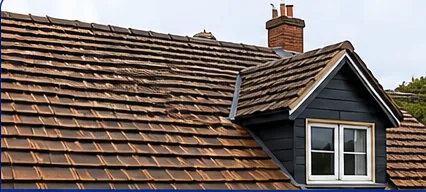
Chapter 1: Why are the clay tiles on our Goring Victorian house slipping out of line?
What we find
On a steeply pitched Victorian roof, plain clay tiles hang from the battens by two small nibs, with a nail through some courses. Over a century or more the nails rust and shear, and the tiles settle downwards. Roofers call this nail sickness. One tile creeps out of its course, then the one beside it, and the gap lets rain reach the underlay and the timbers beneath.
From the road you may see a ragged row where the roof was once neat, or a pile of tile fragments under the eaves after a windy night. Frost works on the clay too, because softer, older tiles absorb water and flake off their faces in layers. Inside, a brown ring on a bedroom ceiling below a steep slope is a common first sign.
What we fix
We climb the roof and photograph the failed area, then lift a sample of tiles to see how far the trouble goes. Often only part of one slope has gone, and the sensible repair is to strip that section, fit new battens and relay the sound tiles with stainless or copper fixings in place of the old nails. Missing and broken tiles are replaced with reclaimed clay of a matching colour and camber, since new machine-made tiles rarely blend into an old roof.
If the underlay behind has perished, we replace it with a breathable membrane while the section is open. You see the photographs before anything is agreed, and the quote that follows is fixed. Inside the conservation area, a like-for-like repair of this kind keeps the roof looking as the appraisal describes it, and our guide to roof work in a conservation area explains when consent comes into play.
