Beacon Basingstoke Roofing

Roofers in Pirbright

Pirbright is 23.7 road miles east of Basingstoke, a village ringed by heathland with a conservation area of tile-hung timber frames, red brick and clay-tiled gables. We survey roofs there with photographs of your own roof, explain what is failing and why, then give you a fixed quote on paper.

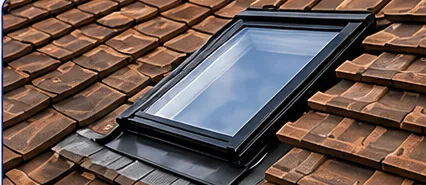
Roof window fitted in a tiled pitched roof

Roofs we see in Pirbright

  • Brick estate houses with concrete tile roofs among pine trees

    Tile-hung timber-frame cottages

    The village's early buildings were timber framed, and many were later refaced in brick or tile-hanging, which the council's appraisal treats as a feature of the place. On these cottages the roof and the wall meet in awkward ways: tile-hanging runs up into the eaves, dormers sit in the slope and old chimneys rise through the middle. Leaks tend to start where one covering stops and another begins.

  • Brick chimney stack with clay pots

    Gabled terraces with bargeboards

    The houses on Pirbright Terrace have prominent gables with decorative bargeboards (the carved boards that run up the edge of a gable), fish-scale tile-hanging, rich red brick and plain clay tiles. A roof like that has many small parts that each wear out on their own timetable, from the bargeboard ends to the hips and the tile courses beside them.

  • A Hampshire village cottage of flint and brick with a steep clay plain tile roof

    Listed buildings and their neighbours

    Nineteen listed buildings sit inside the conservation area, among them the church of St Michael and All Angels, rebuilt in 1784 with a brick nave and galleted heathstone in its tower and chancel. Houses beside a listed building are often handled with the same care, even when they are not listed themselves. We photograph the whole roof first, so that any repair can be described to the council clearly and matched to what is there already.

23.7 road miles east of Basingstoke

Planning and building control in Pirbright

Pirbright comes under Guildford Borough Council for planning and building control. The village has a conservation area, and the council's Pirbright conservation area appraisal records 19 listed buildings within it. It also names the materials it values: rich red brick, plain clay tile and tile-hanging over what were originally timber-framed buildings. Read the appraisal before anything is ordered, because it tells you what the council expects to see on a roof.

Inside the conservation area, like-for-like repair is usually straightforward. Changing the covering, swapping clay for concrete, or altering decorative features such as bargeboards may need consent, and a listed house is stricter again, so check with the council's conservation officer first. Beyond the conservation boundary, building control tends to matter more than planning, since stripping and re-covering a large slope can fall under the regulations and we take care of the paperwork. For a new roof window on a Pirbright house, start with our skylight planning permission explainer, because heritage controls change the answer here.

What we find on Pirbright roofs

The roofs here ask for different skills from one street to the next. In the old core the work is small and fiddly: old clay tiles, tile-hung walls, timber bargeboards and brick stacks that have stood for generations. Around the edge of the village, heath and woodland press close, and what falls from them ends up in valleys and gutters.

Chapter 1: Why are the fish-scale tiles coming away from the gable of our Pirbright cottage?

What we find

Fish-scale tiles are plain clay tiles with a rounded lower edge, hung on the wall in overlapping courses to shed rain. They are held on battens (the thin timber laths that the tiles hook over), usually with a nail through each tile, and the battens are fixed to a frame that may be several centuries old. Nails rust through over time, the heads snap and a tile drops. Roofers call it nail sickness, and once it starts it spreads along the course.

The signs from the ground are gaps in the pattern, tiles sitting proud of the wall and small fragments in the flowerbed below. Behind the gap, rain reaches the boarding or the old timber, and the frame can start to rot long before any stain shows indoors. Frost then flakes the face off softer handmade tiles, so one weak patch can turn into a bare strip on a gable in a couple of winters.

What we fix

We start by tapping along the courses and lifting a sample of tiles to see whether the battens and the framing behind them are sound. Where they are, the repair is simply to take off the failed area, replace rotten battens with treated softwood, and rehang the tiles with fresh fixings. Sound tiles are kept. The gaps are filled with reclaimed or handmade fish-scale tiles picked for the same hue and curve, so the repair does not show as a patch.

Where the boarding behind has been wet for years, we cut it back to sound timber before closing it up, and tell you plainly if the frame needs a carpenter before any tile goes back. A small patch of tile-hanging is a repair, not a new roof. Our pitched roofing page explains how we approach clay tile work, and the photographs from the survey show you the damage before any price is set.

Chapter 2: The bargeboards on our gabled Pirbright terrace house are rotting. Can they be repaired?

What we find

A bargeboard is the board fixed along the sloping edge of a gable to cover the ends of the roof timbers and shield them from weather. On the gabled houses of the older village, they are often cut with decorative patterns that make them the most noticeable feature of the front elevation. They also take a beating. Rain runs down the board, the lower tip stands in water against the end grain, and paint on the underside cracks first, where nobody looks.

From the pavement, look for peeling paint, dark staining near the tip, hairline splits along the grain and a board that has begun to bow away from the wall. A screwdriver pushed gently into the lower end will show whether the timber is soft. If it is, the rot often travels behind the board into the rafter ends, which is where it turns from a painting job into a roofing one.

What we fix

Rot confined to the tips is usually repaired, not replaced. We cut out the soft section and splice in new timber of the same profile, so the original pattern survives. Where a whole board has gone, we make a copy from the old one, in primed hardwood or a durable softwood, and fix it with stainless screws rather than the rusting nails that were used at the time. The rafter ends behind get a close look, and any decayed timber is cut back and treated.

The tile edge beside the board matters as much as the board itself. A watertight verge, meaning the roof edge at a gable, needs the tiles to overhang correctly and the undercloak (a thin strip beneath them) to be sound, or rain comes in behind. Because a change to decorative features may need consent in the conservation area, we match the existing profile and keep a photographic record. The wider roofline, from gutters to soffit boards, is dealt with on our guttering, soffits and fascias service page.

Chapter 3: Why do the gutters on our house near the Pirbright heath overflow every autumn?

What we find

Pirbright is almost entirely surrounded by heathland, and the pine, birch and scrub on it shed a steady supply of needles, seed and twigs. Houses on the edge of the village catch all of it. Pine needles are the worst: they are thin and stiff, they lie flat in a gutter and they knit together with moss and grit into a mat that holds water. In a valley (the internal angle where two roof slopes meet), the same mat can back water up beneath the tiles.

The giveaways are a gutter that spills over the front in heavy rain, green staining down the wall beneath a joint, and plants sprouting from the gutter itself. On roofs shaded by trees, moss grows thick on the tiles, holds moisture against them and sheds crumbs that block outlets. Over a few seasons the extra weight and standing water can pull gutter brackets loose and rot the fascia behind.

What we fix

We clear the gutters and valleys by hand, then check that every outlet and downpipe runs freely, because a clear gutter that feeds a blocked pipe still overflows. Moss is removed by hand and treated with a biocide (a chemical that kills the growth) in preference to pressure washing, which can strip the surface from tiles and push water under the laps. Typical UK prices for roof moss removal are reported between £748 and £978, rising with roof size, with the fixed quote coming after the survey.

If brackets have sagged or the fascia has gone soft, we reset or replace them, and where leaf fall is relentless we can discuss a mesh guard sized for pine needles, with the honest caveat that no guard removes the need to look at the roof each year. Our roof cleaning page sets out the method, and a regular visit is cheaper than the repairs that blocked outlets cause.

Chapter 4: Does the brick chimney on our old Pirbright house need rebuilding, or just repointing and new lead?

What we find

The red brick that the appraisal describes as a feature of the village shows up on its chimneys too. Older stacks are often built from soft bricks laid in lime mortar, and they stand in the full force of the weather above the ridge. Mortar joints erode, bricks flake where frost gets in, and the flaunching (the sloped mortar cap that holds the pots in place) cracks and lets water run straight down the flue.

At the base of the stack, the lead flashing and the soakers (small lead pieces tucked between the tiles up each side) carry the load of keeping the joint dry. When lead lifts or splits, water follows the brickwork down into the ceiling below, often appearing as a stain on the chimney breast that gets worse after wind-driven rain. A stack that leans, or has bricks you can wiggle by hand, belongs in a different category from a simple repoint.

What we fix

We look at the stack from the roof and, where possible, from the loft, checking how far the damp has travelled. If the bricks are sound, the answer is raking out the failed joints and repointing in a lime mortar matched to the original, because a mortar harder than the brick would force frost damage into the brick faces. Cracked flaunching is renewed, pots are re-bedded and the lead flashings and soakers are renewed to the existing tile gauge. Lead flashing work on a chimney is usually quoted nationally at £350 to £920, with the fixed quote coming after the survey.

If the upper courses have gone, we take them down and rebuild with matching brick, which on a listed house or in the conservation area is something to agree with the conservation officer first. A leaning stack is made safe before anything else. Our chimney repairs page explains the full range of options.

Pirbright roofing questions

Why do tile-hung walls leak where they meet the roof?

At the junction a tile-hung wall sits against the roof slope, and water is carried across it by flashings or soakers. If those have lifted or cracked, or the hung tiles above have slipped, rain gets behind the cladding and into the structure. We check how the wall and roof meet, and renew the flashing and any loose hung tiles so that the water runs onto the roof.

Can you match old handmade clay tiles on a house in the Pirbright conservation area?

Usually, yes. We source reclaimed plain clay tiles or new handmade ones in a similar colour and camber, and we mix them through the roof instead of placing a block of new tiles in one corner. That matters in a place where the council's appraisal values the clay tile and red brick. Because changes of material may need consent, we photograph the roof first and suggest you check with the council's conservation officer before ordering.

Is the roof of a house beside the church in Pirbright treated as listed too?

Only if the house itself is on the list. The church of St Michael and All Angels is Grade II* listed, and the conservation area holds 19 listed buildings in all, but a neighbour is not automatically listed, though it may well sit inside the conservation area. Ask Guildford Borough Council which category your address falls into. If it is listed, we recommend strictly like-for-like repair, and bats and nesting birds are protected in old roofs, so timing may need care.

We back onto the heath at Pirbright. Why is our flat roof extension holding leaves and water?

Flat roofs have very little fall to shed debris, so pine needles and birch seed collect and hold water against the membrane. Standing water ages it faster, and fine roots from seedlings will push into any weak seam. We clear the roof, check the outlet and look for blisters and open laps. A felt roof may need re-covering, and typical UK prices run from £60 to £100 per square metre in felt and £80 to £120 in EPDM, and the fixed quote comes once we have surveyed. See our flat roofing page.

A tile has slipped on our Pirbright roof after a storm. Should we wait for the survey?

Do not climb up yourself. If water is coming in, put a bucket under the drip and tell us when you ring, because a leaking roof is made safe first when you ring us, and emergencies go to the front of the queue, though no arrival time is promised. If nothing is coming in, a single slipped tile can usually wait for the survey. Our emergency roof repairs page explains what we do first and what we leave for the full repair.

Get your free roof survey in Pirbright

Tell us what’s happening and we’ll call you back to arrange a visit. You’ll get photos of your roof and a fixed written quote.

  • No obligation
  • Photo report of your roof
  • 10-year workmanship guarantee

Rather talk? 01256 213956

Call Free survey