Beacon Basingstoke Roofing

Roofers in Knaphill

Knaphill is 25.4 road miles east of Basingstoke, in Woking borough, on the hill that gives the village its name, with the Basingstoke Canal to the south. Its roofs run from Victorian prison officers' terraces to flats converted from the old Brookwood Hospital. We survey with photographs, then give you a fixed written price.

Roofer fitting roof tiles on a brick house near Basingstoke

Roofs we see in Knaphill

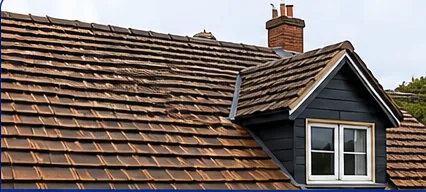
  • House roof stripped to battens during a roof replacement

    Victorian terraces and officers' housing

    Inkerman Barracks began in 1859 as a Home Office prison, became infantry barracks in 1892, and some of its prison officers' housing survives on Raglan Terrace. Terraces of that age have long shared slopes, party walls and chimney stacks, often serving two houses at once. We commonly meet natural slate or clay tile on them, but we confirm the covering at the survey, and a fault on one house frequently reaches the next.

  • A row of Victorian terraced houses with Welsh slate roofs and brick chimneys in Reading

    Converted hospital buildings and new homes

    The late-Victorian Brookwood Hospital was built on former Knaphill Common. Its listed central building was kept and converted into flats, and new houses went up where the wards stood. That gives two kinds of roof side by side: a large historic roof with long slopes, valleys and stacks, looked after by a freeholder or management company, and modern tiled homes with their own fixing and underlay questions.

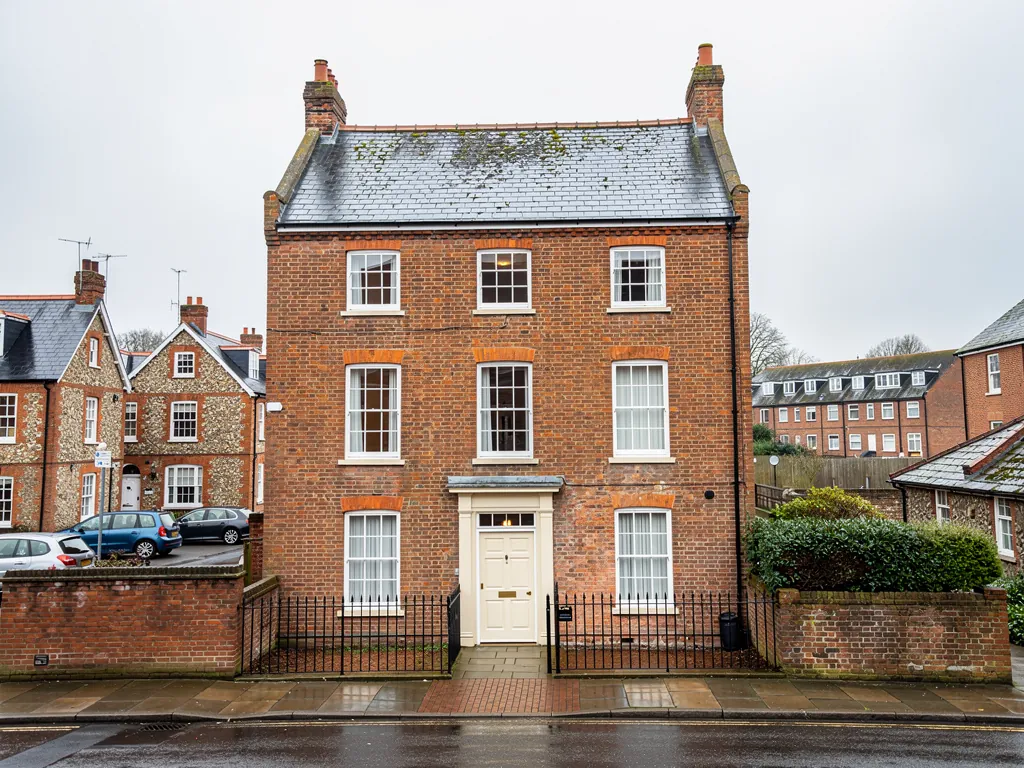
  • A Georgian brick town house with a slate roof and parapet in a Hampshire market town

    Hillside homes above the canal

    Part of Knaphill stands on a hill, with the A322 along its western border and the Basingstoke Canal, built in 1794, to the south. Roofs on a slope are more exposed to wind, and the fall of the ground changes how a scaffold has to be set. Ridge, hip and verge fixings take the strain first, and gutters on the downhill side carry the most water.

25.4 road miles east of Basingstoke

Planning and building control in Knaphill

The authority for Knaphill is Woking Borough Council, which handles planning and building control, and whose planning information is on the Woking Borough Council website. Lower Knaphill is one of the borough's 27 conservation areas, so a house inside its boundary is treated differently from one outside it. The converted Brookwood Hospital building is a further case: its central block is listed, and anything done to its roof is a matter for the freeholder and the council together.

Like-for-like repair, matching slate for slate and clay for clay, is normally the straightforward route in a conservation area. A switch of covering, or anything that changes the roof's appearance from the road, may need consent, so ring the council's conservation officer before ordering anything. Outside the conservation area, the question is usually building control. Stripping and recovering a whole roof may need a building control application, which we arrange. If you want a roof window, our roof window planning page sets out where the limits fall.

Faults we deal with on Knaphill roofs

Knaphill is a village of contrasts. Victorian terraces with shared stacks sit near large converted institutional buildings, and newer houses fill the ground between. Many of the roofs are on a hill and meet the wind head on.

Chapter 1: Who deals with the leaking lead around the shared chimney on our Victorian terrace in Knaphill?

What we find

On a terrace, the chimney stack often sits on the party wall and serves both houses. That makes it a shared structure, and its flashings run across both roofs. Lead flashings wear out through years of heating and cooling, the soakers (small lead pieces interleaved with slates up each side of the stack) corrode at the edges, and the mortar holding the lead into the brickwork falls out. A weakness on one side lets water into the other house first.

The signs are ceiling stains next to the chimney breast, damp on the party wall, peeling paint beside the flue and, in the loft, wet timber near the stack. Neighbours often report the problem before the owner sees it. Because the roof line runs unbroken along the terrace, a leak on one slope can wet more than one property.

What we fix

We start with a conversation with you about whether your neighbour is willing to deal with the stack at the same time, because a shared stack is usually cheaper and tidier to repair in one visit. Our photograph survey of the stack and the lead gives both of you the same evidence. We then replace the flashings and soakers with new lead, repoint in a lime mortar if the bricks are old, and check the pots and flaunching.

A typical UK range for replacing chimney leadwork is £350 to £920, scaffolding extra. Where slates around the stack are slipping, we replace those too. Related reading: soakers and step flashing and our chimney repairs page.

Chapter 2: We are leaseholders in the converted Brookwood Hospital building. How do roof problems get dealt with?

What we find

In a converted building, the roof normally belongs to the freeholder or a management company, and the leaseholders pay through a service charge. The central block of the old hospital is listed and the roof is large: long slopes, valleys, parapet gutters and tall chimney stacks. When water appears in a top-floor flat, the cause might be a slipped slate, a lifted flashing or a blocked valley gutter some distance away.

The signs inside are brown rings on a ceiling, bubbling plaster, damp near a window head, and a musty smell in a top-floor flat after rain. Outside, a roof of this size can hide problems that only show from the access level, such as cracked lead in a valley or a stack that has lost its pointing.

What we fix

We work with the managing agent or freeholder instead of individual flats, because the roof is a shared asset. A roof inspection with photographs gives everyone the same record, and a fixed written quote turns a vague service-charge worry into a number. We say honestly whether the cheapest sound repair is local or whether a section is worn out beyond economic repair.

Because the central building is listed, a change in material or appearance may need consent, and the council's conservation officer is who to ring. Like-for-like repair is the usual route. Our listed building roof guide explains what to ask, and our roof inspections page describes how a survey runs. We carry out residential and commercial work.

Chapter 3: Why do the ridge and gable-end tiles on our hillside house in Knaphill keep loosening?

What we find

A roof on a hill meets the wind with nothing to break it. The ridge, the row of capping tiles along the top, and the verge, the sloping edge at a gable end, take the greatest uplift. Houses of a certain age had these set in a sand and cement bed, which shrinks and cracks over decades of frost and sun. Once the bond goes, a tile can rock in its bed and lift in a gust.

From the road, look for ridge tiles out of line, cracks running through the mortar, mortar crumbs in the gutter or a verge tile that has slid at the end. From inside the loft, a chink of light along the ridge may show or damp on the timber below it. Gutters on the downhill side collect the most debris, which is why overflow marks often appear there.

What we fix

We lift a few ridge tiles to see whether the tiles are sound and only the mortar has failed. Sound tiles go back, but BS 5534 requires ridge, hip and verge components to be mechanically fixed, so we fit a dry-fix system: tiles screwed or clipped down onto a continuous batten, with breathable roll beneath, with BS 8612 covering dry-fix performance. Verges get dry verge caps at the same visit.

On a slope, scaffold has to be set carefully and often costs more, so we include it in the quote. UK cost guides report £900 to £1,600 for dry-fix ridge work on a semi, with scaffold at £300 to £900 on top. Your fixed quote follows the survey. The choices are set out on our ridge tile repairs page.

Chapter 4: Why does the flat roof on our Knaphill extension keep ponding after rain?

What we find

Behind many terraced and semi-detached houses sit flat roofs: a kitchen extension, a porch, a garage. When water stands on one for a day or more after rain, it is called ponding, and it points to a deck that has sagged or a fall (the slight slope towards the outlet) that was never quite right. Standing water speeds up wear on any covering, and bitumen felt in particular blisters, splits and lifts at its joints.

The signs are puddles with a tide mark, cracks along the front edge, bubbles in the surface and soft boards when you press them from inside. A stain on the extension ceiling under the roof usually means the water has already passed through. If the deck has gone soft, the covering is only part of the story.

What we fix

We check the deck from above and below. If the boards are sound, a new covering with a corrected fall will often cure the ponding. If they have gone soft, they are replaced first. For the covering, EPDM (a one-piece synthetic rubber sheet) and GRP (glass-reinforced plastic, a resin and fibre layer that sets rigid) are the usual choices. Cost guides list EPDM at £80 to £120 per square metre and GRP at £100 to £160; your fixed quote follows the survey.

Replacing a covering on a larger area can bring building control into play, and we handle that. Where a patch repair is enough, we say so. The flat roofing page weighs up the coverings, and the garage roof replacement page covers garages.

Knaphill roofing questions

Brookwood Hospital's old central building is now flats. Who decides on repairs to its roof?

For flats in a converted listed building, the roof is normally the responsibility of the freeholder or management company, not the individual flat owner. Start with them, because changes to materials or appearance may also need consent from the council's conservation officer. We can survey, photograph the roof and give your managing agent a written report to work from.

Is our house in Lower Knaphill conservation area, and does that affect roof repairs?

Lower Knaphill is one of Woking borough's 27 conservation areas, so check with Woking Borough Council's planning team whether your address falls inside it. If it does, like-for-like repair is normally fine, but changes to materials or appearance may need consent. We photograph the roof as it stands so you have a clear record for the conversation with the council.

Can you repair the roof on a house that was part of the old Inkerman Barracks housing?

Yes. Some of the prison officers' housing survives on Raglan Terrace, and terraces of that age have shared stacks, party walls and long slopes. We survey each house on its own merits, work out with you what is shared, and give a separate fixed quote for your roof. Slate and clay are repaired like for like.

Do you work on blocks of flats as well as houses?

Yes. We do residential and commercial roofing, including flat roofs and pitched roofs on blocks, and we are used to working with managing agents. We survey with photographs, give the freeholder a written fixed quote, and keep the work tidy for residents. Our commercial roofing page explains how larger jobs run.

The Basingstoke Canal runs south of Knaphill. Does the damp affect roofs here?

It can, in the places where trees and shade keep a roof damp. Moss and algae grow on slopes that dry slowly, and gutters fill with leaves. On a hillside house the effect is smaller than in a hollow, but a north-facing slope near trees still stays green. We clear moss by hand with a biocide and clear the gutters at the same visit.

Get your free roof survey in Knaphill

Tell us what’s happening and we’ll call you back to arrange a visit. You’ll get photos of your roof and a fixed written quote.

  • No obligation
  • Photo report of your roof
  • 10-year workmanship guarantee

Rather talk? 01256 213956

Call Free survey