
Beacon Basingstoke Roofing

Roofers in Cove

Cove is 17.2 road miles east of Basingstoke, a suburb of Farnborough where Rushmoor records new housing in the 1950s and 1960s, with Southwood alongside it built up in the 1980s. Expect concrete tile on post-war houses, plus flat-roofed garages and porches. Before any work, we photograph your own roof and give you a written price that does not move.

House roof stripped to battens during a roof replacement

Roofs we see in Cove

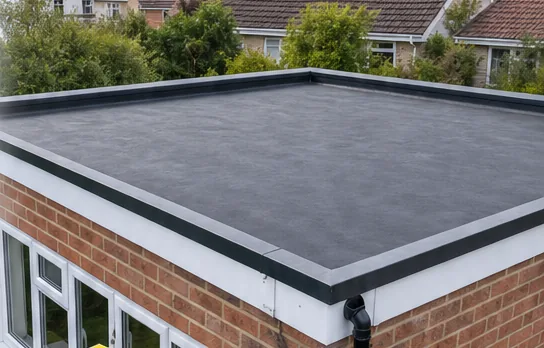
  • New EPDM flat roof on a brick extension

    1950s and 1960s estate houses

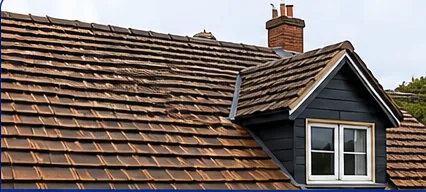
    Rushmoor's conservation overview records new housing at Cove in the 1950s and 1960s, and houses from that building wave are typically roofed in concrete interlocking tiles. After this many decades the first things to tire are the felt beneath the tiles, the mortar at ridge and verge, and the timber boards along the eaves.

  • 1960s and 70s brick semi-detached houses with concrete interlocking tile roofs on a Basingstoke estate street

    Southwood's 1980s houses

    Next to Cove, the Southwood area was developed in the 1980s, so its houses are a generation younger. They tend to have shallower pitches, concrete tiles clipped at the edges and plastic or timber roofline boards. Faults here are smaller and more local: a slipped tile after a gale, a lifted verge, or a valley gutter (the lined channel where two slopes meet) that has collected leaves.

  • An Edwardian red-brick detached house with clay tile roof and tile-hung gables in north Hampshire

    Garages, porches and flat extensions

    Behind the estate houses are the flat roofs: single garages, utility rooms and entrance porches, most of them first covered in bitumen felt. Felt splits where it folds at the upstand, blisters in summer sun and ponds where the deck has dipped. We re-cover in EPDM or GRP, or repair the felt where it still has life, and price it from your survey photographs.

17.2 road miles east of Basingstoke

Planning and building control in Cove

Cove sits in Rushmoor Borough Council's area, so Rushmoor handles both planning applications and the council's own building control service. Cove is in Hampshire, but it is part of the Farnborough urban area, and its administrative history explains why: it became a separate civil parish in 1866 and was merged with Farnborough and Hawley on 1 April 1932. The council publishes a conservation areas overview, which is the place to confirm whether your road, or a neighbour's, falls inside a designated area before you choose materials.

For the estate houses most people own here, the usual question is building control rather than planning. A patch repair or a small re-cover normally sits under the thresholds the Planning Portal sets, but a full strip of a main roof may not, and a new covering that is noticeably heavier than the old one needs approval. We handle that side where it applies. Adding a roof window is a separate matter with its own limits, explained in the skylight planning permission page on this site. If a house is listed, ask the council's conservation officer first.

What we find on Cove roofs

Cove is a place of two eras. Its name goes back to the Domesday Book, but the housing Rushmoor records here went up in waves from the 1950s onwards. That means a fairly narrow set of repeating faults, tied to the age of the felt, the mortar and the flat-roofed additions.

Chapter 1: Why does the felt roof on our Cove garage keep blistering and splitting?

What we find

Garages and porches added to Cove's post-war houses were usually covered in bitumen felt, laid in layers over a timber deck. Felt is a modest material, and it lives a hard life on a small flat roof. Sun softens the surface, so blisters rise where moisture has been trapped between the layers. Winter frost then opens those blisters into cracks. The most exposed places are the upstand, the short vertical edge where the roof meets the house wall, and the drip edge at the front.

Look for a roof that holds a puddle for more than a day after rain, felt lifting away from the wall, or a ceiling stain inside the garage or utility room. A soft patch when you press on the deck from below means the boards have absorbed water and are starting to rot.

What we fix

If the blisters are few and the deck is dry, a localised repair is often enough: we cut out the damaged felt, dry the deck, patch with new membrane and re-seal the upstand. Where the covering has failed across the whole roof, patching only buys a season or two. We strip to the deck, replace any soft boards, fit a vapour layer if the room below is heated, and re-cover.

Our usual choices are EPDM (a one-piece synthetic rubber sheet) or GRP (fibreglass resin that is brushed on liquid and sets rigid). Typical UK ranges per square metre run £80 to £120 for rubber and £100 to £160 for fibreglass, and the fixed quote is set once we have surveyed. See our flat roofing page for how each system is laid.

Chapter 2: Is the roof on our 1960s Cove house worn out, or is it just the felt underneath?

What we find

Concrete interlocking tiles are tough, and many Cove roofs from the 1960s still shed water perfectly well. What wears out is what you cannot see: the bitumen-based felt stretched beneath the battens (the thin timber laths the tiles hang from). Over several decades it dries, cracks and tears at the laps, particularly near the eaves and around the chimney. Tiles can look fine from the pavement while the felt below has quietly given up.

The clues are inside. Look in the loft for daylight where the felt meets the wall plate, dark streaks on the rafters, damp insulation or a musty smell after wet weather. On the outside, tiles with a heavy green crust, tiles that have slipped a few millimetres out of line, and sagging between the rafters can all point to a roof that is working harder than it should.

What we fix

We start in the loft, and then lift a few tiles to check the felt and battens. If only a section is tired, we strip that section, fit new breathable underlay and battens, and relay the sound tiles. This is usually the best value for money, and a roof with years left in it should be repaired, not replaced.

When the felt has failed across the slopes, a full re-cover is the honest answer. A typical UK range for a concrete-tile re-roof on a three-bed semi is £6,500 to £10,500, and the fixed quote is set once we have surveyed. A job of that size is likely to be notifiable, so we deal with building control. Our roof replacement page sets out the whole sequence.

Chapter 3: Why is there so much moss and lichen on roofs near Cove Brook and Marrowbrook?

What we find

Cove Brook and Marrowbrook are the only natural water features left in Cove, and the low ground along them is damper than the surrounding streets. Gardens beside a brook tend to hold mature trees, and a shaded roof stays wet long after the sun has dried the one next door. Moss grows in that dampness. It lodges in the overlaps between concrete tiles, holds moisture against them and sheds clumps into the gutters, where it blocks the outlets.

Lichen is the flat, grey-green or orange crust on tile faces. It is mostly cosmetic, but a thick mat of moss is not. It can lift the edge of a tile, trap water against the felt below and send a stream over the gutter edge, soaking the fascia and the wall beneath.

What we fix

We clear moss by hand, brushing it off downwards and not driving it up under the tiles, then apply a biocide to the roof so regrowth is slow. We avoid hard pressure washing on older concrete tiles because it strips the surface and pushes water under the laps. The gutters are cleared at the same visit, and the downpipes are flushed.

Across the UK, a hand clean with biocide is reported at £748, £863 or £978 depending on roof size, and the fixed quote is set once we have surveyed. If overhanging branches are keeping the roof wet, we tell you, because cutting back a tree can do more than another clean. See our roof cleaning service for the detail.

Chapter 4: Why does the ceiling around the chimney breast in our Cove house go damp when it rains?

What we find

Many of Cove's houses from the 1950s and 1960s have a brick chimney stack rising through the slope, and the joint between stack and tiles is the weak point. Often it was sealed with a fillet of sand and cement, a sloping bead of mortar pressed into the corner. Cement is rigid and the roof moves a little with every change in temperature, so the fillet cracks and lets water behind it.

The same fault can come from a lead flashing (the strip that seals the stack to the roof) that has lifted, or from crumbling mortar between the brickwork and the flaunching, the sloped mortar cap that holds the pots. Damp patches on the chimney breast inside, or on the ceiling nearby, usually appear a day or two after heavy rain.

What we fix

We inspect the stack closely, photograph each side, and trace where the water enters before suggesting anything. Where the cement fillet has failed, we cut it out and fit proper lead flashings and soakers (small lead sheets interleaved with the tiles up each side), which flex with the roof rather than cracking. If the brickwork needs repointing, that is done at the same time so the new lead is not set against crumbling mortar.

Replacing the lead around a stack is reported at £350 to £920 across the UK, averaging about £570, and the fixed quote is set once we have surveyed. Our chimney repairs and leadwork pages cover both halves of the job.

Cove roofing questions

Why do the ridge tiles on our Cove 1960s house keep coming loose?

Ridge tiles on a house of that age were bedded on a strip of sand and cement. After decades of frost and wind the mortar cracks and lets go, and the tiles can shift or slide. We lift the loose ones, clear the old bedding and re-bed them, or fit a dry-fix ridge system with mechanical fixings, so the ridge no longer depends on mortar alone.

Our Cove house was built in the 1960s. Does it need a new roof now?

Not automatically. Concrete tiles from that period often outlast the felt beneath them, so we check the loft and lift a few tiles before saying anything. If the roof has years left, we say so and quote a repair. Any job we do here is backed by a 10-year workmanship guarantee in writing.

Is there a difference between roofing in Cove and in the rest of Farnborough?

Not in the council: Cove was merged with Farnborough in 1932, and Rushmoor Borough Council now decides planning and runs building control across the pair of them. The difference is mostly the age of the houses, since Cove's recorded growth came in the 1950s and 1960s, with Southwood following in the 1980s. Ask us at the survey and we will explain what building control means for your particular job.

Can you re-cover the flat roof on my garage without disturbing the house?

Usually, yes. A detached or attached garage roof is independent of the main pitched roof, and the work takes a short time compared with a full re-roof. We strip the old felt, check and repair the deck, and fit a new membrane. Where the roof meets the house wall, we form a neat upstand and fit flashing so the joint stays watertight.

Do old pottery sites around Cove affect my roof?

Not the roof itself. Rushmoor records many former pottery sites in Cove, which matters mainly for ground and archaeology, not for tiles or felt. If you are building an extension and a roof together, ask the council's planning team whether your plot has any recorded history. For repairs to an existing roof, the survey photographs tell us everything we need.

Get your free roof survey in Cove

Tell us what’s happening and we’ll call you back to arrange a visit. You’ll get photos of your roof and a fixed written quote.

  • No obligation
  • Photo report of your roof
  • 10-year workmanship guarantee

Rather talk? 01256 213956

Call Free survey