Beacon Basingstoke Roofing

Roofers in Blackwater

Blackwater is 18 road miles east of Basingstoke, a Hampshire town that grew up around a ford over the River Blackwater, with the A30 running through it as a dual-carriageway high street. Its roofs include shop parades, business premises by the M3 and ordinary houses. We photograph each, with a fixed quote after.

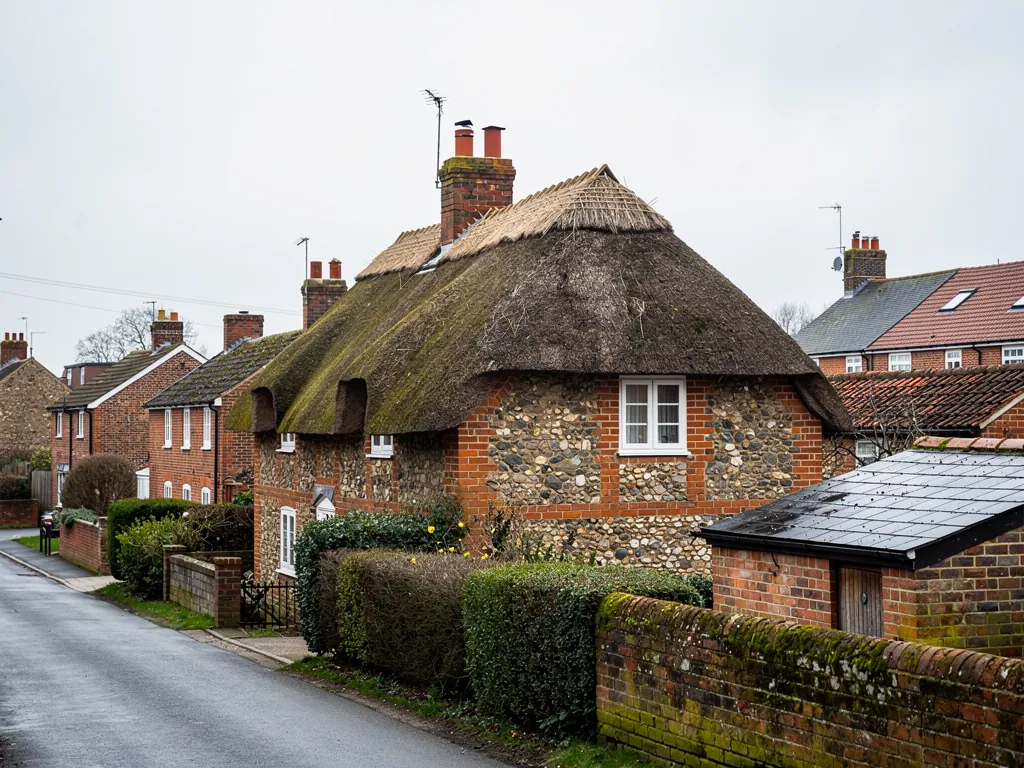
A thatched cottage in a Test Valley village with a brick chimney

Roofs we see in Blackwater

  • 1960s and 70s brick semi-detached houses with concrete interlocking tile roofs on a Basingstoke estate street

    Shop parades and flat roofs

    Blackwater's high street runs along the A30, and it includes the White Hart parade of shops, named after the coaching inn that once stood there. Where shop parades carry flat roofs over the units and any flats above, those roofs live hard: parapet walls, rooflights, roof-mounted plant and drainage outlets all give water a way in. Felt, single-ply or asphalt covers wear at the upstands and outlets first.

  • An Edwardian red-brick detached house with clay tile roof and tile-hung gables in north Hampshire

    Business premises by the M3 junction

    Sun Microsystems' former UK headquarters stood at the M3 junction near Blackwater, on the site of the old Guillemont Barracks, and larger business premises near a motorway junction like this one bring a different kind of roof. Commercial roofs of this type tend to be low-pitched or flat, with single-ply or built-up membranes, profiled sheet and rooflights. Access planning and fragile-roof safety matter as much as the covering.

  • Roofer fitting roof tiles on a brick house near Basingstoke

    Houses in and around the town

    Beyond the A30, Blackwater is mostly houses, with pitched roofs of concrete or clay tile, flat extensions at the back and garages alongside. Blackwater has been on the map since at least 1281, when it was recorded as Bredeford, and houses of different periods have their own weak points. We check the roof you actually have, not the type we expect for the street.

18 road miles east of Basingstoke

Planning and building control in Blackwater

Hart District Council deals with both planning and building control in Blackwater. We have no conservation area or listed building to point to here, so before you plan roof work, ask Hart's planning team whether your address has any designation or an Article 4 direction that removes permitted development rights. That takes a short call and avoids a surprise later.

For houses, the Planning Portal says a repair or re-cover touching under a quarter of the building envelope and under half of the roof does not normally need a building control application. Above that, approval is needed and the insulation of the whole roof may have to be improved. For shops and offices, the roof is also treated as a thermal element, so a strip and re-cover on business premises can bring insulation upgrades into play. We deal with the building control side where work is notifiable. Thinking of a roof window? Our page on skylight planning permission sets out what applies.

What we find on Blackwater roofs

Blackwater is a working town, and its roofs are a mix of flat commercial coverings above the A30 and pitched domestic ones in the streets behind. Each type fails in its own place.

Chapter 1: Why does the flat roof above our shop on the high street leak at the parapet wall?

What we find

A flat roof over a parade of shops meets its surrounding walls at an upstand, the short vertical edge of covering that turns up the wall behind it. At the top of that upstand sits a flashing or a coping that stops rain running behind it. On older parades the felt or asphalt at this junction has often dried out, split along the fold, or pulled away from the brickwork, and the coping above has cracked mortar joints that let water into the wall itself.

Inside the unit, you see a stain on the ceiling or a damp patch low on a party wall, usually after prolonged rain instead of a short shower. Another common cause is a blocked outlet: leaves, litter and moss gather around the drain, water ponds, and the standing water finds every weak seam in the covering.

What we fix

We start with the survey photographs of the upstands, copings and outlets, then check the deck by pressing it for soft spots. If the field of the roof is sound and only the junctions have failed, we cut back the old edges, replace the upstand covering and fit new flashings or coping seals. Where water has ponded for long, the deck may need patching before anything goes back on top.

If the whole covering is tired, we price a strip and re-cover in single-ply, EPDM or built-up felt, with new outlets and falls corrected. Informal tradesperson answers put a full commercial flat roof strip and replace at £90 to £180 or more per square metre, which is a low-confidence figure, so treat it as a typical UK range only. See our flat roofing page for how the coverings compare. Your fixed quote follows the survey.

Chapter 2: How do you reroof or repair a large low-pitch business roof near the M3 without stopping work?

What we find

Business premises near a motorway junction often have large roofs of profiled metal sheet or a flat membrane, with rooflights set into them. The covering can last a long time, but the faults are predictable: fixings that back out of the sheet, laps that open, sealant that perishes, and rooflights that crack or sag. A leak can run a long way along a purlin before it shows at a ceiling, so where it drips and where it starts can be many metres apart.

Safety adds a second problem. Old rooflights and weathered sheets can be fragile, and people have fallen through roofs that looked solid. Anyone working on one must use proper edge protection, crawl boards and covered openings. Work at Height Regulations apply, and we plan access before anyone steps onto the roof. Asbestos cement sheets, common on older sheds, need identifying first.

What we fix

We survey with photographs and trace each leak to its source before quoting. Often a fix is local: new fixings and sealing tape at the laps, replacement rooflights, or a patch in the membrane. Where the whole roof is tired, overcladding, a new sheet laid over the old, can avoid stripping and keep the building in use. We tell you if the old sheets could contain asbestos cement, and that changes the method.

Work can be phased in bays so staff and stock are not disturbed, with the site cleared each day. See our commercial roofing page for the systems we work with, and the guide on overcladding an asbestos roof for the older sheet roofs.

Chapter 3: Why is the underside of our Blackwater roof damp and mouldy when the tiles look fine?

What we find

Damp in a loft with no obvious leak is usually condensation. Warm, moist air from kitchens, showers and drying washing rises through the ceiling into the roof space and meets the cold underside of the roof, where it turns to water. It collects on the underlay, drips onto insulation and settles as black mould on the rafters. Houses of mixed ages in an area like Blackwater suffer from it when loft insulation has been added without keeping ventilation open at the eaves.

Sagging felt underlay makes it worse, because moisture pools in the dip. Older bitumen felt does not let moisture pass, while a modern breathable membrane does. You will notice a musty smell in the loft, beads of water on the felt on cold mornings, and mould on timber near the eaves. Staining on a bedroom ceiling that does not match the weather outside points the same way.

What we fix

We find the source before touching anything. If the roof coverings are sound, the answer may be better ventilation: eaves vents so air can move, tile or ridge vents at the top, and a gap kept clear between insulation and underlay. Bathroom and kitchen extractors that vent outside, not into the loft, make a difference too. Where the old felt has failed along the slope, a strip and re-cover with breathable membrane is the permanent fix.

Re-covering a large part of a roof is the point at which building control and the insulation question arise, and we handle that. Our guide to breathable roof membranes explains how they differ from old felt. We say so plainly if a roof has years of life left, and your quote is fixed in writing after the survey.

Chapter 4: What should we do first when a Blackwater roof starts leaking in a storm?

What we find

A roof that begins leaking in a storm is stressful, and the first instinct, climbing up to look, is the wrong one. Wet tiles are slippery, wind is strong, and ladders on a storm night are dangerous. Water through a ceiling can also spread along joists to a light fitting or a socket, so the immediate danger often sits indoors.

Typical storm damage includes slipped or blown tiles, lifted ridge or verge tiles, torn flat roof coverings, displaced lead flashings and chimney damage. The visible leak is not always the real entry point, because water runs along timbers before it drips. Insurers also want evidence of the damage, which is hard to gather from a rooftop in the dark.

What we fix

Stay inside. Move belongings clear, put a bucket under the drip, and if water is near light fittings or sockets, switch off the circuit at the consumer unit. Photograph the damage from the ground and the ceiling stain from inside for your insurer. Then ring us on 01256 213956 or send a WhatsApp with the photographs. We prioritise emergency calls.

Our first job is to make the roof safe: a temporary covering over the damaged area to stop more water getting in. Lasting repairs follow once the weather settles, when we can see the whole roof, with the photographs for your claim. Typical UK emergency call-out prices run from £150 to £350 before materials. Read more under emergency roof repairs.

Blackwater roofing questions

Does the traffic on the A30 shake roof tiles loose in Blackwater?

Traffic vibration is rarely the cause of loose tiles. Wind, ageing nails and crumbled ridge mortar are the usual reasons. A house beside a busy road may collect more grime and dust, which can block gutters sooner. We look for slipped tiles, rusted clips and cracked ridge bedding, and photograph what we find so you can see the actual cause.

Can you work on a shop roof on the White Hart parade while the units stay open?

Usually, yes. We plan access and materials handling at the survey, and work from the roof and the rear where possible. Phasing the job and clearing the site each day keeps customers and tenants moving. A landlord or leaseholder should check who is responsible for the roof under the lease before work starts.

Do you handle roofs on business premises near the M3 junction as well as homes?

Yes. We do residential and commercial roofing. For offices, units and warehouses we deal with membrane, sheeted and flat roofs, rooflights, and fragile-roof safety. Read our commercial roofing page for the systems, or ring 01256 213956 to talk through an access plan.

Does the A30 traffic and dual carriageway make scaffold or deliveries difficult in Blackwater?

It can on the high street, where the A30 is a dual carriageway and kerbside space is limited. We check delivery points and scaffold positions at the survey, and whether the work needs a highway licence. On side streets and private drives the arrangements are simpler. We keep the site tidy throughout and take the waste away at the end.

Is there a conservation area in Blackwater that affects a re-roof?

We have no designation to point you to, so ask Hart District Council's planning team whether your address has a conservation area, listed status or an Article 4 direction. The call takes minutes and settles whether like-for-like matters. For ordinary houses and shops, building control is the more common question, and we handle it for you.

Get your free roof survey in Blackwater

Tell us what’s happening and we’ll call you back to arrange a visit. You’ll get photos of your roof and a fixed written quote.

  • No obligation
  • Photo report of your roof
  • 10-year workmanship guarantee

Rather talk? 01256 213956

Call Free survey