
Beacon Basingstoke Roofing

Roofers in Haslemere

Haslemere is 28.9 road miles south-east of Basingstoke, at the Surrey end of our 30-mile area, with Blackdown rising behind the town. Victorian villas built after the railway arrived sit among older sandstone, tile and brick buildings. Before any work, we photograph the problem on your own roof and send a written quote at a fixed price.

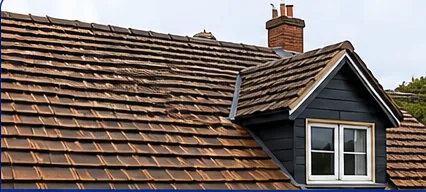
Brick chimney stack with clay pots

Roofs we see in Haslemere

  • A Hampshire village cottage of flint and brick with a steep clay plain tile roof

    Victorian villas after the railway

    The railway reached Haslemere on 1 January 1859, and the town grew through the rest of the century as wealthy residents moved in from London. The villas they built have busy roofs: gables, bays, valleys, tall chimneys and decorative ridges. Every junction is a place where water can find a way in, and after more than a century the lead and the mortar at those junctions are usually what fails first.

  • 1930s semi-detached houses with hipped clay tile roofs and bay windows on a suburban road

    Sandstone, tile and brick cottages

    Records for the town centre conservation area note extensive use of local sandstone, tile and brick, and many houses in the area went up in local bricks. Roofs on these older buildings tend to be clay tile, laid with a good deal of hand-fitting at verges and chimneys. Walls of soft stone and brick behave differently from modern masonry, and the roof needs repairs that suit them.

  • House roof stripped to battens during a roof replacement

    Wooded hillside homes

    The Surrey Hills National Landscape lies to the north, the South Downs National Park to the south and Blackdown rises south of the town. Many homes sit on slopes among mature trees. That means shade and slow-drying roofs, leaves and twigs in the gutters, and wind that climbs the hillside and catches the ridge and the edge tiles. Roofs here need checking more attentively after autumn and after storms.

28.9 road miles south-east of Basingstoke

Planning and building control in Haslemere

Waverley Borough Council, not a Hampshire authority, handles planning and building control here, because Haslemere is in Surrey. The Haslemere Town Centre Conservation Area was designated in 1974 and extended in 1975, 1985 and 2005, and Waverley also lists a separate Springhead and River Wey conservation area in the town. The council sets out its areas on its conservation areas page, which is the place to confirm whether your street falls inside one.

Inside a conservation area, swapping clay tile for clay tile or brick for brick rarely causes difficulty. Altering the material or the look of a building could need consent, so put the question to the council's conservation officer first, as you would for a listed house. Because Haslemere lies between two protected landscapes, it is also sensible to ask the planning team whether anything visible from outside needs extra thought. A large re-cover can be notifiable under the Building Regulations, and we manage the paperwork for that. For roof windows, read our planning guide.

What we find on Haslemere roofs

Haslemere roofs are shaped by two things: the age of the housing and the hillside setting. Houses from the Victorian expansion carry complicated roof shapes and old lead, while homes among the trees battle moss, leaf fall and wind.

Chapter 1: Why does our Victorian villa in Haslemere leak at the valley where two roof slopes meet?

What we find

A valley is the trough where two roof slopes meet at an internal angle, and it carries the run-off of both slopes. On a villa with several gables and bays, the valleys take a lot of water. Many Victorian valleys were lined with lead laid in long sheets, and lead can crack where it has expanded and contracted for a century or more. In other valleys the tiles were cut tightly to a mortar bed, and that bed has since cracked and washed out.

Leaks at a valley show up in an odd place. Water runs down the trough, finds a split and drops onto the timbers below, then travels along a rafter before it reaches a ceiling. So a damp patch in a bedroom may be a metre or more from the real fault. In the garden, look for a dark streak along the valley, moss in the trough or tiles that have shifted on either side.

What we fix

We start from the roof and the loft together, tracing the stain back along the timbers to the point of entry. Where the lead is sound but has lifted at the edges, it can be dressed back and the tile cuts tidied. Where the sheet has split along a fold or the underlay beneath it has perished, the honest repair is to lift the tiles either side and re-line the valley with new lead, with fresh underlay under it. Our guide to the lead valley explains how the sheet is laid and why the width matters.

Some owners ask about swapping lead for glass-reinforced plastic, and we compare both in lead valleys against GRP valleys. Either way, the photographs we take show you the damaged section, and the fixed quote follows once we have surveyed it.

Chapter 2: Our gutters overflow every autumn because of the trees. Is the roof edge being damaged?

What we find

It can be. Gutters on wooded Haslemere slopes fill with leaves, seed cases, twigs and moss washed off the tiles, and once an outlet blocks, rain has nowhere to go but over the front. Water then pours down the wall face or soaks back against the fascia board, the board fixed along the eaves to hold the gutter up. A fascia that stays wet will rot from the back, and rot can spread into the rafter ends and the soffit beneath.

On the tiles themselves, shade is the problem. A north-facing slope under oaks and beeches never fully dries, so moss builds up along the courses and holds water against each tile. Moss also lifts the edges of tiles over the years and can crumble the surface of concrete ones. Inside, you may see a damp patch on an outside wall or a ceiling near the eaves after a long wet spell.

What we fix

We clear the gutters first, then look at what the water has already reached. Fascias and soffits that have only suffered surface damp can be dried, treated and painted. Where the timber has gone soft we cut out the failed length and fit a new board, or replace the whole run if the boards are beyond repair. For the tiles, we remove moss by hand and apply a biocide rather than using a pressure washer, which can strip the surface from the tile. Cost guides give £748 to £978 for hand moss removal with biocide, rising with the size of the roof.

Read our guide to rotten fascia boards for what to look for, and our roof cleaning page for the method. Your fixed quote follows the survey.

Chapter 3: Can a sandstone and clay tile cottage in the town centre be repaired without changing how it looks?

What we find

Usually yes, and that is often what the conservation area expects. Cottages built from local sandstone and brick under clay tile rely on all three materials working together. The tiles shed water; the walls take the weight; and the mortar joints between stone and brick act as a sacrificial layer that moves and weathers so that the stone does not. When a roof fails at the verge, where the tiles meet the gable wall, water gets into the wall head and softens the mortar and the stone beneath.

Look at the gable ends and the chimney stack. Pale crumbs of mortar in the gutter, a verge tile that has slipped, green staining on the wall below the edge of the roof, or a stack leaning slightly are all signs that water has been getting in for a while. Clay tiles on older cottages also suffer frost damage on their faces, which leaves pits and flakes.

What we fix

We look for the smallest repair that works. Sound tiles stay on the roof. Failed ones are replaced with reclaimed or new clay tile matched to the colour and size of what is there, and the verge is re-bedded with a mortar suited to old masonry, with the tiles mechanically fixed so they do not depend on mortar alone. Pointing on stacks is done in lime, which breathes with soft brick and stone and does not trap damp behind it.

Before a change of material, we advise talking to the conservation officer at Waverley Borough Council, and we record the roof in photographs so that there is a clear picture of its condition. Our single tile replacement guide shows how individual repairs are made, and the lime or cement mortar for chimneys page explains the mortar choice.

Chapter 4: Do roofs on the Haslemere hillsides need extra fixing against the wind?

What we find

Exposed edges are where wind does its damage. A house high on an exposed slope meets air that has climbed the hill with little to slow it down, and the wind lifts at the ridge, the hips and the verges, then works along the first and last tiles in each row. Older roofs relied on mortar at these edges and on weight and friction in the body of the roof. Once the mortar has loosened, a gust can lift a ridge piece or flip a verge tile into the garden.

You may notice rattling in the loft in a blow, tiles in the lawn after a storm or a line of ridge tiles that no longer sits straight. Light coming through in the roof space, especially along the ridge, is a sign that the bedding has gone. Tiles on the exposed side can also slip because the fixings, the nails and clips that hold them, have corroded.

What we fix

The standard for fixing ridge, hip and verge components, BS 5534, calls for mechanical fixing, and mortar alone is no longer relied on. On exposed Haslemere roofs we therefore favour dry-fix, where a fixed batten runs the length of the ridge, the capping tiles are screwed or clipped down onto it and clip-on verge caps finish the gables. BS 8612 is the standard such kits are tested against. Field tiles on exposed slopes can also be fitted with clips so a lifted course cannot peel back.

A dry ridge on a semi has a typical UK range of £900 to £1,600, and access scaffolding is reported at £300 to £900 more. Where wind has already done damage, we make the roof safe first and then repair it properly. See our guide to whether roof tiles need clips and our ridge tile repairs page.

Haslemere roofing questions

Why do the lead valleys on a Victorian Haslemere villa fail before the tiles do?

Lead moves with the temperature, and over many years it fatigues and splits along folds, particularly where it was laid in long unsupported lengths. Tiles tend to outlast it. A split valley often means a repair, with new lead and underlay beneath, rather than a re-roof. We photograph the split so you can see whether the fault is local.

Which council deals with roofing consents in Haslemere?

Haslemere lies in Surrey, so Waverley Borough Council is the planning and building control authority, not a Hampshire council. If your street may be in the town centre conservation area, or in the separate Springhead and River Wey area, ask Waverley's conservation team before work starts. We handle the Building Regulations side where a job is notifiable and can supply survey photographs for any application.

Can you fit a roof window in a Victorian villa near the station?

Often, though the rules and the best style depend on whether the house is listed or in a conservation area. Start with our conservation rooflights guide, then check with Waverley's planning team. On a clay tile roof, a slim low-profile frame flashed neatly into the tiles usually looks best, and we check the rafters in the loft before recommending a position.

We have a leak after a storm. Will you come out quickly?

We prioritise leaking roofs and will make a roof safe first, whether that means a temporary cover over a slipped section or a patch at a flashing. We cannot promise a set arrival time, and a roof on a steep hillside plot may need scaffold or a tower before anyone can work on it safely. Call 01256 213956 or message us on WhatsApp with photographs, and we will take it from there.

Do the Surrey Hills and the South Downs affect what I can do to my roof?

Haslemere sits between the Surrey Hills National Landscape and the South Downs National Park, but whether either affects roof work at a particular house is a question for the planning team, not for us. Like-for-like repair rarely raises an issue. A new material, a large dormer or a visible change may do, so check with Waverley Borough Council before you commit to anything.

Get your free roof survey in Haslemere

Tell us what’s happening and we’ll call you back to arrange a visit. You’ll get photos of your roof and a fixed written quote.

  • No obligation
  • Photo report of your roof
  • 10-year workmanship guarantee

Rather talk? 01256 213956

Call Free survey