
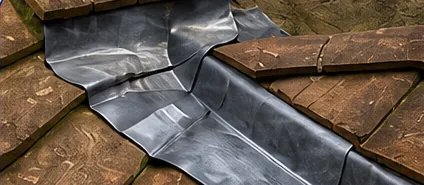
On a roof with two pitches meeting at an inward angle, the valley is where the water collects. Everything that falls on both slopes runs towards it, along with leaves, moss and grit, so it works harder than any other part of the covering. It is also where a repair is hardest, because the tiles on both sides have to be lifted to reach it. The lining under the valley therefore needs to be chosen with some care. In the UK the two choices that matter most are lead sheet and glass-reinforced plastic, known as GRP. This page compares them honestly, because each has a place, and the right answer depends on the roof.
What a valley has to do
A valley lining sits on a board or batten bed between the rafters, below the tiles or slates, and forms a watertight channel. Its edges are covered by the roof coverings on each side, which are cut to follow the line of the valley, leaving a gap in the middle through which the lining is visible. Water runs down that open channel to the gutter. To work, the lining must be continuous, free of joints where water can collect, strong enough to carry the flow in a storm, and flexible enough to move with the roof. It must also tolerate people occasionally walking in it, since a roofer inspecting or clearing a valley will step there.
Both materials do this. They differ in how they are made, how they behave over time and what happens when they fail. Our wider page on roof valleys describes all the valley types, including the open, closed and mitred forms.
How a lead valley is built
Lead valley linings are formed from code 5 sheet, laid in a continuous channel on a layer of building paper or geotextile over a timber valley board. Side upstands are formed, with the lead turned up under the tile or slate edges, and the sheet is lapped at its joints with the upper piece over the lower. The lap length depends on the pitch of the valley, and a shallower roof needs a bigger lap. Because lead moves with temperature, each piece is kept to a limited length and joints are made with laps, not soldered, so movement is spread out. Our guide to what a lead valley is sets out the sequence.
Lead valleys suit slate and clay plain tile particularly well. It dresses neatly against the shape of the covering and can be formed to match the width of the open channel, whether narrow or wide. It is the traditional lining for period roofs, so it keeps the look of the house. A good lead valley, correctly specified and laid, can last as long as the slates beside it.
How a GRP valley is built
GRP valleys are factory moulded troughs of glass-fibre reinforced polyester resin, usually grey, green, brown or black, delivered in lengths that are laid in the valley and fixed to the rafters or valley board. Side upstands are moulded in, and the trough is typically sold with a defined width for the open channel. The lengths overlap and are screwed or clipped in place, then the tiles are cut to the edges. The system was designed for concrete interlocking tiles on modern housing and is widely used on estates built from the 1970s on.
GRP has real advantages. It is light, it does not corrode, it is not worth stealing and the cost of the material is low. It does not expand and contract much, so thermal movement is less of an issue. Installation is quick for a skilled roofer. On a modern concrete-tile roof, a correctly fitted GRP valley is a sound, economical answer.
How each ages
Lead ages by oxidising, forming a protective grey layer, and by fatigue where it moves. A well-made lead valley rarely fails through wear on its surface. Its enemies are cracks at the laps from thermal movement, thin spots from foot traffic and damage from stiff debris. Where it fails, it usually does so slowly and visibly, with cracks or a sag that a survey can spot.
GRP ages by weathering. UV light breaks down the resin at the surface, leaving the glass fibres exposed, which gives a rough, chalky look. Over many years the surface becomes brittle and can crack under foot or a heavy branch. Overlaps can lift where fixings loosen, and the original colour fades. The material itself stays watertight until it cracks, and a crack in a GRP trough is harder to mend than one in lead. In practice a GRP valley is usually replaced as a unit when it has gone, not patched.
| Factor | Lead valley | GRP valley |
|---|---|---|
| Best with | Slate, clay plain tile, period roofs | Concrete interlocking tile, modern estates |
| Material cost | Higher | Lower |
| Labour | Skilled hand work | Quicker, mostly fixing |
| Ageing | Oxidises, may fatigue at laps | UV weathering, can turn brittle |
| Repairable | Yes, patch or re-lay a length | Rarely, usually replaced |
| Theft risk | Yes, if exposed | No |
| Appearance | Matches traditional roofs | Plain, designed to blend |
Flow, width and pitch
Whichever lining is chosen, it has to be sized for the water it will carry. A long valley that drains a large roof area, or one where the two slopes meet at a shallow angle, collects more water than a short one on a small dormer. The channel needs a minimum width at its base and sides high enough to stop water overtopping in a downpour. Where it receives the flow from a dormer or a higher roof above, it may need a bigger section or a lead-lined trough. This is the sort of detail that decides whether a valley copes with a storm. Leaves in the channel make it worse by slowing the flow, so trees nearby push the choice towards a smoother, wider design and a regular clearing routine.
The pitch of the roof also matters. On low pitches, laps in lead must be longer. GRP troughs are designed for particular pitches, and the manufacturer's installation guide should be followed. Our guide on the minimum roof pitch for tiles covers the related limits for the tile covering itself.
Which to choose
For a slate roof or a clay tile roof on a period house, lead is the natural choice. It matches the character of the building, it is repairable and a good one lasts. Where the house is listed or sits inside a designated conservation area, expect the council to want the existing material kept, and ask its conservation team before swapping anything.
For a modern concrete-tile roof, GRP is usually sensible and economical. The valley design fits the roof system, it is quick to fit and the cost is lower. It is not a lesser choice on that kind of roof, provided it is installed to the manufacturer's instructions and the tile cutting is neat.
Where a roof is exposed to theft, GRP has an obvious advantage. Where the roof is complex, with several valleys meeting at awkward angles, lead can be shaped to fit when a preformed trough cannot. In the middle ground, such as a 1930s semi with concrete tiles and a lead valley that has aged, we would look at the lead's condition before deciding: if it is sound, a repair is cheaper than a change, and if it is worn, either could be fitted.
Mixed and hybrid solutions
Some roofs combine the two, with lead used at the head of a valley and at junctions with walls, and GRP in the long runs. Some contractors fit a tiled valley, where special valley tiles curve into the channel, which hides the lining altogether. Each has its own advantages. A closed or tiled valley looks cleaner from the ground but hides problems and can be harder to maintain, so we only use it where the roof's design calls for it.
Replacing a valley: what the job involves
A new valley is not a quick swap. The tiles or slates for a metre or more either side are stripped and stacked, the old lining is lifted and the valley board is checked. If the board is rotten or the rafters beneath are wet, they are renewed before anything else goes on. The new lining is laid with the correct laps and side upstands, the covering is cut to the valley line with a consistent gap, and the lead or GRP is checked for fall before the tiles go back. Ridge ends and the foot of the valley, where it discharges into the gutter, need their own attention, since an undersized gutter overflows in the same storms that test the valley.
On a tiled roof, the cut tiles along the valley edge are the most exposed to wind. They should be mechanically fixed, not left to sit on mortar alone, and each edge tile should be bedded or clipped according to the system. If those details are skipped, the valley can leak at the edges even though the lining itself is fine.
Maintenance and signs of trouble
Whatever material is in the valley, it needs clearing at least once a year. Leaf litter and moss hold water and speed up corrosion in lead and weathering in GRP. Look from the ground for sagging valley lines, stains on the ceiling below the valley line, displaced tiles at the edges and moss growth in the channel. If you see daylight in the loft along the line of the valley, or a drip that appears in heavy rain only, the valley is a prime suspect. Our guide to the signs of failing lead flashing sets out many of the same symptoms.
What we do
We look at the valley from above and from inside the loft, check the condition of the lining and the tile edges, and tell you what we find with photographs of your own roof. A sound valley is left alone, a worn one is repaired or replaced, and where replacement is needed we recommend the lining that suits your roof, with reasons. The quote that follows is a fixed written price, and the finished valley is covered by our written 10-year workmanship guarantee. More on this kind of work is on the lead roofing and leadwork page, or phone 01256 213956 or WhatsApp us a photo of the valley.
