
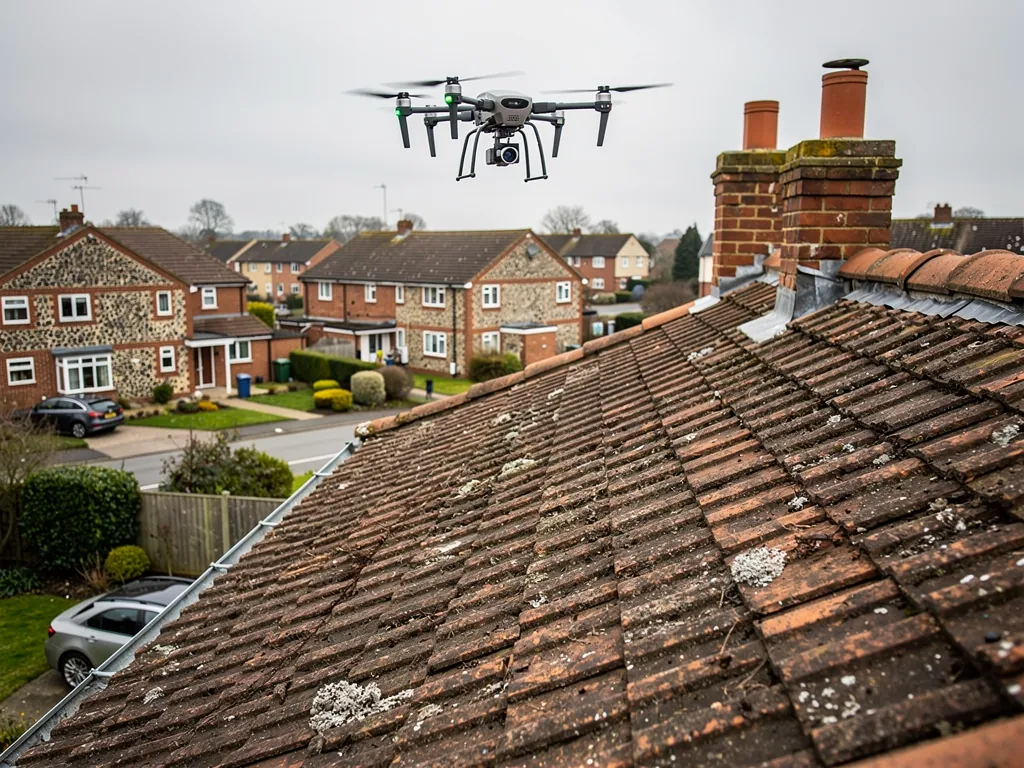
A drone fitted with a good camera can fly over a roof in minutes and bring back detailed images of every slope, the ridge, the chimney and the gutters. For roofs that are hard or dangerous to reach, that is a real advantage. It is not a complete inspection, though, and the companies that sell drone surveys do not always make clear where the pictures stop and the guesswork starts. This guide sets out what a drone survey is good for, what it cannot see, what it costs and how it fits with other kinds of roof inspection.
What a drone survey is
A drone survey is an inspection in which an operator flies a camera-carrying drone around and above a roof and records still images and video. The operator or an analyst then looks through them for visible defects and produces a report, often with annotated photographs. Some include a measured plan of the roof. Some drones carry thermal cameras as well as ordinary ones, which we cover separately in thermal imaging roof surveys.
The appeal is plain. No one needs to climb, no scaffold is needed, the survey can be quick, and the pictures give a record you can keep. For large, high or awkward roofs, those advantages are significant.
What a drone does well
Overview and access
A drone sees the whole roof, including areas that a ladder cannot reach: the back slope, a roof behind a gable, a roof over a conservatory or a long run of commercial roof. It is safer than sending someone onto a fragile or steep surface.
Visible damage on the surface
Missing, slipped or displaced tiles, broken slates, gaps in ridge and hip lines, lifted or missing flashing, damaged chimney pointing, blocked valleys, debris and heavy moss growth show up well in good images. A drone also shows blocked gutters from above.
A record
The images are dated and can be compared with later surveys. After a storm, they can show what changed. That is useful for a landlord, a managing agent or an insurance conversation, and our page on roof reports for insurance claims covers how reports are used.
Measurement and planning
Imagery can help with a rough roof plan and area, useful when planning a job. It does not replace a measured survey where precision matters.
What a drone cannot show
This is the part sellers of drone surveys tend to skim. A camera above a roof only records the outside surface, and much that matters is hidden.
The underside
The condition of the felt, the battens and the rafters, which is where leaks and rot show up first, is out of view. Damp, staining, daylight through gaps and condensation are visible from the loft and invisible from the air. Our guides to inspecting your loft and roof damage that cannot be seen from outside show what a drone misses.
Fine detail
Hairline cracks in tiles, small gaps at the end of a flashing, the state of mortar beneath the surface and the firmness of a ridge tile are difficult to judge from images. A tile that looks fine may rock. Whether a ridge is held by a mechanical fixing or by mortar alone cannot be seen from above. See our guide to the BS 5534 fixing rules for ridges for why that matters.
Flat roofs and ponding
A drone can show standing water and visible splits on a flat roof, but it cannot tell you whether the deck beneath is soft or the insulation is wet. For that, someone has to be on the roof or use specialist equipment.
Materials and age
Telling the exact type of tile, its age and its remaining life from images alone is guesswork. An operator may be good at reading a photograph and still unable to tell whether a tile is brittle. Our answer on how to tell how old a roof is shows the clues that need a closer look.
Interpretation
Images are not a diagnosis. A report that lists defects from photographs should say what could not be seen. A report that presents a drone's view as a complete survey overstates what it can do.
| Question | Drone | Hands-on inspection |
|---|---|---|
| Is a tile missing or slipped? | Usually yes | Yes |
| Is a tile cracked or loose? | Sometimes | Yes, by touch |
| Is the felt sound? | No | Yes, from the loft or by lifting a tile |
| Is the ridge mechanically fixed? | No | Yes, by lifting a sample |
| Is a flat roof deck soft? | No | Yes |
| Is the gutter blocked? | From above, yes | Yes |
What a drone survey costs
Published UK guides report about £200 for a domestic drone roof survey and £750 to £1,000 for a commercial one. A drone inspection with a digital report is reported at £200 to £350. These are typical UK ranges for orientation, not Beacon prices, and what you get for the money varies with the report. Our page on how much a roof survey costs compares the options, including hands-on inspections.
When you read a drone quote, ask what is delivered: raw images, annotated photographs or a written report; whether it includes a loft check; whether the operator is competent to read roof defects; and what the report says it could not see.
Permissions and rules
Drones are regulated in the UK, and an operator has to follow the rules of the Civil Aviation Authority. Flying near other buildings, people and roads, or in restricted areas, raises further questions, and neighbours may have views on a camera overhead. We do not set out the rules here, since they change and should be checked at source. Our answer on whether drone roof surveys need permission gives the practical picture. Ask any operator to confirm they comply, and to deal with the privacy side if images could include neighbouring gardens.
When a drone is the right tool, and when it is not
A drone suits a roof that is high, steep, fragile, hard to reach or large, and a case where a visual record is wanted quickly, such as after a storm or for a managing agent. It is a good first look, and it often tells you whether a closer look is needed.
It is not enough on its own where a leak is being traced, where you are buying or selling and need to know the roof's condition, where the roof is old and its remaining life matters, or where repair or replacement is being priced. In those cases the roof needs someone on it or in the loft. Our guides to what a roof inspection covers and roof condition reports show the gap between a photographic overview and a full report. For a sense of what can be seen from the ground, see whether a roof can be inspected from the ground.
Reading a drone report with a critical eye
If you commission a drone survey, or one arrives with a surveyor's report, read it with a few questions in mind. Does it say what was looked at and what was not? Are the defects shown in photographs with a location marked on a plan? Does the language match the evidence, so "possible slipped tile at the north-east hip" is not turned into "roof in poor condition"? Are recommendations tied to a visible fault? Is there an overall opinion about remaining life, and what is it based on? A report that cannot show the evidence for a conclusion is opinion.
It also helps to look at the pictures yourself. Images from a drone are often crisp enough that you can see for yourself whether the ridge is straight, whether moss is heavy and whether a flashing has lifted. You do not need to be an expert to see a gap. If something worries you, mark it and ask for a closer look.
Drones, mortgages and house sales
Buyers sometimes commission a drone survey after a homebuyer report flags the roof. It can be a quick, low-cost way to see the slopes the surveyor could not, but it is no substitute for the kind of inspection that gives a view of remaining life. The steps after a flagged roof are set out in our guide for homebuyers, and RICS survey levels and what they say about roofs shows how far a standard report goes. Sellers can use dated imagery to show the roof's state, as in surveying the roof before selling.
Drones and other inspection methods
A drone is one tool among several. A ground view with binoculars costs nothing and spots the obvious. A loft check finds leaks, damp and condensation. A hands-on roof inspection tests tiles, flashings and mortar by touch. Thermal imaging finds heat loss and some wet insulation. A measured survey supplies the numbers for a quote. The right mix depends on the question. If you want to know whether a storm moved a few tiles, a drone may be all you need. If you want to know whether an old roof is worth repairing, it is not.
Questions to ask before you book a drone survey
A short list helps. Who flies the drone, and are they competent to read roof defects as well as to pilot the aircraft? What will you receive: raw files, a marked-up set or a written report? How long will it take? Does the report state its limits? What happens if the weather stops the flight? Will the pilot check for neighbouring privacy issues? And does the price include a follow-up if the images show something worrying? Answers to these tell you whether you are buying a record or a diagnosis.
How we survey
Our survey is hands-on. We go up where it is safe, look at the loft, photograph what we find and tell you what each photograph shows. Where a part of a roof cannot be reached safely, we say so in the report and say what the options are, including whether an aerial image is worth commissioning to fill the gap.
The result is a photographed report on your own roof and one fixed written quote for any work. If repair beats replacement, or the roof has years left, we tell you so. See our roof inspections and surveys page, or tell us why a drone appeals when you call 01256 213956 or write on WhatsApp, and we will say whether it is the right tool.
