Beacon Basingstoke Roofing

Roofers in Woodley

Woodley lies 20.4 road miles north-east of Basingstoke and kept growing after the Second World War and later filled the old aerodrome site with housing. That means post-war semis, 1980s estates, new flats and a church-centred conservation area. We photograph the roof first, then write the price down.

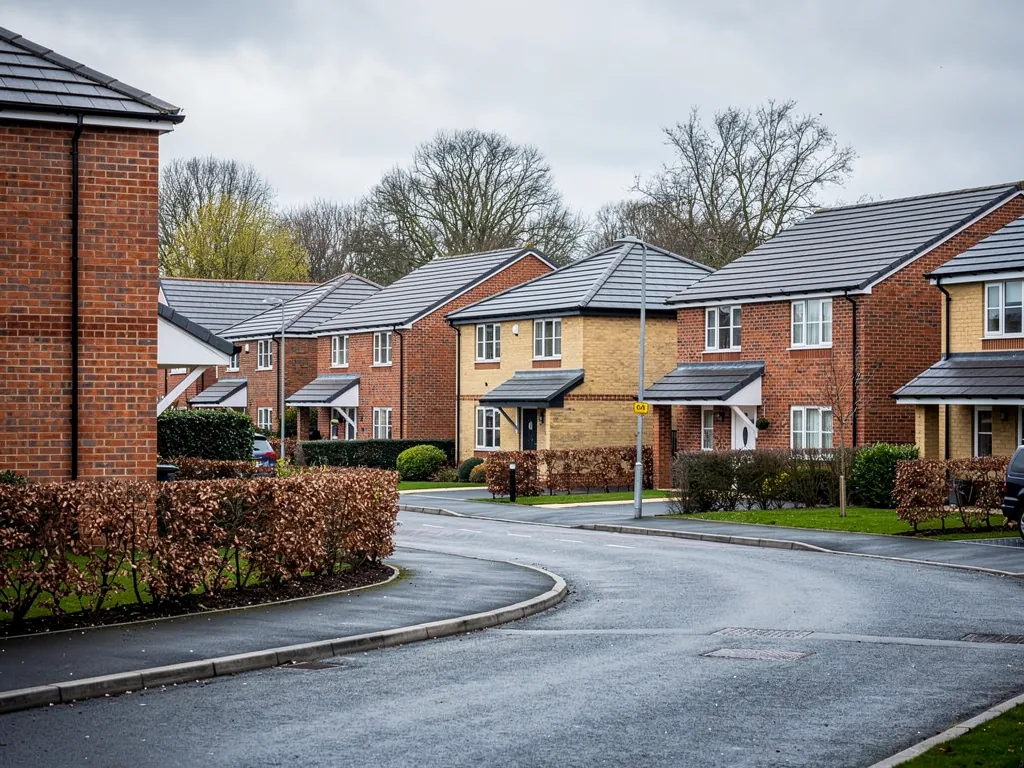
Modern 2000s brick houses with grey concrete tile roofs on a new estate near Basingstoke

The roofs of Woodley by age

  • A Hampshire village cottage of flint and brick with a steep clay plain tile roof

    Post-war family housing

    Woodley kept growing after the Second World War as industries moved in from Reading, and new housing followed that growth. Expect pitched roofs in concrete or clay interlocking tile over felt, with chimneys, small flat-roofed porches and timber fascias. At seventy years or so, the underlay, the ridge bedding and the eaves are the parts that fail first, not the main tile field.

  • 1930s semi-detached houses with hipped clay tile roofs and bay windows on a suburban road

    Aerodrome-site housing and units

    The former Woodley Aerodrome was redeveloped in the 1980s for housing and light industry, after gravel extraction in the 1960s and 1970s. The houses are generally concrete-tiled with plastic roofline, while the light industrial units carry low-pitched or flat roofs in profiled sheet, single-ply or built-up felt. Different roofs, different faults, and we price each from photographs of the roof in question.

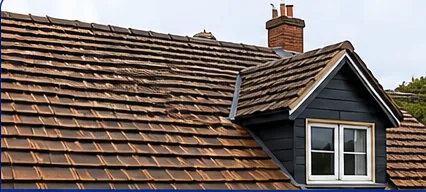
  • House roof stripped to battens during a roof replacement

    Flats and care home on Bulmershe

    The former Bulmershe campus was sold in 2013/2014 and is now a housing estate of houses, flats and a care home. Newer buildings are still roofs with weak points: flat roof terraces and parapets on the flats, lead and sealed upstands at abutments, and gutters that serve many households at once. Access, scaffold and who is responsible for what tend to shape the job more than the repair itself.

20.4 road miles north-east of Basingstoke

Planning and building control in Woodley

Woodley answers to the same borough authority as Wokingham for planning and for building control. The council lists Woodley Green among its church-centred conservation areas, and its website carries the conservation area leaflets. The Church of St John the Evangelist is Grade II* listed, so work on a roof close to Woodley Green deserves a call to the council before anything is bought, because the setting is protected as well as the buildings themselves.

Most of Woodley is outside that area: the post-war streets, the aerodrome-site estates and the Bulmershe development are ordinary building control matters. Mending or re-covering a small part of a roof usually needs no application. Taking off and replacing the whole covering is different, and the roof insulation may then need upgrading too. We handle the building control side where the work is notifiable. On a flat in a block, check the lease and the managing agent first. For a roof window, start with the skylight planning guide.

Faults on Woodley roofs, and the fixes

Woodley's roofs sit in three bands: the post-war streets that grew alongside Reading's industries, the estates and units built on the old aerodrome in the 1980s, and the newer blocks where the Bulmershe campus used to be. Each has its own typical weaknesses.

Chapter 1: The felt under the tiles of our post-war Woodley house looks black and brittle. Is the roof finished?

What we find

Underlay is the sheet laid over the rafters, beneath the battens, to catch anything that gets past the tiles. On houses built in the years of Woodley's post-war growth, that sheet is bitumen-based felt, and seventy years of loft heat and condensation have turned it dry and brittle. It cracks where it was nailed, and tears at the eaves and around the chimney, where it meets the walls.

From the loft you will see it plainly: black, flaking felt hanging between the rafters, light showing at the ridge, or nail heads with rusty streaks around them. Staining on the upper floor ceilings is often traced to the felt, not to the tiles. The concrete or clay tiles above it have often outlasted the layer meant to back them up, which is why a tile-by-tile patch rarely holds.

What we fix

Tiles in good order do not have to be thrown away because the felt has failed. We strip the roof in sections, tile by tile, stack the sound ones, fit a new breathable membrane (a vapour-open sheet that lets the loft dry out), renew the battens and relay the tiles. Broken or soft ones are replaced with matched tiles. The roof lasts for years after that, at much less than the cost of an entirely new covering.

That is a full re-cover, though, and a job on that scale is notifiable, so the building control application is something we take care of. A concrete-tile re-cover on a three-bedroom semi is reported at £6,500 to £10,500, though the real figure depends on tile choice and access at your Woodley address. If the roof is sound apart from one slope, we say so. Your fixed quote follows the survey. Details of the process are on the roof replacement page.

Chapter 2: Why are the fascias and gutters rotting on our 1980s house on the old aerodrome site?

What we find

Houses on the former aerodrome were built in the 1980s, and their rooflines often began with painted softwood fascias and basic guttering, since replaced by plastic on many of them. Either way, the eaves are where a 40-year-old roof goes wrong first. A leaking gutter joint drips onto the fascia board, and the water works behind it into the rafter feet and the soffit (the board under the overhang).

The signs are peeling paint, a soft board when you press it with a screwdriver, sagging gutter runs that hold water, and green staining on the brick below a joint. A nest in the soffit gap is a further sign that the board has opened up. Left alone, the water reaches the wall plate, the timber that carries the rafters, and the repair stops being a roofline job.

What we fix

We check the rafter feet and the wall plate first, because that decides whether this is a fascia job or something deeper. Where the damage stops at the board, we remove the old fascia, soffit and gutter, treat or replace any timber that is affected, and fit new boards with ventilated soffits and new guttering on fresh brackets set to a fall. Old gutter runs that are merely blocked are cleared and re-jointed.

Putting a whole uPVC roofline onto a semi costs between £1,800 and £3,500 in published UK guides, and a Woodley job can land either side of that. Scaffold hire is often a large share of the price on a two-storey house, so we tell you where it sits in the quote. Our rotten fascia boards guide explains what to look for.

Chapter 3: Who deals with the flat roof over our Bulmershe-area flat, and how is it repaired?

What we find

Flats built on the Bulmershe site are recent compared with the post-war streets, but a flat roof or terrace is a membrane over a deck, and every upstand, outlet and joint is a place where water can get in. On a block, a single leak can affect several homes. The common causes are a split at an upstand where the membrane meets a parapet wall, a blocked outlet that lets the roof pond, and gutters shared by neighbours.

You may see a ceiling stain in the top flat, a patch of ponding water that is still there after a dry spell, or a bubble in the membrane. In a building with a managing agent, it is worth finding out who is responsible for the roof before you call anyone, because the leaseholder usually pays through the service charge rather than directly.

What we fix

We survey the roof, photograph the failure point and give the managing agent or freeholder a written report, so that the cause is clear to everyone. Small defects, such as a split upstand or a lifted joint, are repaired with a patch or a local re-seal. If the membrane has failed over a wider area, we recommend re-covering in EPDM (a synthetic rubber membrane laid in one sheet) or GRP (fibreglass laid wet and cured hard), depending on the roof.

Per square metre, UK flat roof ranges are typically £80 to £120 in EPDM against £100 to £160 in GRP. Larger blocks are treated as commercial work. See commercial roofing and our flat roof repair or replace page.

Chapter 4: We live near Woodley Green. Can the roof be repaired in a way the council will accept?

What we find

Woodley Green is one of the council's church-centred conservation areas, and the older buildings near the church, St John the Evangelist (built in 1873 of flint with a tiled roof), keep a village look that newer streets lack. Older roofs here may be clay tile or slate, often cut around an older chimney, and the materials and the way they are laid are part of what makes the area what it is. That is also why a tile that has been replaced carelessly with a different one can stand out.

Faults on these roofs are the ordinary ones: slipped tiles, cracked pointing around the stack, moss in the lower courses and an old lead gutter that has split. Mature trees nearby mean leaves collect in valleys and gutters. What makes the work different is that the council may care about the materials we use, so the method of repair matters as much as the repair itself.

What we fix

We repair like for like. That means keeping every sound tile, replacing failed ones with reclaimed or matched tiles of the same size and colour, and keeping the original profile of the roof. Lead is renewed where it has split, and chimney pointing is done in a mortar that suits the brick. We photograph the whole roof before and after, so you have a record to put in front of the conservation officer.

If you want to change the covering, or add a roof window, ask the council before ordering anything. Our guide to roof work in a conservation area sets out how that conversation usually goes, and our roof cleaning service deals with moss by hand and biocide, never a pressure washer that strips old tiles.

Woodley roofing questions

Can a flat roof on a Woodley flat or maisonette be repaired without scaffold?

Sometimes. Low roofs can be reached by ladder or roof access and repaired locally, for example by patching a split in the felt or resealing an upstand or outlet. If the roof is high, shared, or needs a full re-cover, scaffold or a mobile platform may be needed. In a leasehold building the freeholder or managing agent may need to agree first.

Can you work on light industrial units in the aerodrome redevelopment area?

Yes. The units built there in the 1980s are commercial roofs, and we work on those as well as on houses. They are usually low-pitched or flat, in profiled sheet, single-ply or felt. We survey the roof, photograph the defects and provide a fixed quote. Our commercial roofing page describes what we handle.

Is a Bulmershe flat responsible for its own roof repairs?

It depends on the lease. In most blocks the freeholder or managing agent is responsible for the roof structure and recovers the cost through service charges, so check the lease before you book anyone. We can survey the roof and give you a photo report that you can hand to the agent, which makes the conversation easier for everyone.

Will pressure washing clear the moss from my roof in Woodley?

Usually we would not do it that way. Pressure washing can strip the surface from concrete and clay tiles and force water under the laps. Moss comes off by hand, a biocide goes on afterwards, and the gutters are cleaned in the same visit. The UK range reported for this work is £748 for a small roof up to £978 for a large one, so a Woodley roof under trees may sit near the top.

Does the River Loddon nearby make roofs here damper?

It can affect the surroundings. The Loddon flows close to the east of Woodley, and low-lying, tree-lined plots take longer to dry after rain. A shaded roof slope grows moss sooner and holds water longer, and gutters collect more leaf fall. None of that is a defect in the roof, but it does mean regular gutter clearance is worth the effort in those spots.

Get your free roof survey in Woodley

Tell us what’s happening and we’ll call you back to arrange a visit. You’ll get photos of your roof and a fixed written quote.

  • No obligation
  • Photo report of your roof
  • 10-year workmanship guarantee

Rather talk? 01256 213956

Call Free survey