
Beacon Basingstoke Roofing

Roofers in Earley

Earley is 17.9 road miles north-east of Basingstoke, on the edge of Reading, and its roofs fall into two camps: the large estates of Lower Earley, built from 1977, and a scattering of far older timber-framed houses. We survey either with photographs, then hand you a written price that holds.

Brick estate houses with concrete tile roofs among pine trees

Roofs we see in Earley

  • Slipped and cracked clay roof tiles

    Lower Earley estate houses

    Lower Earley was built from 1977 by private companies and almost doubled the population of Earley. Estate building on that scale means long runs of similar houses, typically with concrete interlocking tiles, mortar-bedded ridges, shallow-pitched garages and timber fascias. Because so many were finished within the same few years, they are reaching the same stage of wear together, and a fault on one roof is a good predictor of the street.

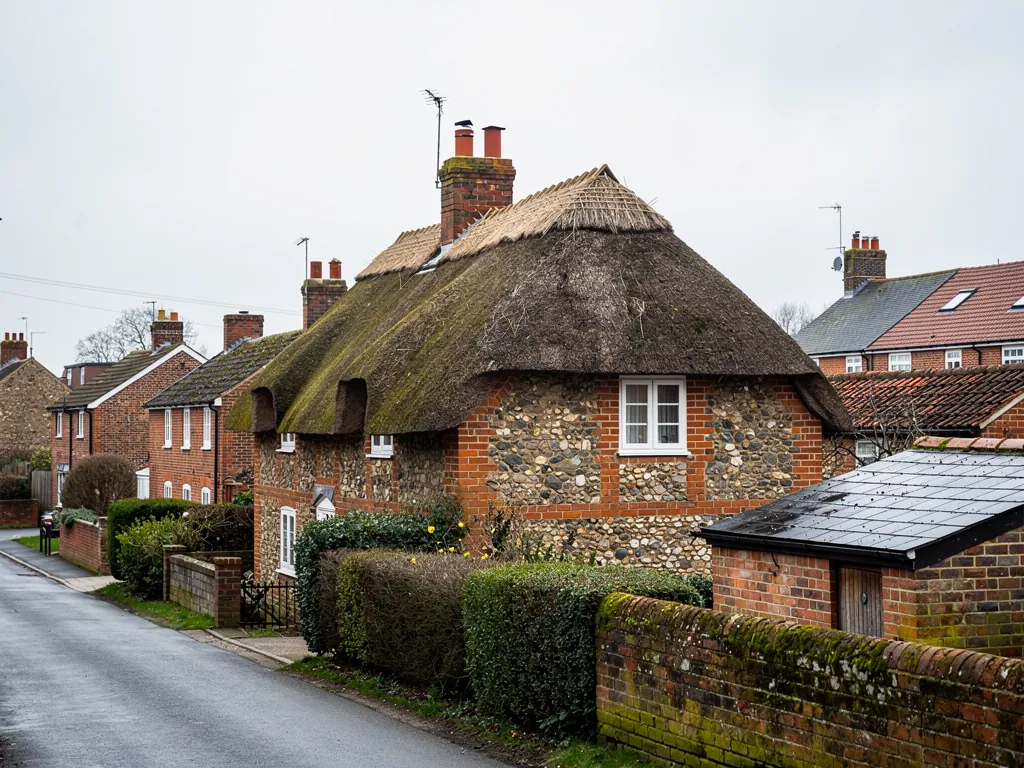
  • A thatched cottage in a Test Valley village with a brick chimney

    Timber-framed and listed houses

    Earley also has far older buildings. Rushy Mead is a late 16th-century timber-framed house and Radstock Cottage an early 17th-century timber-framed cottage, and Foxhill House in Whiteknights Park, built in 1868 of red brick in a diaper pattern, is Grade II* listed. Roofs on buildings like these call for matched materials, lime-based repairs and a careful record of what is there before anyone touches a tile.

  • Brick estate houses with concrete tile roofs among pine trees

    Roofs near the Loddon and the lakes

    The River Loddon runs along Earley's eastern edge, the boundary follows the Thames to the north-west, and Maiden Erlegh Lakes were declared a local nature reserve in 1997. Mature trees, damp air and open water nearby keep roofs and gutters wetter than on a dry ridge. Moss, leaf fall and algae staining are the commonest complaints on houses close to the water and the wooded edges.

17.9 road miles north-east of Basingstoke

Planning and building control in Earley

Earley is within Wokingham Borough Council, which deals with planning and building control for the town. Listed buildings give the clearest rules. Foxhill House is Grade II* listed, and the town's older timber-framed houses such as Rushy Mead and Radstock Cottage carry the same kind of character. On any listed house, a like-for-like repair in matching material is normally acceptable, while a change of covering, a new window opening or a different ridge detail may need listed building consent, which you apply for before the work starts.

Whether your own road falls inside a conservation area is a question for the council, and the planning pages at wokingham.gov.uk are the place to check before you order anything. On the Lower Earley estates the issue is usually building control, not planning. A partial repair rarely needs an application, but replacing the whole covering can be notifiable, and the building control paperwork is ours to deal with. If you are thinking of a roof window in a loft, read our article on skylight planning permission first.

Earley roof faults and fixes

Earley's roofs are shaped by one big decision: the late-1970s push to build Lower Earley. Those estates now make up a large share of the roofs in town, and they age together. Beside them sit rear extensions, garages and a few very old houses that need gentler handling.

Chapter 1: Is our Lower Earley roof due a re-roof, or can the tiles be kept?

What we find

Estate houses of Lower Earley's first years were typically finished with concrete interlocking tiles over bitumen-based felt, fixed to softwood battens. Concrete tiles are tough, and many of these roofs have plenty of life left in the covering. What ages faster is everything under and around it. The felt dries out and cracks where it is exposed at the eaves, the battens can soften where moisture has sat, and the mortar under the ridge shrinks away from the tile.

From the ground, a roof near the end of its working life shows tiles with a rough, eroded surface, patchy green moss that holds water in the joints, and a ridge line that no longer looks crisp. From the loft, you may see pin-prick daylight, damp felt or dark staining on the battens. A single patch of damp rarely means the whole roof has failed, which is why the loft inspection matters.

What we fix

We lift sample tiles in different places, check the battens with a probe, and look at the felt from inside. If the covering and battens are sound, repair is the better value: new ridge fixings, renewed eaves felt and a few replaced tiles. If the felt has failed over most of the slope, a strip and re-cover with new breathable underlay, new battens and either the cleaned tiles or a fresh set is the honest answer.

For a three-bed semi in concrete tile, the typical UK range for a whole re-roof is £6,500 to £10,500, and the price you receive is fixed after the survey. A job of this size is usually notifiable, so we handle building control for you. Our roof replacement page explains what a re-roof involves.

Chapter 2: Why are the ridge and verge tiles on our Earley estate house coming loose?

What we find

Estate roofs of the late 1970s and 1980s relied on mortar. The ridge tiles along the top, and the verge tiles at the gable end, were set in a sand and cement bed. Years of heat, frost and wind make that bed shrink, crack and lose its grip on the concrete. A ridge cap that is loose in its bed can lift in a gale, and verge mortar that has crumbled lets the wind get under the edge tiles.

You can spot it from the road: a ridge tile that sits crooked, a visible dark crack where the mortar meets the tile, or crumbs of grey mortar in the gutter. On a street of identical houses, it is common to see the same fault on several roofs at once. Hip tiles (the capping that runs down the angled corners of a hipped roof) are affected in the same way.

What we fix

The sound tiles are cleaned and relaid, and we change the method of fixing, because BS 5534 now requires ridge, hip and verge parts to be mechanically fixed. We use a dry-fix system, which means the cap tiles are screwed or clipped to a continuous batten laid over a breathable roll, so the roof does not depend on mortar. Dry-fix products are covered by BS 8612. Dry verge units go on at the same visit.

On a semi, a typical UK range for dry ridge work is £900 to £1,600, and scaffold, where needed, is extra at £300 to £900; the final figure follows the survey. Neighbouring houses can share scaffold, which is worth a conversation if your street is in the same condition. See dry ridge versus mortar for the comparison.

Chapter 3: How do we stop the flat roof on our Earley garage extension leaking?

What we find

Many Earley houses have a flat or very low-pitched section: a single garage, a kitchen extension at the back, an entrance canopy. Builders of that era commonly used bitumen felt on timber boarding, and felt is not meant to last for ever. Its surface blisters in the sun, the joints open, and at the wall junction the felt peels away from the brickwork. Water then runs behind it and into the boards.

Look for a spongy feel underfoot (only from a safe ladder position, never by walking on it), shallow pools that stay after rain, or a damp stain on the inside ceiling that grows after a shower. If boards are soft, they have stayed wet for some time. An old garage roof also tends to have a rusted or cracked gutter at the front edge, which adds to the dampness.

What we fix

If the boards are dry and flat, a new membrane over the existing deck is a reasonable fix. If they are soft or sagging, we replace them and form a fall to the gutter, so the roof sheds water properly. For the covering we talk through EPDM (a single-sheet synthetic rubber), GRP (fibreglass and resin that sets hard) and felt. Typical UK ranges per square metre are felt at £60 to £100, EPDM at £80 to £120 and GRP at £100 to £160.

Edge trims and wall upstands (the upturn of the membrane where it meets brickwork) get the most attention, because that is where most leaks start. We also check the insulation, since replacing a membrane can trigger an upgrade under Approved Document L. Our flat roofing page lists the choices in more detail, and every price comes from your survey.

Chapter 4: Why is moss and green staining spreading on roofs near the Loddon and Maiden Erlegh Lakes?

What we find

Moss and algae need three things: moisture, shade and a surface that holds on to both. Houses near the River Loddon and the Maiden Erlegh Lakes sit in damper air, with mature trees close by, and a north-facing slope there can stay damp for most of the day. Concrete tiles are slightly rough, which suits moss, and the moss then packs into the overlap between tiles where it keeps water in contact with the surface.

It also washes into the gutters. A gutter blocked with moss and leaf litter overflows, and the water soaks the fascia and runs down the wall. On the roof itself, a thick moss mat that lifts the tiles can let wind-driven rain pass beneath them. Pale green or black streaks on the tile faces are algae, which looks poor but does less damage than thick moss.

What we fix

We remove the moss by hand with scrapers and brushes, then apply a biocide that kills what is left and slows regrowth. We avoid pressure washing, which can strip the surface from concrete tiles, force water under the laps and shorten the life of the tile. The gutters are cleared at the same visit, the downpipes tested with water, and any sagging runs are reset to a proper fall.

Typical UK costs reported for hand removal with biocide come to £748, £863 or £978 for a small, average or large roof, and our written price follows the survey. Lopping an overhanging branch can slow moss regrowth more than anything we apply, so we mention that if we see one. See roof cleaning for the methods we use.

Earley roofing questions

Why is there moss along the north side of the roof on our Lower Earley house?

The north slope gets the least sun, so it stays damp longer and moss takes hold. Moss holds water against concrete tiles and can lift them at the edges. Light moss can be brushed off by hand. If the tiles are breaking down or the roof sits beneath trees, we look at whether the battens and felt beneath are still sound before suggesting treatment.

Our Lower Earley house is about forty years old. Will the roof need replacing soon?

Not automatically. Lower Earley was built from 1977, and concrete tiles from that time are often still serviceable. The felt, the ridge mortar and the fascias are what wear first. We check them from the loft and the ladder, and if the main roof still has years left, we tell you so and price the repair.

Can you work on a listed house in Earley?

Yes, with care. Foxhill House in Whiteknights Park is Grade II* listed, and other older houses in Earley are protected too. Changes to materials or appearance usually need consent from Wokingham Borough Council before work begins. We record the roof in photographs, suggest like-for-like repairs, and give you a survey report to take to the conservation officer.

Is a roof window possible on an Earley estate house?

Often, yes, particularly where a loft is already used for storage. The key points are headroom, the structure of the rafters and how the window is flashed into concrete tiles. Read our loft conversion roof windows guide, then call us to talk through your own roof.

What should I do about bats or nesting birds in an old Earley roof?

Both are protected, so tell us if you have seen either. Older timber-framed roofs and houses near the lakes and river are the likeliest places for them. Work may need to be timed around nesting, or a survey carried out first. We build that into the plan before starting, so nothing is disturbed and the job is not held up later.

Get your free roof survey in Earley

Tell us what’s happening and we’ll call you back to arrange a visit. You’ll get photos of your roof and a fixed written quote.

  • No obligation
  • Photo report of your roof
  • 10-year workmanship guarantee

Rather talk? 01256 213956

Call Free survey