


Chapter 1: Why is the ridge on our Thatcham estate house shedding mortar?
What we find
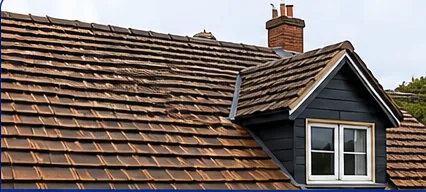
On houses built as part of the town's post-war expansion, the ridge tiles were bedded on sand and cement mortar, as was normal at the time. After decades of frost and sun, the mortar shrinks, cracks and parts from the tiles. Then wind gets under the ridge, and one or two tiles may rock or drop. You may find grit in the gutters, a ridge line that no longer looks straight, or a tile resting on the lawn after a storm.
Estates were built in runs, so neighbouring roofs show similar symptoms at a similar stage. The same goes for the verge, the sloping edge at the gable end, where mortar holds the end tiles and the bargeboard (the board that finishes the roof edge) in place. Failures here let wind driven rain in at the edges of the roof, and the first sign indoors is often a damp patch high on a gable-end bedroom wall.
What we fix
A few ridge tiles come off first, so we can tell whether the tiles themselves are good and only the bedding has let go, which is usual at this age. Current standard BS 5534:2014 expects mechanical fixing for the ridge, hips and verges, with mortar no longer carrying the load alone. Our usual answer is a dry-fix ridge, with tiles clipped or screwed down to a continuous batten, a type of system that BS 8612:2018 covers.
A published cost guide gives a dry ridge on a semi as £900 to £1,600 with scaffold extra, and the figure we give you comes from the survey. If you want to read more, see our ridge tile repairs page.
