


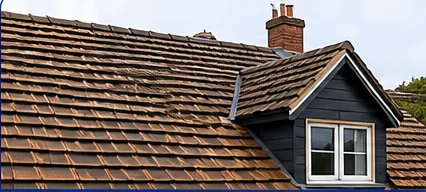
Chapter 1: Why does the wind keep lifting tiles on our house on the Baughurst ridge?
What we find
A house on a ridge has no shelter, and the wind that crosses it speeds up as it rises over the roof. That creates suction on the leeward slope and uplift along the edges, which is why the tiles that go first are the ones at the verge, the ridge and the eaves. If tiles are held only by their own weight and a single clip, or were laid on old and brittle battens, a bad gale will shift them.
From the garden, look for a tile standing proud of its row, a ridge tile that has slid sideways, or a verge where the cement has cracked away. Inside the loft, daylight along the gable wall is a clue, and so is a rattle on windy nights. Neighbouring houses on the ridge usually show the same fault in a similar place.
What we fix
We start by checking the battens, the timber strips the tiles hang from, because tiles fixed to rotten battens will not hold however well they are clipped. Sound battens stay, weak ones are replaced, and loose tiles are fixed with a clip and, on exposed edges, a nail or screw to every tile in the outer courses. That follows the principle in BS 5534 that exposed tiles should be mechanically fixed.
The ridge and verges are dealt with by dry-fix systems rather than mortar, covered by BS 8612. A dry ridge on a semi typically costs between £900 and £1,600, plus scaffold (£300 to £900 extra). Your fixed quote follows the survey. The options for the top of the roof are on ridge tile repairs, and pitched roofing covers whole-roof work.
