Beacon Basingstoke Roofing

Roofers in Kintbury

Kintbury is 25.8 road miles north-west of Basingstoke, in West Berkshire, with the Kennet and Avon Canal running through the village at Kintbury Lock and the North Wessex Downs all around it. It is towards the outer edge of our patch, and we still survey your roof with photographs, and the price that follows is fixed.

House roof stripped to battens during a roof replacement

Roofs we see in Kintbury

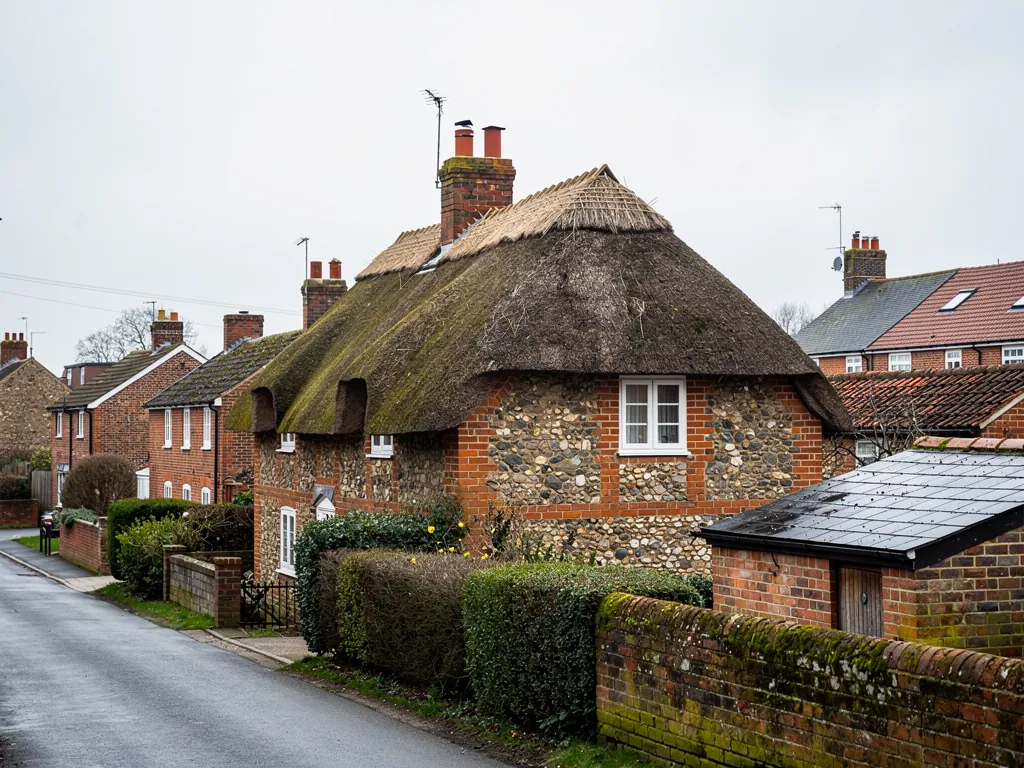
  • A thatched cottage in a Test Valley village with a brick chimney

    Canalside houses and heavy tree cover

    Close to the Kennet and Avon Canal the ground stays damp and the trees are tall, and roofs under that canopy dry slowly after rain. Moss and algae settle on the north slopes first, leaves pack the valleys and gutters, and fascia boards behind the gutters take the overflow. These are not dramatic faults, but left alone for a few winters they turn into rotten timber and blocked outlets.

  • Brick estate houses with concrete tile roofs among pine trees

    Older cottages in the conservation area

    Kintbury Conservation Area was designated by West Berkshire in 1970, so it is long established, and the older houses inside it deserve like-for-like treatment. On cottages of this kind we usually meet plain clay tile or natural slate, brick stacks with lead flashings, and the occasional timber-framed range. We confirm the actual material at the survey, because every house differs, and repair is nearly always the better first answer.

  • Brick chimney stack with clay pots

    Homes near the railway station

    Kintbury station has local services from Reading and Newbury to Bedwyn, so the village works as a base for commuters. Newer houses and extensions bring their own roof types: concrete-tiled pitched roofs, flat-roofed kitchen and garage additions, and loft rooms with roof windows. The usual faults there are tired flat-roof coverings, failed flashings where an extension meets the old wall, and worn ridge fixings.

25.8 road miles north-west of Basingstoke

Planning and building control in Kintbury

The county line matters here. West Berkshire Council, not Basingstoke and Deane, decides planning applications and runs building control for the village. Its conservation pages are on the West Berkshire Council website. Kintbury Conservation Area was designated in 1970, and the whole village lies within the North Wessex Downs AONB, which runs from the Thames at Streatley to west Wiltshire. If your house stands in the conservation area, treat the setting as part of the brief before any roof work starts.

Like-for-like repair inside a conservation area is normally straightforward, clay for clay and slate for slate. Changing the covering or the appearance of a roof can need consent, so check with the conservation officer at West Berkshire before you buy materials. Elsewhere in the village the question is usually building control: smaller repairs and re-coverings usually need no building control application, while larger ones do, and we handle the paperwork when they do. For roof windows, our roof window planning guide covers the rules, and they tighten inside a conservation area.

Faults we deal with on Kintbury roofs

Kintbury's roofs deal with a damp valley setting, plenty of trees and a mix of old cottages and later commuter homes. That combination produces a fairly steady list of faults: shaded roofs that stay green, gutters that overflow under the branches, storm damage on exposed slopes and ageing lead around chimneys.

Chapter 1: Why does moss keep returning to the tiles of our canalside home in Kintbury?

What we find

Moss needs moisture, shade and a surface to grip, and a roof close to the Kennet and Avon Canal and under mature trees offers all three. The north-facing slope, which gets the least sun, usually goes first. Spores settle in the rough surface of a concrete or clay tile, hold water like a sponge, and by the following winter the green layer is thick enough to lift the edges of the tiles and fill the joints between them.

It matters beyond appearance. A mat of moss keeps the tile damp, and on a frosty night that moisture freezes and flakes the face of older clay. Loose moss washes into the gutters and blocks the outlets, so water then backs up under the bottom course. From the garden, look for dark green or black patches, lichen crusts and a roof that looks shaggy along the eaves.

What we fix

We clear moss by hand with brushes and scrapers, then treat the surface with a biocide that goes on killing the growth for months afterwards. We do not pressure wash tiles by default, because a jet can strip the protective surface from concrete and drive water under the laps. We empty the gutters before leaving and check the roof for cracked or slipped tiles.

Cost guides report hand removal plus biocide at about £748 for a small roof, up to £978 for a large one, with £863 in between; your fixed quote follows the survey. Where overhanging branches are the cause, we suggest cutting back, because treatment alone buys a few years in deep shade. Our roof cleaning page explains the methods.

Chapter 2: Why are our gutters overflowing and the fascia boards going soft under the trees in Kintbury?

What we find

Trees drop leaves, seeds, twigs and pollen, and in a village with a lot of tall planting the gutters are the first thing to clog. A gutter full of debris cannot carry a heavy downpour, so water spills over the front edge or down the back, behind the gutter and onto the fascia, the timber along the eaves that the gutter hangs from. If that board stays wet, it softens, the paint blisters and fixings pull out.

The signs are green stripes down the wall below the gutter, water streaming over the edge in rain, plants growing in the gutter itself, and fascia paint that cracks and flakes. A sagging run of gutter often means the brackets have lost their grip in rotten wood, so the problem is the board, not the plastic.

What we fix

First we clear the gutters and downpipes and check the falls, the slight slope that carries water to the outlet. If the fascia is sound under the paint, brackets can be re-fixed at the right spacing and the joints resealed. If the board has rotted, it is replaced, and any soffit, the board under the eaves, that is wet or damaged goes with it, so you do not end up with the same job again in three years.

On a tree-lined plot we often suggest wider outlets or a gutter guard, depending on the leaf type. A gutter guard does not remove the need to clear it, but it can cut the frequency. The work is described on our guttering, soffits and fascias page, and the rotten fascia boards guide shows what a failing board looks like.

Chapter 3: Wind has lifted tiles on our Kintbury house in a storm. What happens next?

What we find

Open ground and downland edges make storm damage a real possibility around the village. Wind gets under the edges of the roof first: the ridge, the hips and the verge at the gable end. Tiles that were bedded in old mortar or nailed with rusting fixings can lift, rock or leave the roof altogether, and the underlay beneath may be torn.

After a storm, the evidence is usually on the lawn: broken tile pieces, a section of ridge, a detached barge board. Indoors, a drip into the loft or a stain spreading on a ceiling shows the water has found its way past the tiles. Do not climb up to look, because wet tiles are slippery and loose ones fall.

What we fix

We prioritise emergency calls, and our first job is to make the roof safe: a temporary cover over the opening, loose tiles secured, and water kept out of the house. Then we photograph the damage and give you a fixed quote for the lasting repair. If an insurance claim is in the picture, those photographs are useful evidence.

The permanent fix depends on what failed. Lost tiles are replaced with matching ones, and torn underlay is renewed. Ridge and verge components are mechanically fixed, because BS 5534 no longer relies on mortar alone. Your fixed quote follows the survey. UK cost guides report £900 to £1,600 for dry-fix ridge work on a semi, with scaffold on top. Our storm damage guide explains the steps.

Chapter 4: Is it worth repairing the lead around the chimney on our older Kintbury cottage?

What we find

On older cottages in the conservation area, the chimney stack is often the one place where lead is doing the work of keeping weather out. The lead flashing seals the joint where the stack meets the roof, and the soakers, small lead pieces interleaved with tiles or slates, make the side joints watertight. Over time lead stretches and cracks from repeated heating and cooling, and the mortar that holds it into the brickwork falls out.

A leak at a stack looks like a damp patch on the chimney breast or a ceiling stain in the room beside it. Because the water follows the brickwork down, the stain may be a long way from the real fault. Crumbling pointing, a cracked flaunching and tilted pots are all signs that the stack as a whole deserves attention.

What we fix

We photograph the stack from above, then decide between repair and renewal. Where the lead is mostly sound and only a joint has lifted, a local repair is fair value. Where it has cracked across a flashing, we fit new lead cut to the tile gauge, with fresh soakers and mortar-free fixing where we can. Repointing is done in a lime mortar that suits older brick.

Reported UK figures for redoing chimney leadwork span £350 to £920. For a house is in the conservation area, we keep to like-for-like materials so the roof keeps its character. See our chimney repairs page and the guide to soakers and step flashing.

Kintbury roofing questions

Does the North Wessex Downs AONB limit the roof materials I can use in Kintbury?

The AONB label mostly bears on larger development. For a house roof, the conservation area designation of 1970 and any listing are what usually decide materials. Like-for-like repairs are normally straightforward, but a different material may need permission, so ask West Berkshire's planning team before you commit. We can describe the existing covering in the survey report.

Which council do I speak to about roof work in Kintbury, West Berkshire or Basingstoke?

West Berkshire Council. Kintbury is in Berkshire, so planning permission, conservation area questions and building control all go through West Berkshire's teams, not Basingstoke and Deane. Check with its planning team before work on a conservation area house, and tell us what they say. We deal with the building control side of notifiable jobs for you.

Will bats or birds near the canal and Newt Ponds hold up a roof job?

They might. Kintbury Newt Ponds is a local nature reserve, and a Site of Special Scientific Interest lies on the parish's south-eastern border, so wildlife is active in the area. Legal protection covers bats and nesting birds alike, and old roofs, soffits and chimneys suit them, so the timing of work may change or a survey may be required. We look for signs at the survey stage.

Can you work on a house with tight access off a canal lane?

Usually, yes, but we plan it before the quote. Narrow lanes, towpath routes and tight gardens affect where scaffold goes, how materials arrive and how waste leaves. We note access at the survey and build it into the fixed price so there is no surprise on the day. The site is cleared and waste taken away when we finish.

Is it better to repair or replace a tiled roof that is green with moss?

Often a clean and a few repairs will do. Moss looks worse than it is, and a roof that has stayed sound under it may have years left. What decides it is the condition of the tiles, battens and underlay beneath. We lift a few tiles and check from the loft, then tell you honestly if the roof has years left in it or is at the end.

Get your free roof survey in Kintbury

Tell us what’s happening and we’ll call you back to arrange a visit. You’ll get photos of your roof and a fixed written quote.

  • No obligation
  • Photo report of your roof
  • 10-year workmanship guarantee

Rather talk? 01256 213956

Call Free survey