Beacon Basingstoke Roofing

Roofers in North Warnborough

North Warnborough lies 8.2 road miles east of Basingstoke, with the River Whitewater and the Basingstoke Canal both running through the village. Its roofs run from medieval timber-framed cottages in a protected conservation area to post-war houses beyond it. We go up, photograph what is failing, and send the pictures with a price that stays fixed.

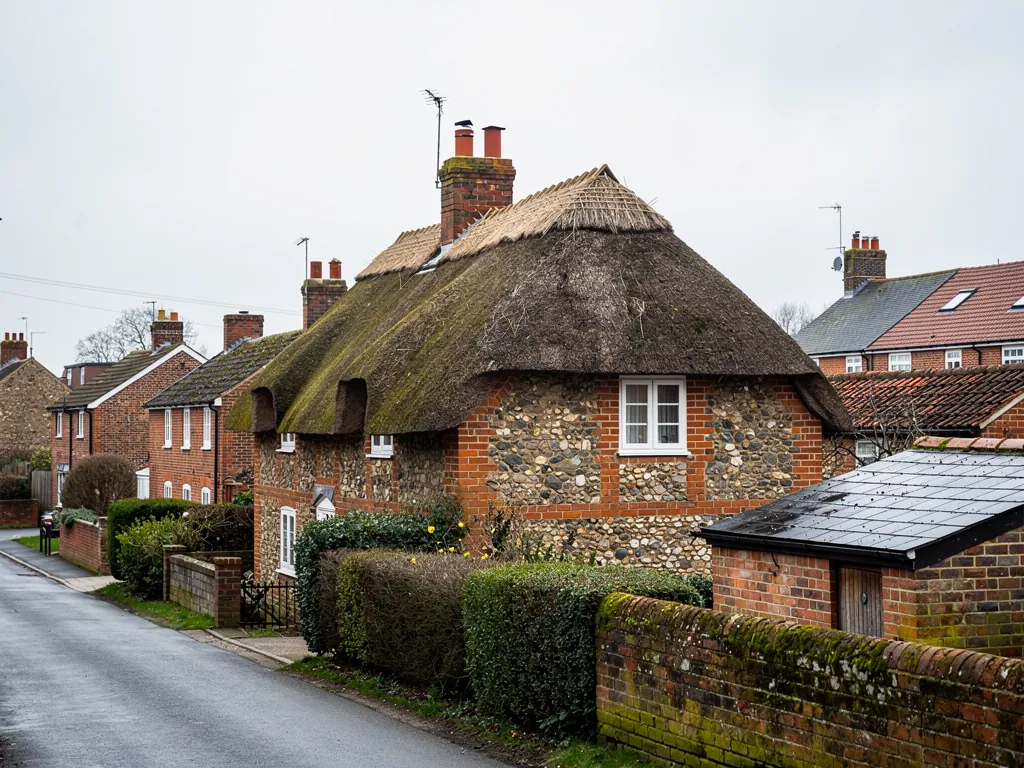
A thatched cottage in a Test Valley village with a brick chimney

Roofs we see in North Warnborough

  • Slipped and cracked clay roof tiles

    Medieval cottages in the village core

    Cruck Cottage has timbers dated to 1383 and 1384, and it shares the conservation area with the rest of the village's listed buildings. Crucks are pairs of curved oak blades that rise from the ground to meet at the ridge. Where frames like these carry a tiled roof, the tiles and laths have to be light enough for ancient timbers to carry, so any repair is a matter of care rather than speed.

  • A thatched cottage in a Test Valley village with a brick chimney

    Listed houses in the conservation area

    All 40 of the village's listed buildings stand inside the conservation area, which runs from Mill Corner in the north down to The Street. That means most of the oldest roofs are protected, and a plain-looking repair can still need the council's agreement. We record each roof in photographs before we propose anything, so you have a clear file to take to the conservation officer.

  • Brick estate houses with concrete tile roofs among pine trees

    Post-war estates such as Old Orchard

    Beyond the conservation boundary, houses such as those at Old Orchard were built after the war, and houses of that generation were commonly given concrete tiles, mortar-bedded ridges and timber boards along the eaves. They are a different job altogether: age shows first at the ridge, the verge and the felt underneath, while the tile faces usually carry on for years.

8.2 road miles east of Basingstoke

Planning and building control in North Warnborough

The planning authority here is Hart District Council, not Basingstoke and Deane, and building control sits with Hart too, even though we travel out from Basingstoke. The conservation area was designated in 1978 and is now covered by a joint appraisal with neighbouring Odiham, which you can read as a PDF on the Hart District Council site. Every one of the village's 40 listed buildings sits within it, so a large share of the old roofs carry both designations at once.

Repair in matching materials, using the same tile or lead as before, is generally acceptable. Changing the material, the colour or the profile may need consent, and so may alterations to a chimney, so speak to Hart's conservation officer before you order anything. On the post-war streets outside the boundary, the question is more often building control: stripping and re-covering a whole roof can be notifiable, and we take care of the notification. For a rooflight in a protected roof, start with our guide to conservation rooflights.

What we find on North Warnborough roofs

Two very different kinds of housing share this one village. In the older streets the roofs carry centuries of repairs, tile on top of tile, with oak frames that dislike damp. Out past the conservation boundary the houses are a few generations old and fail in the usual post-war ways.

Chapter 1: How careful must a repair be on a cottage whose roof timbers date from the 1380s?

What we find

Cruck Cottage shows how old the frames here can be, with oak timbers dated to 1383 and 1384. An old oak roof is not built like a modern one. Rafters may be irregular, laths may be split oak, and the roof has moved with the frame for centuries, so the tiles sit in gentle waves and are rarely flat to a straight edge.

The danger on such a roof is not age as such but water. A slipped tile that lets rain through for several winters wets the oak, and soft rot starts at the point where a timber meets the wall. Brown stains on a ceiling, a damp smell in the roof space, or a patch of green on the inside face of a gable are signs worth acting on early.

What we fix

We begin by looking from inside, with a torch and a moisture meter, before anyone steps on the tiles. Many problems here can be mended from the outside by lifting a small area, replacing the damaged laths, and putting the same tiles back in their original courses. Tiles that have broken are replaced with reclaimed ones that suit the colour and the curve.

We avoid piling new weight onto an old frame, and we do not seal the roof tight with modern membranes that stop it breathing. Any timber that has gone soft is reported to you with photographs, before decisions are made about cutting it out. Because the building is probably listed, the consent question comes first, and our survey pictures give the conservation officer something concrete to look at.

Chapter 2: The lead round our North Warnborough chimney is leaking. Can it be repaired in keeping with the old brickwork?

What we find

Older chimneys in the village are brick, often laid in lime mortar that is softer than the brick itself, and they sit at the top of roofs that have been patched many times. Where the stack meets the tiles, water is kept out by lead: a flashing (the strip sealing stack to roof) and soakers (small lead pieces interleaved with tiles up each side). Old lead splits where it has been bent back and forth by temperature changes, and the sealant that someone once smeared along the top edge has often given up too.

Inside, the stain usually appears on the chimney breast or on the ceiling beside it, and it gets worse after wind-driven rain from one direction. Powdery mortar at the base of the stack suggests the pointing needs attention in the same visit.

What we fix

We cut out failed flashings and fit new lead cut to the tile gauge, with the top edge set into a raked-out mortar joint instead of being stuck on with sealant. Soakers go in as the tiles are relaid, so each course sheds water onto the course below. Repointing is done in lime to match the existing joints, because modern cement is harder than old brick and makes the faces spall.

Your fixed quote follows the survey, but for orientation, replacing the leadwork on a chimney is reported at £350 to £920, averaging about £570. Our chimney repairs page and the lead roofing guide explain the choices in more detail.

Chapter 3: Why is the ridge crumbling on our Old Orchard style post-war house?

What we find

Post-war houses of this generation outside the conservation area were commonly roofed in concrete interlocking tiles with a ridge bedded in mortar. A ridge (the line of capping tiles along the top) gets the worst of sun, frost and wind, and mortar here has been cycling through freeze and thaw for several decades. It shrinks, cracks and pulls away from the tile, leaving the cap loose and a gap for rain.

The first sign is often pale crumbs on a path or in the gutter, or a ridge tile slightly out of line. The same ageing shows at the verge, where the roof finishes at a gable wall, and at the eaves, where the original felt can tear. Neighbouring houses built in the same run usually show the fault at roughly the same stage.

What we fix

We take off a few ridge tiles to see what is underneath. Sound tiles are reused, but the standard BS 5534:2014 requires mechanical fixing for ridges, hips and verges, so we replace the mortar bed with a dry-fix system: a batten, a breathable roll and clips or screws holding each cap. Dry-fix systems are covered by BS 8612:2018. Gable edges can be finished with dry verge units in the same visit.

If the underlay has failed over a wide area, patching stops making sense and we say so. For scale, re-roofing a three-bedroom semi in concrete tile is reported at £6,500 to £10,500, though your fixed quote follows the survey. Work of that size is notifiable, so we handle building control. See ridge tile repairs for the lighter option.

Chapter 4: Does living between the river and the canal make roofs in North Warnborough go green faster?

What we find

The River Whitewater and the Basingstoke Canal both run through the village, and low, damp ground with mature trees beside the water keeps shaded roofs wet long after the rain stops. Moss and algae follow. Moss holds water against the tile, packs into the laps between tiles, and in winter freezing water in the moss can lift and flake the surface of older tiles.

The runoff goes to the gutters, and leaf litter from trees overhanging the banks does the rest, blocking outlets until the channel overflows down the wall. Look for green growth on the north slopes, green streaks beneath the eaves, and gutters with plants growing from them.

What we fix

We remove moss by hand and treat the tiles with a biocide, and we avoid blasting with a high-pressure jet because it can strip the surface from older clay and concrete and drive water under the laps. Gutters get cleared during the same call, and downpipes are flushed to make sure the water leaves the building. Branches that brush the roof are best cut back by a tree surgeon, and you may need the council's permission if the tree is protected.

Reported prices for hand moss removal with biocide run from £748 for a small roof to £978 for a large one. The method and the aftercare are set out on our roof cleaning page.

North Warnborough roofing questions

I live in the North Warnborough conservation area. Can I replace my roof tiles with whatever I like?

Not necessarily. Like-for-like repairs are usually acceptable, but a different material or finish may need permission first. The village has a conservation area with 40 listed buildings inside it, so the council takes care over appearance. Check with Hart District Council's conservation team before you choose a different tile. The 1383-84 dated timbers of Cruck Cottage show how old some of the frames under these roofs are, and the roof over them should be treated with care.

Is our North Warnborough house inside the conservation area?

Check on Hart District Council's website, which publishes the joint Odiham and North Warnborough appraisal and its map. The boundary runs from Mill Corner in the north to The Street in the south. Houses such as those at Old Orchard were built outside it. Inside the line, assume that changes to roof materials need discussion with the conservation officer.

Can you repair a listed cottage roof near Odiham Castle?

Yes, on a like-for-like basis. The castle ruins beside the canal, begun by 1207, are a reminder of how old this stretch of the village is, and the cottages nearby deserve the same respect. We photograph the roof, recommend matched reclaimed tile and traditional lead, and give you a report to send to the conservation officer. Bats and nesting birds are protected, which may affect timing.

How do we know whether the roof needs patching or replacing?

We look at the underlay and battens from inside the loft and lift a handful of tiles. A roof with sound battens and a few slipped tiles gets a repair. If the timbers are wet along a whole slope or the felt has perished, a re-cover is the honest answer. Either way, your written quote carries a 10-year guarantee on the workmanship.

Can the roof windows in a North Warnborough loft conversion be changed?

It depends where the house stands. Outside the conservation area, replacing a roof window like for like is usually simple. Inside it, the size, the frame and the glazing may all be questioned. Our roof window building regulations guide covers what building control looks at, and Hart's planning team can confirm the rest.

Get your free roof survey in North Warnborough

Tell us what’s happening and we’ll call you back to arrange a visit. You’ll get photos of your roof and a fixed written quote.

  • No obligation
  • Photo report of your roof
  • 10-year workmanship guarantee

Rather talk? 01256 213956

Call Free survey