
Beacon Basingstoke Roofing

Roofers in Finchampstead

Finchampstead lies 15.8 road miles north-east of Basingstoke, a wooded Berkshire village of Norman church, Restoration brick and pine-fringed lanes running toward the old Windsor Forest. Many of its roofs sit under trees or on sloping ground. We photograph your own roof first, then send a quote with the price fixed on paper.

Roofer fitting roof tiles on a brick house near Basingstoke

Roofs we see in Finchampstead

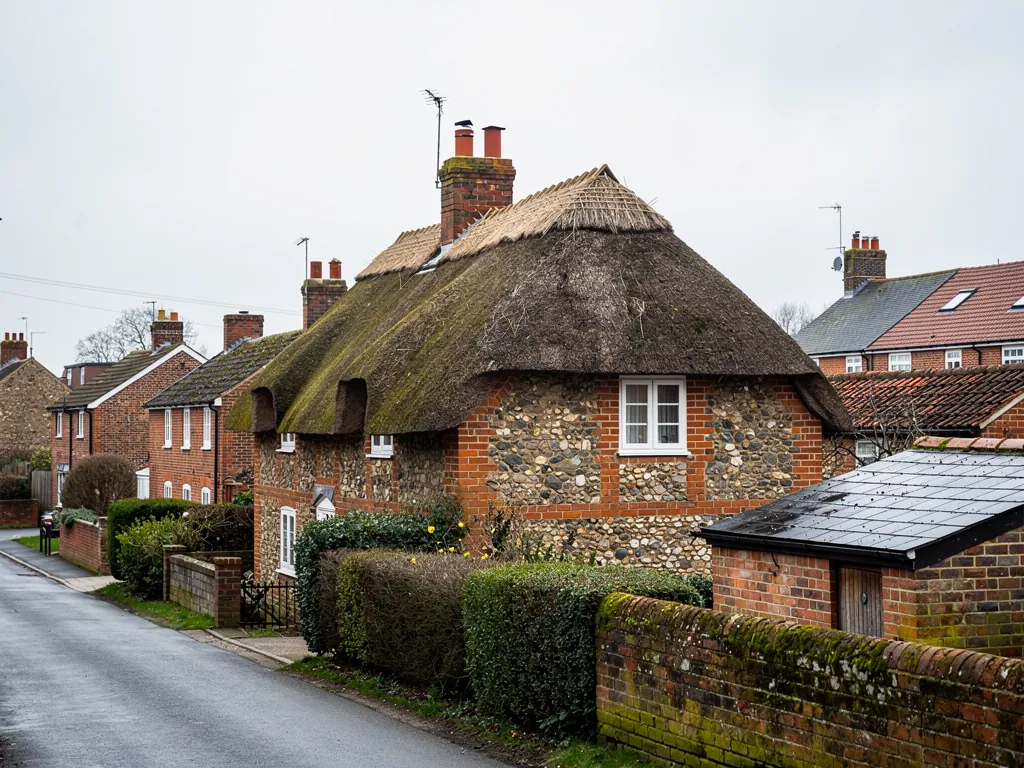
  • A thatched cottage in a Test Valley village with a brick chimney

    Old brick houses and brick towers

    The village has some very old buildings. St James' church is almost entirely Norman with a brick tower added in 1720, and Banisters, on the lower slopes of Fleet Hill, is a brick house dated 1683. Roofs of that age typically carry hand-made plain tiles, lime mortar and lead details that need like-for-like repair, and a roofer who looks before lifting anything.

  • Brick estate houses with concrete tile roofs among pine trees

    Roofs under pine and oak canopy

    Finchampstead is richly wooded, on the western edge of old Windsor Forest, and The Ridges are pine woodland. Houses near the trees spend much of the year in shade, so tile faces stay damp, moss builds up on the north slopes, and needles and leaf litter pack into valleys and gutters. The roof covering is rarely the first thing to fail; the drainage is.

  • Brick chimney stack with clay pots

    Later estate houses and extensions

    Around the older village centre, newer houses stand in cul-de-sacs and along the lanes, many under concrete interlocking tile with a flat-roofed garage, porch or kitchen extension tacked on. Those flat roofs, usually bitumen felt or an early rubber membrane, age faster than the pitched slopes beside them, and they are where we are most often asked to find a leak.

15.8 road miles north-east of Basingstoke

Planning and building control in Finchampstead

For anything to do with permissions on a Finchampstead roof, the first call is Wokingham Borough Council, which covers both planning and building control. The council lists Finchampstead among its church-centred conservation areas, and its published conservation material is on the Wokingham Borough Council website. If your house is near St James' church, on the hill inside the old earthwork, assume the rules are stricter and check the boundary with the council before you order anything.

Inside a conservation area, repairing like for like is normally fine: the same plain clay tile, the same lead, the same lime mortar. Switching to a different covering, or changing how the roof looks from the road, may need consent, and a listed house needs the council's conservation officer involved from the start. Outside the conservation area, the question is usually building control. A strip and re-cover that is large enough can be notifiable, and the paperwork with building control is ours to sort out. If you want a roof window, read our planning guide for skylights before choosing a position.

What we find on Finchampstead roofs

A woodland village makes its own demands on a roof. Shade, falling debris and damp air matter as much here as the age of the house, and the oldest buildings add a layer of heritage care on top.

Chapter 1: Why is my Finchampstead roof so green and mossy under the pines?

What we find

A tile roof with trees on its north side can stay wet for days after every shower. Moss and algae spread across the shaded slopes, and the moss holds water against the tile like a sponge. On concrete tiles, that water works into the surface over winters of frost, and the tile face starts to flake. Moss also packs into the gaps where one tile overlaps the next, which lets rain creep sideways under the lap.

Pine needles make it worse. They collect in valleys (the internal channels where two roof slopes meet) and along the back of a chimney, where they sit as a damp mat, rot down and block the flow. In the loft, a patch of darker, stained timber under a valley is the usual sign that the water has already found a way through.

What we fix

We clear the roof by hand, brushing off the moss and applying a biocide wash, because pressure washing can strip the protective surface from concrete tile and force water under the laps. Valleys are cleaned out and checked for pinholes, and any valley lining that has gone soft is replaced. We clear the gutters on the same visit, since the same debris is feeding both.

Where trees overhang the roof, we suggest the owner talks to the tree's owner or a tree surgeon about cutting back. Nesting birds and bats are protected, so lopping may need careful timing. Our roof cleaning service explains how a clean is done, and reported UK figures for a hand clean with biocide treatment range from £748 to £978 by roof size; we quote a fixed price after the survey.

Chapter 2: Can the roof on a very old brick house in Finchampstead be repaired instead of replaced?

What we find

Houses from the 1600s and 1700s, such as the brick buildings that give the village its character, were typically roofed with small handmade clay tiles hung on timber laths. Tiles of that age are uneven and porous, and over centuries the pegs or nails that hold them rot or corrode. The usual symptom is a tile slipping out of its course, then a second one beside it, because the load shifts onto the neighbours.

Around the chimney, lead flashings (the strips that seal the joint between stack and slope) fatigue and split. Old brick stacks laid in soft lime mortar are also prone to losing joints. Inside the loft, you often see hand-sawn rafters, sagging between purlins, which tells us how much weight the structure can reasonably carry before we plan any work.

What we fix

Repair is the right starting point. We strip only the area that has failed, set aside every sound tile, and make up the gaps with reclaimed or handmade plain tiles picked to suit the shade and curve of the originals. New battens (the timber strips the tiles hook over) go in under the stripped patch, and the tiles are fixed with stainless or copper nails, not the iron originals.

Chimneys get new lead flashings, and repointing is done in lime mortar so that the soft brick is not trapped behind a harder cement mix that makes the face spall. Because a change of material on an old house may need consent, we photograph the whole roof and talk through the options with you before you contact the council. Our chimney repairs page sets out how that work runs.

Chapter 3: Why do the leaves and needles keep blocking our gutters on a Finchampstead lane?

What we find

Oak, beech and pine all drop debris at different times of year, and a house backing onto The Ridges or standing along a wooded lane takes it nearly year-round. Leaves wash into the gutter and settle at the outlets, where the downpipe begins. Pine needles are thin enough to slip through the guard on a gutter and then knit together into a plug. Once the outlet is blocked, the gutter fills, overflows over the front edge, and runs down the wall behind it.

The cost is often hidden. A gutter that is always full holds weight on its brackets, which bend, and the fascia board behind it (the board along the eaves that carries the gutter) stays wet and can rot. A green streak on the wall under a joint, or a drip from the middle of a gutter run, means the outlet or the joint is failing.

What we fix

We clear the full run, flush the downpipes and check every joint and bracket. Sagging sections are re-set to a fall toward the outlet, joints are resealed or the section replaced, and any fascia that has gone soft is cut out and renewed with new timber or cladding. Where the trees cannot be moved, a leaf guard on the outlet or a mesh over the gutter helps, though it still needs an occasional clean.

On a house that has had a lot of water down the wall, we also look at the brickwork and the eaves tiles for staining and rot. Typical UK prices reported to replace the whole roofline in uPVC on a semi sit between £1,800 and £3,500, and the fixed quote only comes once we have surveyed. See our guttering, soffits and fascias page for how we approach the job.

Chapter 4: What is wrong with the flat roof on our garage or extension in Finchampstead?

What we find

Many Finchampstead houses carry a flat roof somewhere: a garage, a rear kitchen extension, a porch. Most were finished in bitumen felt, laid in layers over a timber deck. Felt in a shaded garden has a harder life than on an open site. Leaf litter sits on it, the surface stays damp, and the layers lift at the joints. Where the deck has dipped, water pools, and a pool left for a season soaks into the felt and the boards beneath.

Look for blisters, cracks along the front drip edge, and moss growing in the hollow. From inside, a brown ring on the ceiling, or a soft patch where the board meets the wall, tells you the water has been in for some time. Few flat roofs of this kind fail overnight; they give months of warning.

What we fix

If the deck is sound and the damage is local, a patch repair can buy time and we say so. Once the felt has failed across much of the roof, we strip back to the deck, replace soft boards, add a vapour layer and insulation where the room below needs it, and re-cover in EPDM (a one-piece synthetic rubber sheet) or GRP (fibreglass resin that is poured on and sets solid). Both take a leaf-fall far better than old felt, and both can be cleared with a soft brush.

Per square metre, typical UK ranges are £100 to £160 for GRP and £80 to £120 for EPDM, and the fixed quote only comes once we have surveyed. Replacing a membrane can bring insulation upgrades into play, which we handle with building control. Our flat roofing page compares the materials.

Finchampstead roofing questions

Why do my gutters keep filling with pine needles, and what harm does it do?

Needles pack into gutters and valleys and hold water. The water then backs up under the tile edge or spills over the fascia, and in time the fascia and rafter ends rot. The fix is to clear the runs, check the felt and valleys for water damage and consider guards. Under a heavy canopy, the roof also needs looking at after the autumn fall. The survey photographs show the condition.

Does my house near St James' church count as being in the conservation area?

Wokingham Borough Council lists Finchampstead among its church-centred conservation areas, but the boundary matters, and only the council can confirm whether your address falls inside it. Ask the planning team before any roof work, and tell us what they say. If your roof is inside, we photograph the existing materials and keep repairs like for like.

Can you work on a roof near The Ridges, where there are so many trees?

Yes. Trees mean more debris and shade, and sometimes tighter access for scaffold, but not a different approach. We clear the roof and gutters by hand, look closely at valleys and chimneys where needles collect, and advise on a leaf guard. Protected species such as bats and nesting birds can mean we need to time work around them.

Is it worth keeping the original tiles on an old Finchampstead house?

Usually, if they are sound. Old clay tiles often outlive the nails and battens that hold them. We lift a sample, test a few for soundness, and report with photographs. If the tiles are good, we re-fix them on new battens, fill gaps with matching reclaimed tiles, and the work is covered by our written 10-year workmanship guarantee.

Do the Wellingtonia trees along the avenue cause roof problems?

Not directly, but any very tall tree close to a house drops cones, bark and fine debris, casts shade, and in a gale can shed branches onto a roof. If a limb has already damaged your tiles, we'll make the roof safe first, then repair. Anything we find while we are up there goes into the photo report, so you see it too.

Get your free roof survey in Finchampstead

Tell us what’s happening and we’ll call you back to arrange a visit. You’ll get photos of your roof and a fixed written quote.

  • No obligation
  • Photo report of your roof
  • 10-year workmanship guarantee

Rather talk? 01256 213956

Call Free survey