
Beacon Basingstoke Roofing

Roofers in Crowthorne

Crowthorne is 20.6 road miles north-east of Basingstoke, in Berkshire, and it grew from a hamlet into a village around Wellington College and Broadmoor. Its roofs run from Victorian cottages to the mid-century modern houses of Edgcumbe Park. We photograph your own roof first, then give you a quote that does not move once it is written down.

Roofer fitting roof tiles on a brick house near Basingstoke

Roofs we see in Crowthorne

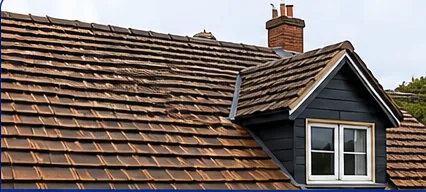
  • A Hampshire village cottage of flint and brick with a steep clay plain tile roof

    Victorian cottages and terraces

    Crowthorne was only a hamlet until Wellington College opened in 1859 and Broadmoor Hospital followed in 1863, and the houses that went up to serve them are still the older core of the village. Houses of that age commonly carry slate or small clay tiles on pitched roofs, with brick chimney stacks and lead at every joint. Age shows first at the fixings, the chimney flashings and the gutter brackets, long before the roof covering itself gives out.

  • 1930s semi-detached houses with hipped clay tile roofs and bay windows on a suburban road

    Edgcumbe Park mid-century houses

    Edgcumbe Park, off Dukes Ride, was built between 1958 and 1972 by the Renway Construction Company as an example of British mid-century modern architecture. The houses there are known for shallow roof pitches, and mid-century designs often add flat-roofed sections over garages, porches and links. Where a house has them, those flat sections date from the original build or from later repairs, and they are where leaks tend to start.

  • House roof stripped to battens during a roof replacement

    Roofs at the heathland edge

    Crowthorne sits beside heathland: the Sandhurst to Owlsmoor Bogs and Heaths Site of Special Scientific Interest lies to the south-east and Heath Lake runs along the northern edge. Houses near it often stand among pines and birch. Shed needles and seed pack into valleys and gutters, shade keeps the north slopes damp, and moss follows. These roofs need clearing and checking more often than a house in an open street.

20.6 road miles north-east of Basingstoke

Planning and building control in Crowthorne

Crowthorne falls under Bracknell Forest Council for planning and building control. The Crowthorne Conservation Area mainly lies in the triangle formed by Duke's Ride, Waterloo Road and the High Street, and the council lists it on its conservation areas page. Roofs inside that triangle are seen from the street, so the council cares about how they look as well as how they perform.

Like-for-like repair, with the same slate or tile in the same pattern, is normally the simple route there. Changing the covering, adding a dormer or fitting an unusual window is the point to ring the council's planning team before ordering anything. Edgcumbe Park is noted as an example of mid-century modern design, so if your house sits in or beside a protected area, ask the council what applies to your road. Elsewhere in the village the question is usually building control: re-roofing a whole house can be notifiable, a duty we take on for you. If a roof window is on your list, our planning permission guide for roof windows explains the rules and where a conservation area changes them.

Common faults on Crowthorne roofs

Crowthorne's roofs divide into three groups: Victorian pitched roofs near the High Street, flat-roofed sections on the mid-century houses of Edgcumbe Park, and anything standing under trees near the heath. Each group fails in its own way, and each has a repair that suits it.

Chapter 1: Why does the flat roof over the garage and porch of our mid-century Crowthorne house keep leaking?

What we find

Houses designed in the mid-century modern manner use flat roofs generously: over the garage, the entrance porch, the link between house and outbuilding. However well such a section was built, a flat roof has no slope to throw water off, so every flaw is felt quickly. Bitumen felt cracks along its upstand (the vertical turn-up where the roof meets a wall), and edge trims lift where the old timber behind them has softened.

Inside, the clue is a stain that spreads slowly across a ceiling lined with timber boards or plasterboard, often worse a day or two after rain because the water travels along the deck before it drops. Ponding, with shallow pools lingering after a shower, usually means the deck has sagged between joists.

What we fix

We open the roof at a few points on the survey to find out whether the deck is dry. If it is, a new membrane over the existing structure may be all that is needed. If boards are soft, they come out and new ones go in, with a proper fall built in so water runs to the gutter. For the covering we usually talk through EPDM (one sheet of synthetic rubber), GRP (fibreglass resin that sets into one hard shell) and felt. Typical UK ranges per square metre are £80 to £120 for EPDM, £100 to £160 for GRP and £60 to £100 for felt, and the written price only arrives once we have seen the roof.

Matching a modern membrane to an original architect's detail takes care at the edges, so we photograph those joints before and after. Our flat roofing page sets out the full range.

Chapter 2: Why are slates slipping on our Victorian cottage near the High Street?

What we find

Slate on a house of this age was usually hung on iron nails driven through the slate into timber battens (the thin laths the slates are fixed to). Iron rusts, the nail thins at the point where it passes through the slate, and eventually the slate slides down a few centimetres and hangs from its neighbours. A cracked slate tends to show as a dark line where water has run onto the felt below, not as a hole.

From the pavement, look for a slate sitting lower than the rest of its row, a gap showing darker slate below it, or fragments in the gutter after a windy night. In the loft, daylight at the joints and damp patches on the rafters give the same story. Tile roofs of the same period suffer the same way, a problem roofers call nail sickness. Where houses of the same age stand side by side, one house's problem is often its neighbour's coming.

What we fix

A handful of slipped slates is a repair, and we say so. We take out the failed slates, slide in new or reclaimed ones of matching thickness and colour, and secure each with a slate hook (a stainless strip that clips over the batten and holds the slate from below) instead of another nail. That spot repair keeps the rest of the roof working. When nails have rusted across most of a slope, repair stops making sense, because every slate you disturb loosens the next, and a strip and re-cover with the same slates, sorted and relaid on new battens, is the honest option.

Where slates are too thin or broken to reuse, we source a closely matched replacement. Our slate roofing page covers sourcing and costs, and our nail sickness guide shows what the fault looks like.

Chapter 3: Why are our gutters always blocked with pine needles and moss near the heath?

What we find

Houses on Crowthorne's heathland edge sit among conifers and birch, and a conifer sheds fine needles through every season. They wash off the tiles and pack into the gutter, then bind into a mat with seed and moss. Water that cannot reach the downpipe overflows the front of the gutter and runs down the wall or back under the first row of tiles.

Shade makes it worse. A north-facing slope under trees stays damp, moss establishes in the gaps between tiles, and the moss holds more water against the surface. You may notice green staining on the wall below the gutter, a gutter that sags in the middle, or water pouring over the front lip during a heavy shower. Left alone, the fascia board behind the gutter starts to rot.

What we fix

We clear the gutters by hand first, then check the falls and the joints, because a gutter that holds water leaks at the joints and pulls away from its brackets. Where the fall has gone, we reset it. On roofs where debris is a permanent feature, we fit gutter guards (mesh or brush strips that let water through and stop needles) and widen the outlet if the downpipe is too narrow to keep up.

The moss is treated at the same visit. We remove it by hand and apply a biocide, because jet washing drives water under the tiles and strips the surface from older concrete. Typical UK costs reported for hand removal with biocide come to between £748 and £978 by roof size, and the written price only arrives once we have seen the roof. Our roof cleaning and guttering and fascias pages explain the options.

Chapter 4: Why does the chimney on our older Crowthorne house leak after strong rain?

What we find

On a Victorian house, the chimney is the busiest junction on the roof. Lead flashing (the strip of metal that seals the joint between brick stack and roof slope) is dressed into the brickwork and over the tiles. Soakers, small pieces of lead interleaved with slate or tile up the sides, carry water out onto the roof. Over decades the lead work thins and splits, and the mortar that holds it in the brick joints erodes.

The signs are rarely dramatic: a brown mark on the chimney breast upstairs, plaster that stays cold and damp on one side, or a stack where the pointing has fallen out and left the brick faces open to the weather. A cracked or missing chimney cowl, or crumbling mortar at the top of the stack, lets rain in from above. In the loft, the water often shows on the side of the stack, not at the point where it entered.

What we fix

We work from the top down. The pots and flaunching (the cement collar holding them) are checked first, then the stack is repointed where the mortar has gone, and the lead is renewed from the roof slope up. New flashings and a back gutter (a small lead channel behind the stack that sends water around it) are cut to the existing roof covering and chased into the brick, not simply stuck on with sealant. Typical UK costs reported for chimney leadwork sit between £350 and £920, and the written price only arrives once we have seen the roof.

We would rather make the stack watertight than recommend taking it down. If the chimney is no longer used, a ventilated cap is an option, and we talk it through after the survey. Our chimney repairs page covers the work in detail.

Crowthorne roofing questions

Why are tiles slipping on a Victorian roof near Crowthorne High Street?

Slipping on an older pitched roof usually means the nails or pegs holding the tiles have corroded or the battens have softened. We lift a few tiles to check the fixings. If the damage is local, we re-fix or replace the affected tiles. If the fixings have failed across a whole slope, a strip and re-lay of that slope is the sound repair, reusing good tiles where we can.

Do I need permission to repair a roof inside the Crowthorne Conservation Area?

Matching repairs are normally acceptable, but changing the material or the look of the roof may need consent. The conservation area mainly lies in the triangle between Duke's Ride, Waterloo Road and the High Street. Ask Bracknell Forest Council's planning team before ordering materials, and we will supply survey photographs that show exactly what is there now.

Our Edgcumbe Park house has a low pitched roof with a flat section. Who looks after both?

We do. Many mid-century houses mix a low pitch with flat roofs over the garage or porch, and the two covering types need different skills. We survey them together and report on each separately, so you can see whether one needs work and the other does not. The work carries our written 10-year workmanship guarantee.

Does living near the heath mean more frequent roof checks?

Usually, yes. Pines and birch drop needles and seed into valleys and gutters, and damp shade encourages moss, so a house close to the Sandhurst to Owlsmoor heathland edge benefits from a look after each autumn. Bats and nesting birds are protected, so on older roofs we may need to time the work or have a survey first.

Can you reuse our old slates if the roof needs stripping?

Often, yes. We sort the strip into sound slates, cracked ones and broken ones, relay the sound ones on new battens and underlay, and make up the shortfall with matching slates. That keeps the look of the roof, and it can matter in a conservation area. If the slates are too thin or soft to reuse, we show you in the photographs before quoting.

Get your free roof survey in Crowthorne

Tell us what’s happening and we’ll call you back to arrange a visit. You’ll get photos of your roof and a fixed written quote.

  • No obligation
  • Photo report of your roof
  • 10-year workmanship guarantee

Rather talk? 01256 213956

Call Free survey