

Beacon Basingstoke Roofing

Roofers in Farnham

Farnham is 16.1 road miles east of Basingstoke, across the Surrey border, and a town with an unusually deep stock of old roofs: a medieval tile-making past, old clay plain tile, and the slate that arrived by rail. We look first, show you the evidence on your own roof, and write down a fixed price afterwards.

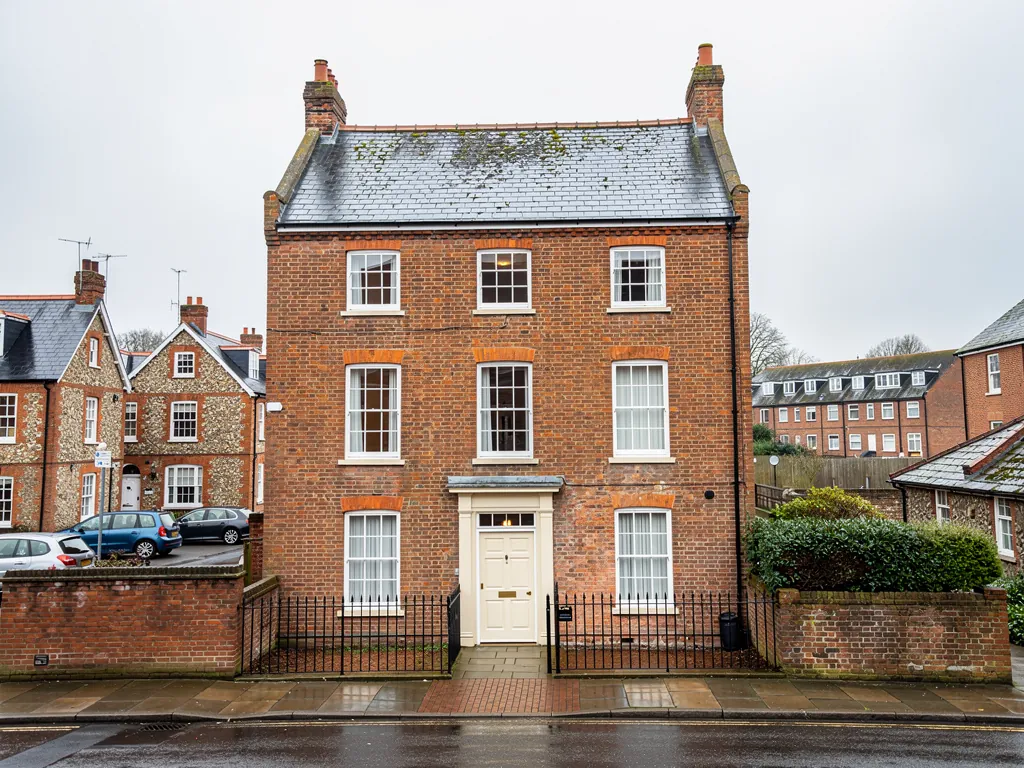
A Georgian brick town house with a slate roof and parapet in a Hampshire market town

Roofs we see in Farnham

  • Roofer fitting roof tiles on a brick house near Basingstoke

    Peg tile and plain clay

    Farnham has a long history of making its own tiles. A medieval kiln dug up in Borelli Yard, dated to just before 1216, was turning out pegged roof tiles and dragon-backed ridge tiles. Plain clay tiles are still the traditional covering in the old centre: small, double-lapped and slightly curved, with a rich mix of orange, red and brown that machine-made tiles struggle to copy. They repair well when the right matching tiles can be sourced.

  • White uPVC fascia, soffit and guttering under a tiled roof

    Yellow brick and slate

    Waverley's appraisal records that once the railway reached Farnham, yellow bricks and slates were brought in and began to appear as building materials. Houses built from then on often pair brick walls with slate roofs, brick stacks and lead flashings. The slate lasts, but the nail fixings and the lead details tend to age faster than the covering they hold in place.

  • Modern 2000s brick houses with grey concrete tile roofs on a new estate near Basingstoke

    Listed buildings in the centre

    The town centre conservation area holds 387 listed buildings, which Waverley's appraisal calls a very high number for a town centre of its size. Many are shops and houses under old clay tile roofs with timber structure beneath. Work on them is a conversation with the council first, so our job on these is to record what is there and propose a like-for-like repair.

16.1 road miles east of Basingstoke

Planning and building control in Farnham

Waverley Borough Council looks after planning and building control for Farnham. Waverley lists six conservation areas in the town: Farnham Town Centre, Great Austins, Old Church Lane, Shepherd and Flock, Waverley Abbey and Wrecclesham. Its conservation areas page has the maps and the appraisals, and with 387 listed buildings in the centre alone, many roofs here come with extra responsibilities attached.

For a listed building, any change that affects its character, including a change in roof covering, needs listed building consent from the council, even where planning permission would not apply. In conservation areas, repairing in the same material is usually uncontroversial, while changing it may need permission. Ask the conservation officer before you order anything. For roofs outside those areas, a large strip and re-cover can fall under the Building Regulations, and we handle that for you. A roof window in an old street is a special case, so read our conservation rooflights guide first.

What we find on Farnham roofs

Farnham sits on the north branch of the River Wey, with the chalk ridge of the Hog's Back to the east and the Surrey Hills National Landscape on its edge. Houses on the valley floor stay damp and shaded, houses up on the ridge take the wind, and the centre is crowded with old buildings that need careful hands.

Chapter 1: Can the old peg tiles on a listed building in Farnham be repaired instead of replaced?

What we find

Peg tiles are fixed with a small wooden peg through a hole at the top of each tile, hooked over a batten (the narrow timber lath that carries the tiles). Over time the pegs rot or split, and the tile slides down. In the old centre you also find tiles whose faces frost has flaked away in thin layers, and ridge tiles that have worked loose from their bed. The timber structure beneath may be centuries old and sensitive to damp.

Because the town once produced its own tiles, the roofs here contain tiles of varied age and colour, patched in over the centuries. That patchwork is part of the look, and it is why a rushed full re-cover in modern tile spoils a roof that a careful repair would have kept. From the ground, the signs are gaps in the courses, tiles tilted outward and green staining under the eaves.

What we fix

Repair is normally the right route, and for a listed building it is often the only one the council will accept. We take off only the failed area, keep each sound tile, and fix replacements with new oak pegs or modern stainless fixings behind the scenes, depending on the building. Missing tiles are made up with reclaimed or hand-made plain tiles chosen to match the colour and camber. The ridge is reset on a bed that suits the age of the building.

Before we start, you get photographs and a written scope that you can show to the council's conservation officer, who should agree the plan if the building is listed. That keeps consent simple and avoids a stop-work order halfway through. For general options, see our pitched roofing page.

Chapter 2: Our yellow-brick Victorian terrace in Farnham has slates slipping. Is the roof finished?

What we find

Not necessarily. Terraces of the railway period were roofed in slate that came in by train, and slate that is not splitting can outlast the nails holding it. Those nails were often iron or poor-quality metal, and they rust through the slate's fixing hole. The slate slips an inch or two, hangs from its neighbour, and leaves a gap. Neighbours often notice the same thing on the same row, because a run of terraces was fixed in the same period with the same nails.

Inside, look for light at the eaves, a damp patch at the top of a party wall where one terrace roof meets the next, or a stain beside a chimney breast. The lead at the party wall is another weak spot: it is the flashing that seals the roof to the dividing wall, and it splits where the terrace moves with temperature changes and settling.

What we fix

We lift the slipped slates and check the battens beneath. Sound slates are refixed with copper nails or stainless clips so the same fault does not return, and cracked ones are replaced with matching new or reclaimed slates. The lead at the party wall is rebuilt where it has split, and the surrounding slates relaid so water runs off cleanly. If a slope shows widespread delamination, we recommend a new covering for that slope only, and tell you when the others still have years in them.

Reported UK figures for one slate repair are £100 to £250 in labour and £5 to £25 for the slate, with £300 to £800 more if a tower or scaffold is needed. We confirm every figure in writing after the visit. See slate roofing for the wider choice.

Chapter 3: Why is the chimney on our Farnham town house leaking, and does repointing need special mortar?

What we find

A chimney stack on an old town house leaks from three places: the top of the stack where the pot and flaunching (the sloping mortar that holds the pot in place) have cracked, the brickwork joints that have eroded, and the lead flashings where the stack meets the roof. In the centre, the stack may be built in soft old brick laid in lime mortar, and that combination behaves very differently from a modern stack.

Hard cement repointing is the usual mistake. Cement does not let moisture out the way lime does, so the water leaves through the brick instead and the faces of the bricks spall and crumble. We have seen stacks that were repointed once, looked tidy, and were falling apart within a few winters. The signs are damp on the chimney breast, flaking paint around the fireplace and a white salt bloom on the bricks.

What we fix

We rake out the failed joints and repoint them in a lime mortar matched to the brick's colour and softness, so the wall can still breathe. Cracked flaunching is replaced, a cowl is fitted if the pot needs one, and the flashings are redone in lead with a stepped line up each side of the stack and a back gutter behind. If the top courses have gone, we rebuild them with reclaimed brick before repointing. For a listed building the method is agreed with the conservation officer first.

UK cost guides report chimney repointing at £450 to £1,200, with lead flashing work typically between £350 and £920, though your own price comes after the survey. Read more on our chimney repairs page.

Chapter 4: Do roofs on the Hog's Back side of Farnham need dry-fix ridge and verge tiles?

What we find

The chalk ridge of the Hog's Back lies east of the town, and houses on higher, open ground feel the wind far more than those down in the Wey valley. Wind finds every weakness in a roof edge. A ridge tile bedded in old mortar can shift, and once its neighbours lose their grip, a run of tiles can lift in a gale. Verges, where the roof ends at a gable wall, are the next failure point because the cement bed beneath the end tiles cracks.

The signs are cracks in the mortar line along the top of the roof, tiles that sit crooked, and pieces of mortar in the gutter or the garden. Inside the loft, you might see daylight along the ridge or a wet mark on the ridge board. Exposed roofs deserve a check after any winter storm rather than waiting for the next one to prove the point.

What we fix

For exposed positions we recommend dry-fix ridge and verge systems. These use a continuous batten, clips and screws to hold each unit mechanically, rather than leaving a tile to depend on mortar. BS 5534:2014 expects mechanical fixing for ridge, hip and verge components, and BS 8612:2018 covers the dry-fix products. A ventilated roll under the ridge lets the roof breathe, and dry verge caps clip over the tile edges to stop wind getting under them.

A dry ridge on a semi is reported at £900 to £1,600 in UK cost guides, with scaffold at £300 to £900 extra. Your own figure is set once we have been up and looked. For the full picture of the work, visit our ridge tile repairs page.

Farnham roofing questions

Can broken peg tiles be repaired without stripping the whole slope?

Often, yes. Peg tiles hang from battens on small timber pegs, so a broken or slipped tile can be lifted out by raising the ones above and replaced with a matching one. If the pegs or battens have perished across the slope, stripping and re-hanging is the sounder choice. We match from reclaimed stock where possible, and the photographs from the survey show which approach suits your roof.

Which Farnham roofs are likely to be listed or in a conservation area?

The town centre conservation area alone contains 387 listed buildings, and Waverley names five more conservation areas in Farnham: Great Austins, Old Church Lane, Shepherd and Flock, Waverley Abbey and Wrecclesham. Check the council's map or ring its planning team if you are unsure. Treat a listed building as needing consent for changes, and a conservation area as needing a conversation.

Can you find matching tiles when a roof needs repairing near the old Borelli Yard area?

We aim to. Farnham's tradition of pegged and dragon-backed ridge tiles means matching colour and shape matters on old roofs, so we search reclaimed stock first and only fall back on new hand-made tiles when nothing suits. We show you samples against the existing roof before ordering, so you can judge the match yourself.

Why did the yellow brick and slate on our road need work all at once?

Streets built together age together. Houses put up with railway-delivered slate and the same fixings tend to reach the same stage in the same decade, so neighbours often find the same faults. If you are planning repairs, ask next door to compare notes, because shared scaffolding on a terrace can cut the access cost per house.

Get your free roof survey in Farnham

Tell us what’s happening and we’ll call you back to arrange a visit. You’ll get photos of your roof and a fixed written quote.

  • No obligation
  • Photo report of your roof
  • 10-year workmanship guarantee

Rather talk? 01256 213956

Call Free survey