
Beacon Basingstoke Roofing

Roofers in Aldershot

Aldershot lies 17.3 road miles east of Basingstoke, on heathland in the north-east corner of Hampshire. It grew from a camp founded in 1854 into a town of Victorian terraces, officer housing and barracks, and its roofs carry that history. We survey with photographs, then give you a fixed written quote.

Brick estate houses with concrete tile roofs among pine trees

Roofs we see in Aldershot

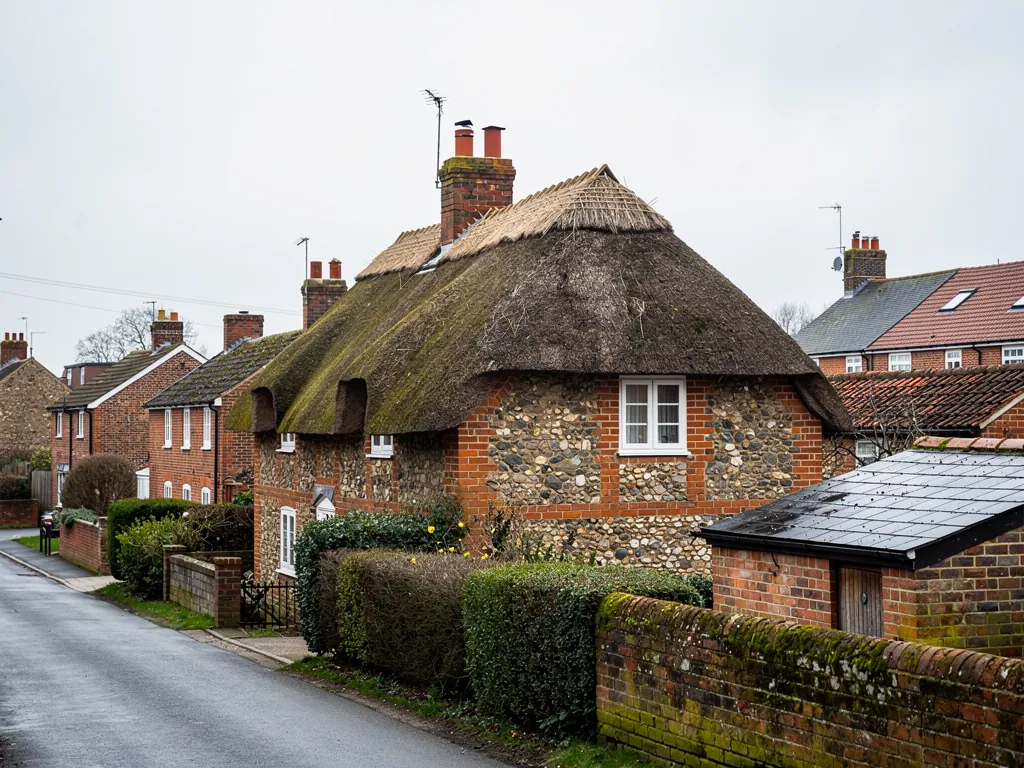
  • A thatched cottage in a Test Valley village with a brick chimney

    Victorian terraces near the centre

    The Army camp turned a small place into a town within a decade, with the population rising from 875 in 1851 to over 16,000 by 1861. Much of the housing went up quickly, in terraced runs near the centre. Rushmoor's own records say slates, bricks and timber for the camp came in by barge along the Basingstoke Canal, so natural slate on brick terraces is a common sight here.

  • Brick estate houses with concrete tile roofs among pine trees

    Officer and middle-class housing

    As the camp grew, larger houses for officers and the middle classes were built on new roads around the centre, Cargate Avenue to the south-west among them. These are bigger roofs with more going on: hips, valleys, bay windows with their own small roofs, and tall chimney stacks. More junctions mean more places for lead and mortar to fail, and they repay a careful look from the loft.

  • Brick chimney stack with clay pots

    Barracks and large buildings

    Aldershot Military Museum is housed in a red-brick Victorian barracks, and the military past leaves its mark on the building stock: long blocks, big pitched roofs and later flat-roofed additions. The same applies to workshops and industrial units around the town. A large roof needs a different method from a house, with edge protection, safe access and a covering chosen for the span.

17.3 road miles east of Basingstoke

Planning and building control in Aldershot

Aldershot is in the borough of Rushmoor, so Rushmoor Borough Council deals with planning and building control. The council has designated several conservation areas in the town, including Aldershot Military (2003), Aldershot West (1980) and Cargate (1980), and publishes an overview of them on the Rushmoor website. That document is worth a read before roof work on an older house, because it records the military history that shaped the buildings, including the slate and brick brought in for the camp.

If your house is inside one of these areas, like-for-like repair is normally straightforward. Swapping natural slate for concrete tile, or otherwise changing how the roof looks, can need consent, so speak to the council's conservation team before ordering materials. Outside the conservation areas the question is usually building control: a full strip and re-cover can be notifiable, and we handle that side. Thinking about a roof window in a loft? Our guide to planning permission for roof windows sets out the rules, and they are tighter in a conservation area.

What we find on Aldershot roofs

Aldershot's roofs sort themselves by purpose. The terraces and villas put up as the camp expanded carry natural slate, a material that lasts well but fails in a recognisable way. Behind them sit the large roofs of barracks-era buildings and later industrial units. Around everything is heathland, with pines, birch and open ground, which affects what lands on a roof and how quickly it dries.

Chapter 1: Why are slates sliding off our Victorian terrace in Aldershot?

What we find

Natural slate is held by nails driven through two holes, and on a roof of this age the nails are the weak point. Iron nails rust through in the damp between the slates and the batten, and the slate then hangs on nothing but friction until a gust or a hard frost lets it slide. Where you see a slipped slate with a small rusty stain beneath it, that is the usual story. The slates themselves can be perfectly good, which is why they can be reused.

Another sign is a slate that has split along its length, or one that has delaminated into thin layers. That is a fault in the stone, not the nail. From the loft, light through the roof between slates and dark marks on the battens show how widespread the problem is. On a terrace, neighbours' roofs often show the same pattern at a similar stage, which tells you something about the building period.

What we fix

If only a few slates have slipped, a repair is the sensible answer. We fit new slates or reuse sound ones, secured with copper nails or a stainless steel hook, called a tingle, that holds the slate without a hole. Where the nails have failed across a whole slope, strip and re-slate is the honest route: sound slates are sorted and kept, damaged ones are replaced, and new battens and a breathable underlay go underneath.

Typical UK prices for natural slate re-roofing are £120 to £180 per square metre, and man-made slate is £90 to £130; your fixed quote follows the survey. A single slate repair is typically £100 to £250 in labour, with access equipment on top. In a conservation area, natural slate is usually expected on a repair, and we check this with the council before work. Our slate roofing page sets out the choices.

Chapter 2: Where is the leak coming from on the bay window of our house off Cargate Avenue?

What we find

The larger houses built for officers and the middle classes in the second half of the 19th century often have a bay window with its own small roof, and these are some of the most leak-prone parts of an old house. A bay roof is usually covered in lead or in slate or tile with lead at its edges, and it meets the main wall through a flashing (a strip of lead tucked into the brickwork that sheds water away). The mortar that holds the flashing in the joint perishes first.

Lead itself also fatigues. It expands and contracts with the temperature, and on a long run without proper joints, it cracks along the folds. Inside, the leak appears as a stain on the bay ceiling or the wall just below it, often after wind-driven rain from one direction. Valleys, the internal angles where two roof slopes meet, give the same kind of fault on a house with several gables.

What we fix

We expose the junction, inspect the lead and the brickwork behind it, and replace what has failed. New lead is cut to the right code for the job, fitted with expansion joints at sensible lengths, and chased into the mortar course so that rain cannot track behind it. Where the bay roof itself has failed, we renew the covering and the timber deck beneath it. Sealant over cracked lead does not hold, and we do not recommend it as a fix.

Typical UK prices for replacing chimney leadwork range from £350 to £920, with an average near £570, and a similar scale applies to a small bay; your fixed quote follows the survey. For a patch repair on sound lead, the figure is lower, and we say so when it will do. Our lead roofing page explains the codes and methods.

Chapter 3: Why do the gutters on our Aldershot house fill up with pine needles and moss?

What we find

Aldershot sits on heathland, and the soil and tree cover reflect it, with pine, birch and scrub around many gardens and open spaces. Needles, seeds and leaves collect on the roof in autumn and wash into the valleys and gutters, where they pack down and hold water. A valley (the internal angle between two slopes) carries the run-off from a large area of roof, so a blockage there sends water over the side or back under the tiles.

That water then reaches places that are not meant to be wet. The fascia board, the timber carrying the gutter, rots from the top edge, and the brickwork under an overflowing joint grows green and stays damp. Inside, a stain high on the wall, below the eaves, is the usual sign. On shaded slopes the same debris feeds moss growth.

What we fix

We clear the roof surface and the valleys by hand, flush the gutters and downpipes and check that each outlet runs freely. Cracked gutter joints are resealed or the section replaced, and any fascia board that has gone soft is cut out and renewed. Where trees overhang, we can fit gutter guards or a leaf screen, though these still need an occasional clean, and we say when they help and when a cleaner schedule is the better answer.

Typical UK prices for a full uPVC roofline on a three-bed semi run from £1,800 to £3,500, with scaffold for the roofline anywhere from £200 to £2,600; your fixed quote follows the survey. Most blocked-gutter jobs cost far less than a full replacement, and we tell you if clearing and local repairs are all that is needed. Our guttering, soffits and fascias page explains the choices.

Chapter 4: Our unit near the barracks area has a leaking flat roof. Should it be repaired or overlaid?

What we find

Industrial units and large outbuildings around a garrison town tend to share a type of roof: a big, low-pitch or flat span, often covered in built-up bitumen felt or profiled metal sheeting, with rooflights set into it. Felt on this scale fails at the laps and around penetrations, where pipes, vents and rooflight kerbs break through the covering. Metal sheets leak at the fixings and at the overlaps, particularly where the sealant has aged.

Fragile rooflights are a safety issue as well as a leak risk. An old plastic or fibre-cement rooflight can look like the rest of the roof and give way under a person's weight. Anyone working on a roof like this needs edge protection and safe access, not a ladder and good intentions. Water ingress may show far from the actual fault, as it runs along the underside of the sheets.

What we fix

We start with a survey of the whole roof, with photographs, and trace the leak to its cause rather than patching the wet spot. If the covering is basically sound, a repair to the laps, a new flashing at the rooflight kerb or a coating can extend its life. If it has reached the end of its life, overlaying with a new single-ply membrane can be an option, provided the structure and the existing insulation allow it. Where insulation is wet, it is removed.

Typical UK figures for stripping and replacing a commercial flat roof are £90 to £180 or more per square metre, though that is an informal range and varies with the access and the build-up; your fixed quote follows the survey. Roof work can be programmed around trading hours. Our commercial roofing page explains the systems and how a job runs.

Aldershot roofing questions

Do the Victorian terraces near Aldershot's old camp need their lead valleys and gutters renewed?

Many Victorian terraces have lead in the valleys, behind chimneys and along parapet gutters, and old lead can crack from age and thermal movement. Splits show up as stains on ceilings below. We survey each lead run, photograph any splits, and patch it with new lead where the sheet is otherwise sound. Where it has worn through, the run is replaced.

Does my house fall inside one of Aldershot's conservation areas?

The council lists Aldershot Military, Aldershot West and Cargate among its conservation areas, and Rushmoor's planning team can confirm whether your address is within one. If it is, check with them before changing the material or look of the roof. We survey with photographs, which gives you a record of the roof as it stands and helps in any conversation with the council.

Can slates from our old roof be reused on a repair?

Often, yes. Sound natural slate is durable, and the weak point on a roof of this age is usually the nail, not the slate. We sort the slates as they come off, keep those that ring true and are intact, and replace the split or delaminated ones. Reusing good slate keeps the roof's appearance, which is a real advantage in a conservation area.

Is the Army-era red brick on our building a problem for the roof?

Not in itself. Red brick is hard-wearing, but the roof edges, the chimney stacks and the parapet gutters on larger Victorian buildings take the weather, and their joints and lead need checking. Where a long barracks-style block has a parapet or valley gutter, a blocked outlet is the usual cause of damp inside. We trace the water to its source before suggesting a fix.

Can you take on a warehouse or industrial roof in Aldershot as well as houses?

Yes. We carry out commercial roofing as well as domestic work. For larger roofs we plan edge protection and safe access, and we give a fixed written quote after the survey. Fragile rooflights and old fibre-cement sheets need particular care, so tell us what you know about the roof's age, and we will build the survey around it.

Get your free roof survey in Aldershot

Tell us what’s happening and we’ll call you back to arrange a visit. You’ll get photos of your roof and a fixed written quote.

  • No obligation
  • Photo report of your roof
  • 10-year workmanship guarantee

Rather talk? 01256 213956

Call Free survey