Beacon Basingstoke Roofing

Roofers in Crondall

Crondall lies 13.1 road miles east of Basingstoke, on the gentle slopes at the western end of the North Downs. Steep clay-tiled roofs, Victorian slate and tile-hung timber-framed houses mark the village, and Hart District has made it a conservation area. We survey with photographs, tell you plainly whether a repair will hold, and give a written price before work starts.

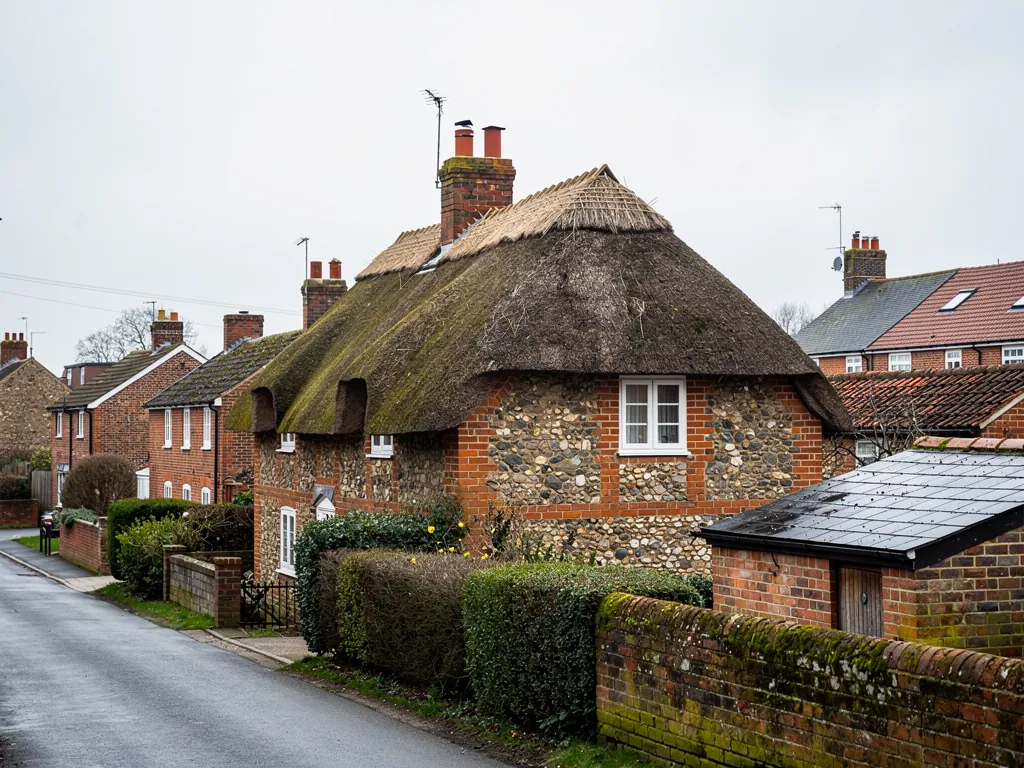
A thatched cottage in a Test Valley village with a brick chimney

Roofs we see in Crondall

  • 1960s and 70s brick semi-detached houses with concrete interlocking tile roofs on a Basingstoke estate street

    Steep clay tile over old frames

    Hart's conservation area appraisal notes that almost all of Crondall's roofs are steeply pitched, a sign of former thatch that clay tiles replaced from the 17th century onwards. That steepness is a gift for drainage, but the roof timbers beneath are often centuries old and uneven, so tiles sit a little differently on each slope and need hand-sorting when they are repaired.

  • An Edwardian red-brick detached house with clay tile roof and tile-hung gables in north Hampshire

    Victorian slate and polychrome brick

    Slate reached Crondall only after the railway came to nearby Winchfield in 1838, so the Victorian houses in the village carry slate roofs above polychrome brickwork, which means bands of different coloured brick. Slate is thin and hung on nails or pegs, and the usual faults are slipped slates, rusted fixings and tired lead where slopes meet the chimneys.

  • Roofer fitting roof tiles on a brick house near Basingstoke

    Hung tiles on timber-framed walls

    By the end of the 17th century, many of Crondall's timber-framed houses had their wattle-and-daub panels replaced with brick or covered in hung clay tiles, the small tiles fixed vertically to the wall. These walls meet the roof at eaves, verges and dormer cheeks, and those junctions are where water most often finds a way into the building.

13.1 road miles east of Basingstoke

Planning and building control in Crondall

Crondall is in Hart District Council's area, and Hart has designated the village centre as a conservation area, with an appraisal adopted in March 2024. You can read it as the Crondall conservation area appraisal. It describes the roofscape in detail: the steep pitches, the clay tile, the Victorian slate and the hung tile on timber-framed walls. Those are the features Hart will expect a roof job to respect.

In practice, a like-for-like repair, using matching tile or slate in the same coursing, is the safe route. Switching material, say from clay to a concrete or fibre-cement lookalike, or altering the pitch or the appearance of a roof slope, may need consent, so put the question to Hart's conservation officer ahead of any order. Re-roofing is also a question for building control, and where the work is notifiable we handle that for you. If you are weighing a roof window, our page on conservation rooflights covers the styles that suit a protected village.

What we find on Crondall roofs

The roofs of Crondall record the village's history in layers. A steep pitch built for thatch, retiled in clay, a Victorian extension in slate, a timber-framed wall protected with hung tiles. That variety means the faults here are rarely generic. Each material fails in its own way and wants its own repair.

Chapter 1: Our steep clay-tiled roof in Crondall has tiles slipping out of line. Can it be repaired, or does it all need redoing?

What we find

A steep pitch sheds water fast, but gravity also pulls on every tile. On the older cottages, plain clay tiles were hung from battens by small pegs or nails, and each tile has two nibs, or projecting lugs, that hook over the batten. When a peg rots or a nail rusts through, the tile loses its hold and creeps downward until it drops out of its course. Roofers call this nail sickness, and on an old roof it spreads in patches.

The signs are visible from the lane: a tile hanging lower than its neighbours, a gap showing dark felt or boards, or shards of clay in the border bed. Inside, a pale wet patch on the underside of the rafters often appears long before the ceiling stains. Frost can also flake the face of a soft clay tile, and a flaked tile no longer sheds water properly.

What we fix

Where the damage is local, repair is the right answer. We strip only the affected area, keep every tile that is still sound, and fill the gaps with reclaimed or hand-made plain tiles matched for colour and camber. New battens go in beneath, and the tiles are fixed with stainless steel nails or clips, not hung on the old corroded fixings. On very old roofs we may also add a breathable membrane to catch wind-blown rain.

A repair of this kind preserves the character Hart's appraisal describes, and it keeps costs down. A roof that is failing right across the slope is another matter, and we tell you honestly when that point has been reached. Our pitched roofing service describes how a tile repair or re-cover is planned and carried out.

Chapter 2: We have a Victorian house in Crondall with a slate roof. Why do slates keep slipping?

What we find

Slate came late to Crondall, only after the railway reached Winchfield in 1838, and the village's Victorian houses were roofed in it, often above polychrome brick. A slate is held by two nails through the head, or by a single nail or pegs near the middle, and it relies on the overlap of the slates above for its weather-tightness. The nails are the weak point. In a damp climate they corrode, shear and leave the slate hanging by almost nothing.

The first sign is usually a slate resting on the path or in the border, a visible gap in the course, or a thin line of daylight in the loft. Once one has slipped, wind catches the exposed edge of its neighbours, and the damage spreads. Hairline cracks can also let moisture in, particularly on slate that has not been laid with a decent headlap, the overlap between courses.

What we fix

For a few slipped slates, we fit new ones using stainless fixings and, where the course allows it, a copper or lead tingle, a small strap that holds the replacement without nailing through the slate above. This is a neat repair that does not disturb the surrounding roof. Reclaimed slate is matched for size and colour, as new slate can look stark against old.

If many slates have gone because the nails have failed along a whole slope, re-slating is the better route: strip, fit new battens and underlay, and relay the good slates with new fixings, topping up with matching stock. Typical UK prices reported for natural slate re-covering are £120 to £180 per square metre, and a single slate repair can run higher because of access; your quote is fixed after the survey. See our slate roofing page.

Chapter 3: Why does water get in where the tile-hung wall meets the roof on our Crondall house?

What we find

Hung tiles on a timber-framed house keep the weather off the frame, but they are only the outer skin. Behind them sit battens, and behind those the old frame and infill. Where the wall runs up to a roof slope, at a dormer cheek, a gable or the eaves, the tiles on the wall and the tiles on the roof have to be lapped with metal or lead so the water passes from one surface to the other without finding a gap.

On Crondall's older houses that junction is often made from lead flashings that have split along their folds, or from a cement fillet that has cracked. Water then runs behind the hung tiles, and the timber frame takes the damp. You may spot a stain on the first-floor ceiling beneath a dormer, a patch of green growth on the wall tiles, or a frame timber that feels soft when probed.

What we fix

We open up the junction, usually by lifting a few courses of tile on both the wall and the roof, to see how far the damp has travelled. Failed cement is removed and replaced with a lead soaker and flashing, dressed to the line of the tiles and secured so it can move with the roof. Hung tiles are put back in their original bond, with replacements picked to match, and any rotten batten is cut out and renewed.

If the frame itself is damaged, we stop and show you photographs, because carpentry repair to a historic timber frame is work to agree with the conservation officer before anything goes in. Typical UK ranges reported for lead flashing around a stack or abutment start from about £350, and the fixed price follows the survey. Our leadwork page explains the details.

Chapter 4: Does the old brick-and-tile character of Crondall mean our chimney needs special care?

What we find

Crondall once had its own brickworks, which supplied tile and brick to local towns. An old brick stack may have a corbelled top, a stepped projection that carries the pots. The brick is often softer than modern stock, and it was laid in lime mortar, which is breathable and flexible. A century or two of frost can still loosen it, and the pots and flaunching, the sloping mortar cap, may crack.

The problems show up as crumbled joints you can scrape out with a fingernail, brick faces that flake, a stack that leans, or plants growing from the top. On a steep roof, the stack is also exposed, so wind and rain reach it from every side. A damp patch on the chimney breast inside is the usual first warning.

What we fix

The golden rule on a stack like this is to match the mortar to the brick. We rake out the failed joints and repoint in lime mortar, not hard cement, so the old brick can breathe and does not crack at the faces. Cracked flaunching is rebuilt, and pots are bedded afresh. Where a stack is leaning, we photograph it and assess whether it needs rebuilding course by course, reusing the original bricks.

The flashings and soakers at the base are renewed in lead while we are there. A typical UK figure reported for chimney repointing is around £750, with ranges from £450 to £1,200, and the price we give you is fixed once the survey is done. Read more on our chimney repairs page. Wildlife law protects roosting bats and nesting birds, and old stacks can attract them, so we plan the timing carefully.

Crondall roofing queries

Why do hung tiles on a timber-framed Crondall wall slip, and can they be repaired?

Hung tiles sit on battens and hold by their nibs and a few nails. Over time the nails corrode and the battens soften, so tiles slip or crack and let water reach the frame behind. The repair is to replace failed battens, re-hang sound tiles and make up the rest from matching reclaimed stock. The junction where a hung wall meets the roof slope is checked at the same visit.

Is my house inside the Crondall conservation area?

Hart District Council holds the map, and its March 2024 appraisal for Crondall is the document to consult. Since a boundary can run along one side of a lane, check your exact address with the council's planning team. If you are inside it, we recommend like-for-like repair and we give you survey photographs to help your conversation with the conservation officer.

Can you match old clay tiles in Crondall, or will a repair look patchy?

We aim for a repair you cannot spot from the lane. Old clay varies in colour and camber, so we select reclaimed or hand-made tiles that suit the existing roof and mix them across the repaired area. New tiles on a historic roof look stark at first but they weather. The 10-year workmanship guarantee we give covers the repair in writing.

Why is our Crondall roof so steep, and does that make repairs harder?

Steep pitches here are a sign of former thatch, which needs a sharp slope to shed water, and clay tile was later laid on the same frame. A steep roof drains well, but it is harder and slower to work on, so access, ladders and scaffolding feature in the price. We assess that at the survey and state it in the written quote, with no surprises afterwards.

Do you work around bats or nesting birds in old Crondall roofs?

Yes. Wildlife law protects them, and older roofs near the church and the village edge are the kind they favour. Should the signs appear when we are up there, we say so, and the work may need to be timed or checked by a specialist first. It is better to plan around them than to be stopped halfway.

Get your free roof survey in Crondall

Tell us what’s happening and we’ll call you back to arrange a visit. You’ll get photos of your roof and a fixed written quote.

  • No obligation
  • Photo report of your roof
  • 10-year workmanship guarantee

Rather talk? 01256 213956

Call Free survey