


Chapter 1: Why are the gable edges of our Chineham house shedding mortar onto the drive?
What we find
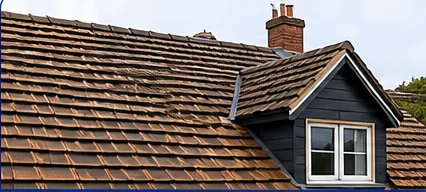
The verge is the edge of the roof where it finishes at the gable wall. On most of the estates built here since the late 1970s, that edge was formed by bedding the last row of tiles in sand and cement mortar, then pointing it flush. It looks tidy for years, but the mortar is rigid and the tiles and wall expand and contract at different rates, so hairline cracks open and then widen.
Frost then works into the cracks, and pieces fall off, often first noticed as grey crumbs by the downpipe or on a car roof. Once the mortar goes, wind can reach under the verge tiles, lifting them in a gale. In the loft you may see daylight where the roof meets the gable wall, or stains on the boards close to the edge.
What we fix
We check each verge tile by hand and from the loft, then decide whether to re-bed in mortar or move to a mechanical dry verge. Dry verge units are plastic or aluminium caps that clip over the tile ends and hold them down, so the edge no longer depends on mortar. The British Standard for slating and tiling, BS 5534, expects mechanical fixing at these edges, which is why we lean towards dry systems on estate roofs like these.
On a terrace of similar houses it often makes sense to work along the ridge in the same visit, since the scaffold is already there. Where the ridge is done too, the typical UK range for a dry ridge is £900 to £1,600 for a semi, with scaffold at £300 to £900. Your fixed quote follows the survey. The verge repairs page goes through the options.
