
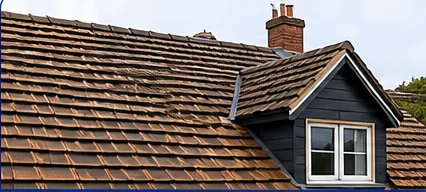


Chapter 1: Why does rain get in where the tile-hung wall meets our Bramley roof?
What we find
Tile-hanging, the covering of small clay tiles fixed vertically over a wall, is one of Bramley's signatures, often finished with scalloped bands. It sheds water well on a flat wall face, but the junction with a roof slope is far less forgiving. The roof tiles stop against the wall, and the wall tiles stop above them, with a joint between that has to be sealed by something other than the tiles themselves.
On older houses that joint was often sealed with a mortar fillet or a thin lead strip, and by now the mortar has shrunk away or the lead has split. Water then runs behind the tile-hanging and down the wall batten, rather than dripping from an obvious spot. The signs are a damp patch that appears some way from the roof, staining on the inside of an upstairs wall, or a hanging tile that has slipped away at its lower corner.
What we fix
We expose the junction and look at how the wall tiles, the battens and the roof covering overlap. A proper repair uses stepped lead flashing, with lead soakers (small lead pieces interleaved between the roof tiles) where the roof runs up the wall, tucked under the hanging tiles and dressed down over the roof covering. That lets water pass over every layer in turn and away.
Wall tiles that have slipped are refixed with new nails, and any that have cracked are matched from reclaimed stock so the scalloped pattern stays whole. A mortar fillet is not something we recommend repeating, because it cracks again with the first hard frost. The lead roofing and leadwork service covers the metalwork, and the guide to soakers and step flashing shows how the layers fit together.
