


Chapter 1: Why do slates keep slipping on our shallow-pitched roof in Hartley Wintney?
What we find
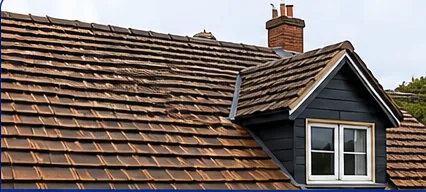
A slate roof is held by nails driven through each slate into the batten (the timber lath it hangs from). On Victorian roofs those nails were often iron, and over a century or more they rust through at the slate, which roofers call nail sickness. The slate does not fall at once. It drops a few millimetres, then slides, then leaves a gap in the course. The shallower pitch that Hart's appraisal notes on many of the village's slate buildings makes this worse, because water does not run off quickly and wind pushes rain up under the laps.
From the garden, look for dark gaps in the courses, a slate lying in a flower bed or a ragged line along the bottom row. Indoors, a brown mark on an upper-floor ceiling, often some way from the actual gap, tells the same story. Old Welsh slate can also split along its layers, with a flaking face that holds water.
What we fix
A few slipped slates can be repaired without disturbing the rest. We remove the broken slate with a slate ripper, a long flat tool that cuts the nails, and fit a replacement held by a copper or lead tingle (a small strap nailed to the batten that hooks over the new slate's tail). Where we can, we reuse sound slates from a less visible slope, so the repair matches in colour. Cost guides put one slate repair at £100 to £250 of labour, with the slate itself at £5 to £25, and a tower or scaffold from £300 to £800 if the roof needs one.
If slipping is widespread, patching just chases the next failure, and we say so after the survey. Re-slating means stripping to the rafters, fitting new underlay and battens and refixing with copper nails. Our slate roofing page covers how that work runs. Once we have surveyed the roof, the price is fixed in writing.
