
Beacon Basingstoke Roofing

Roofers in Elvetham Heath

Elvetham Heath is 13.3 road miles east of Basingstoke, next to the M3 and about 1.2 miles from Fleet station. It was built between 1999 and 2008, so its roofs are now two decades old, with the faults that age brings. We survey with photographs, then put the price down in writing.

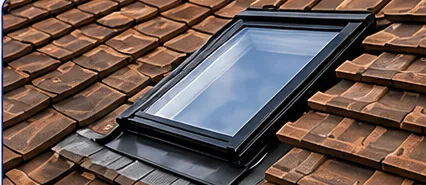
Roof window fitted in a tiled pitched roof

Roofs we see in Elvetham Heath

  • Brick chimney stack with clay pots

    Estate houses from 1999 to 2008

    Construction began in summer 1999 and ended in June 2008, and the site holds 1,894 homes. Houses built in that period commonly have concrete interlocking tiles over a plastic or felt underlay, often with the ridge and verges set in mortar. None of this is old enough to be near the end of its life, but it is old enough for fixings, sealants and joins to begin to need attention.

  • A Hampshire village cottage of flint and brick with a steep clay plain tile roof

    Bays, porches and small flat roofs

    Many of the houses have a bay window, a front porch or a flat-roofed extension, each with a small roof of its own, in lead, GRP or felt. These are cut into the main roof with flashings at the edges. They are small but difficult, because the joint between a small roof and the tiles beside it is where water gets in first, and where a leak is hardest to trace from inside.

  • 1930s semi-detached houses with hipped clay tile roofs and bay windows on a suburban road

    Houses beside the heath and trees

    The estate was built on reclaimed pine plantation and heathland, and Elvetham Heath Nature Reserve, managed by Hart District Council, lies within it. Roofs near the reserve and the retained trees see needles and leaf litter, shade and damp. Trees that were small when the first phases went up have had more than twenty years to grow over some of the roofs below them.

13.3 road miles east of Basingstoke

Planning and building control in Elvetham Heath

Hart District Council is the planning and building control authority for Elvetham Heath, and you can find its services on the Hart District Council website. A modern estate does not have the conservation area concerns of an old village centre, but it may have other limits. Check your deeds and any management company rules for covenants about roof materials and appearance, and ask Hart's planning team if a condition from the original permission applies to your home.

For most work on these houses the question is building control. Repairs and small re-covers are normally outside it, but a full strip and re-cover of a large slope can be notifiable, and in that case the insulation of the roof may need to be upgraded. We take care of that side, working with the council or a registered building control approver. Our guide to building regulations for roofing work explains the thresholds, and the roof window planning guide covers loft windows.

What we find on Elvetham Heath roofs

Houses from the early 2000s are rarely the subject of dramatic failures. What we find instead are small faults at the joints: where the roof meets a wall, where a bay roof joins the tiles, and along the roofline. Left alone they cost more each year.

Chapter 1: Why is damp showing on the wall where our Elvetham Heath roof meets the neighbouring house?

What we find

Where a roof slope ends against a wall, as it does at the side of an attached house or beside a chimney, a weatherproof seal is needed. The traditional seal is a lead flashing (a strip of lead tucked into the brickwork and dressed over the tiles). On some modern estate houses that joint was instead finished with a mortar fillet, a sloping bead of cement that sets hard and rigid. Roofs and walls move slightly with temperature and damp, and a rigid fillet cracks and lets go after twenty years.

The damp usually appears as a stain on the ceiling or the top of the wall at the junction, sometimes with a dark line on the brickwork outside. It may only show after wind-driven rain, which makes the cause hard to pin down without looking at the joint closely.

What we fix

We examine the joint from ladders and photograph it close up. If the fillet or flashing has cracked, we rake it out and fit new lead flashing with soakers (small lead pieces layered between the tiles) where the tiles meet the wall, with the top edge tucked into a cut groove in the brick and sealed. Lead moves with the roof and does not crack. Our guide to lead flashing versus mortar fillet explains the difference.

Cost guides give £350 to £920 for new lead round a chimney, and a patch repair costs less; your fixed quote follows the survey. Our leadwork service covers the full range.

Chapter 2: Why are the fascia boards and soffits on our 2000s house sagging and stained?

What we find

The roofline is the strip of fascia, soffit and bargeboard around the edge of the roof. On houses of this period it is usually plastic, and plastic does not rot, so the failures come from other sources. Gutter joints open up and drip onto the fascia. Brackets loosen. The soffit (the board that closes the underside of the eaves) comes loose where its fixings have worked free, and gaps open that let birds in. Dirty streaks below a joint show where a gutter has leaked for years.

On the earlier phases some roofs may be fitted with boards that have simply moved and warped with age. A sagging gutter holds water, the water overflows, and the wall below goes green. Tidying one gutter run often shows the rest of the roofline needs the same.

What we fix

We start with the gutter, because it is the commonest cause. Joints are resealed or replaced, brackets refixed or renewed at the right spacing, and the fall corrected so water runs to the downpipe. Loose soffit boards are refixed or replaced, and vents are kept clear so the roof can breathe. If the boards are warped or split, we replace them in full lengths.

Replacing every fascia, soffit and gutter in uPVC on a semi is quoted in UK cost guides at £1,800 to £3,500, and scaffold hire can add £200 to £2,600 depending on the house; your fixed quote follows the survey. Gutters on a two-storey house nearly always need a scaffold or tower. Read more on our guttering, soffits and fascias page.

Chapter 3: Why does the little roof over our bay window or porch keep leaking?

What we find

A bay or porch roof is only a few square metres, but it has more edges than a large slope, and every edge is a place for water to find a way in. Most are built as a shallow roof covered in lead, GRP or felt, sealed up against the wall of the house with a flashing and tied into the tiles above. The covering is thin and the roof is often shaded and out of sight, so cracks can go unnoticed for years.

The signs are a stain on the ceiling in the room under the bay, or a damp reveal around the window head. Outside, look for a split or lifted edge where the covering meets the wall, standing water that does not drain, and moss in the corners. Soft timber under the covering is a sign it has been wet for some time.

What we fix

We find the entry point before deciding anything. A small split in the covering can be repaired; a failed upstand (the vertical turn-up where the roof meets the wall) can be rebuilt. If the deck underneath has gone soft, we replace the boards and re-cover the whole roof, in lead, GRP or EPDM (a synthetic rubber membrane) as suits the shape, with a flashing tucked into the wall so water runs onto the covering and not behind it.

Typical UK prices reported for flat roofing are £80 to £120 per square metre in EPDM and £100 to £160 in GRP; your fixed quote follows the survey. For the signs of a failing roof covering, read signs of flat roof failure, and see our flat roofing service.

Chapter 4: Do the trees around our house mean the roof needs cleaning?

What we find

The estate was laid out on former pine plantation and heathland, with trees kept and planted among the houses. Two decades on, those trees are large. A roof that is shaded for much of the day dries slowly, and moss and lichen grow on damp concrete tiles, filling the gaps between them. Needles and leaf litter collect at the foot of each slope and in the valleys, then block the gutter outlets.

Moss does more than look untidy. It holds water against the tile face, and in winter the frozen moss can lift the edge of a tile. A heavy growth also sheds into the gutters, and the downpipes at the bottom of the estate's rows of houses often block first. A dark, damp-looking slope that never dries is the sign to look for, and a blocked gutter is the usual consequence.

What we fix

We remove moss by hand, brushing it down off the tiles and then treating the surface with a biocide (a product that kills spores) so regrowth is slower. We do not use a hard jet wash on concrete tiles, because it can strip the surface and push water under the laps. We clear the gutters and valleys on the same visit, and we tell you if any tiles or the pointing need attention.

UK cost guides list hand moss removal with biocide at £748 for a small roof, up to £978 for a large one; your fixed quote follows the survey. Before disturbing eaves or tile edges we look for roosts and nests, since both are protected. See our roof cleaning page for what is involved.

Elvetham Heath roofing questions

Does a house backing onto trees need its gutters and valleys cleared more often?

Leaf litter, twigs and seeds settle in gutters and valleys, and a blocked run sends water over the fascia or back under the tile edge. Houses beside trees see more of it, so we look at every gutter and valley during the survey and photograph any blockage. Clearing is a small job. What matters is catching it before water finds the soffit or the roof timbers.

Our house was built in the early 2000s. Is the roof likely to need replacing yet?

Not usually. A concrete tile roof from that period should have many years left. Problems tend to be at the joints: flashings, bay and porch roofs, the roofline and the ridge. We check these, plus the underlay from the loft, and tell you honestly if the main roof is sound. That often means a modest repair now rather than a large job later.

Who pays when a roof is shared across a block or a terrace on the estate?

It depends on your lease or title deeds, and whether a management company handles the building. We cannot give legal advice, but our guide to who pays for a shared roof sets out the usual starting points. We can survey the roof and supply photographs for everyone involved, so that the discussion is about the actual fault rather than guesses.

Can you survey a roof before we buy or sell a house here?

Yes. A roof survey with photographs shows the condition of the tiles, the flashings, the roofline and the loft side, and it helps both sides agree what, if anything, needs doing. We can take the survey away and quote for any repairs. See our roof inspections service for how it works.

The nature reserve is next to us. Do bats or birds affect the roof work?

They can. Bats and nesting birds have legal protection, and houses beside heathland and mature trees are more likely to have them under eaves or tiles. We look for signs at the survey and tell you before work starts. Sometimes the answer is to wait for a better time of year, or to have the roof checked first, and we would always choose that over disturbing a roost.

Get your free roof survey in Elvetham Heath

Tell us what’s happening and we’ll call you back to arrange a visit. You’ll get photos of your roof and a fixed written quote.

  • No obligation
  • Photo report of your roof
  • 10-year workmanship guarantee

Rather talk? 01256 213956

Call Free survey