



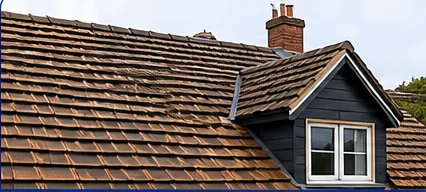
Chapter 1: Why are tiles slipping out of the roof of our old brick cottage in Ramsdell?
What we find
On a cottage that has stood for a couple of centuries, the usual cause is not the tile itself but what holds it. Plain clay tiles were hung on oak pegs or iron nails, and over time the nails rust through and the pegs rot, so a tile that looks fine from the lane quietly loses its hold. Roofers call this nail sickness. The first sign is a tile sitting a little lower than its neighbours, or fragments of clay in a flower bed under the eaves.
Frost adds to it. Softer, older clay takes in water in winter, the face flakes off in thin layers, and a tile weakened this way snaps at the nail hole in a gust. In the loft you may see daylight through a course, or damp on the underside of the battens beneath the slipped area. Rural, open slopes take the worst of the wind, so the fault tends to start on the side facing the weather.
What we fix
We start by photographing the whole roof and tapping through the tiles to find which ones are sound. Often only a patch has failed. We strip that section, keep every good tile, and replace broken ones with reclaimed or handmade plain tiles matched for colour and curve, so the repair does not stand out. Fresh battens are laid where the old ones came off, and each tile is secured with nails and clips chosen for the job, not hung back on the old corroded ones.
If the survey shows the nails have gone across the whole roof, patching stops making sense, and the photographs let you see the evidence for yourself. Our guide to nail sickness explains how to spot it from the ground. Conservation area status makes a careful repair the sensible route either way.
