
Beacon Basingstoke Roofing

Roofers in Wootton St Lawrence

Wootton St Lawrence is 3.7 road miles west of Basingstoke, a long strip of parish whose oldest roofs sit around a church rebuilt in 1864 and whose land runs from Tadley's edge down towards Kempshott. We survey village roofs and outbuildings with photographs, then give you a quote with the price fixed.

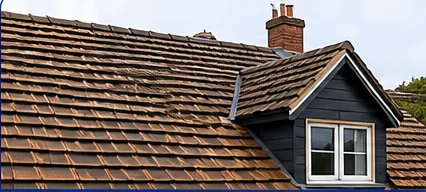
Clay tiled pitched roof gable on a red-brick house

Wootton St Lawrence roofs, house and farm

  • 1930s semi-detached houses with hipped clay tile roofs and bay windows on a suburban road

    Old village houses and cottages

    The village has a long history, from a church whose north arcade and tower date from the 12th century to the Wootton oak taken around 1390 to rebuild the nave of Winchester Cathedral. Older houses here may carry hand-made clay plain tile or slate on steep pitches, and we confirm which at the survey. On a roof of that age the timbers are often sound, while the covering and the flashings are what wear.

  • House roof stripped to battens during a roof replacement

    Outbuildings, barns and garages

    A parish this size has many farm buildings, sheds and garages, and their roofs are a world away from the houses: corrugated sheets of fibre cement, steel or plastic, timber purlins and open-sided bays. These roofs fail at the fixings and the laps. Older grey sheets may contain asbestos cement, so we treat them with care and say what is safe to do before anything is touched.

  • A row of Victorian terraced houses with Welsh slate roofs and brick chimneys in Reading

    Exposed ridges near the A339

    The A339 crosses the parish, and the majority of it lies on the Ramsdell side of the road, and a house standing on open ground there has little between it and the weather. Roofs in that position take more wind at the ridge and the gable edges than a house in a terrace would. The first signs are loosened ridge tiles and lifted verge tiles rather than anything in the main roof slope.

3.7 road miles west of Basingstoke

Planning and building control in Wootton St Lawrence

In Wootton St Lawrence the planning and building control authority is Basingstoke and Deane Borough Council, and the council's website is where to check whether a particular house is listed or sits in a protected area. We have not assumed either for any house in the village. The medieval church of St Lawrence, rebuilt in 1864 but keeping its 12th-century north arcade and tower, is an obvious reminder that older buildings in the parish may carry restrictions.

On an ordinary house, small repairs and patch re-covering rarely trigger paperwork. Replacing the entire covering can, and the roof insulation may need to be improved as part of the job; where it applies, we handle that for you. A listed building is treated differently: matching repairs are generally acceptable, whereas a new material or look may need consent from the council's conservation officer, who should be asked before anything is ordered. For roof windows, the skylight planning guide is the place to start.

Faults on Wootton St Lawrence roofs, and the fixes

Wootton St Lawrence has no single housing type, which is what makes its roofs interesting. A village of older tiled houses sits alongside farm sheds and garages, and the open ground around them gives the wind a clear run.

Chapter 1: Why are the tiles slipping on our old cottage near the church in Wootton St Lawrence?

What we find

Plain clay tiles on an old cottage were hung on battens with oak pegs or iron nails, depending on the age of the roof. Both fail with time. Iron nails rust until they shear, which roofers call nail sickness, and pegs soften and rot where damp lingers. Once a tile has dropped a few millimetres, its neighbours begin to follow, and a stripe of slipped tiles opens across the slope.

From the garden, look for tiles that sit lower than their course, gaps showing dark underlay and moss gathering in the slipped areas. In the loft, there may be pieces of tile or a nail lying on the insulation, and daylight along a line of battens. The timbers of these roofs are often substantial, but the small fixings holding the covering on are the weak point, and no amount of re-bedding fixes that.

What we fix

We strip the affected area only, set aside every sound tile, and check the battens and the rafters beneath. Rotten battens are replaced, and stainless steel nails or clips hold the tiles, where the old rusted ones once did. Missing tiles are replaced from reclaimed stock of a similar colour and curve, so the mended slope blends in.

If the whole slope is affected, we explain why and quote for a larger job. If the house is listed, the survey photographs give you the record to put in front of the conservation officer before work begins. Our nail sickness guide explains the problem in more detail, and the guide to matching new tiles covers the repair side.

Chapter 2: The corrugated roof on our barn near Wootton St Lawrence is leaking. Is it asbestos?

What we find

Farm buildings and larger garages are often roofed in corrugated sheets, and some of the older grey ones are asbestos cement. Nobody can say with certainty by eye. Treat grey sheets of that age as suspect until tested, and do not drill, jet wash or walk on them. Sheets that have weathered become brittle, and a heavy footstep or a fallen branch will break one.

Leaks on these roofs usually come from the fixings and the laps rather than the sheet itself. Bolts rust and their washers perish, the laps between sheets open as the purlins (the horizontal timbers the sheets are fixed to) move, and a cracked sheet lets water through directly. Inside, you will see dripping at the bolts, daylight along the laps, and rusted or rotten purlins.

What we fix

If the sheets are asbestos cement, HSE guidance allows them to be lifted off intact as non-licensed work, provided there is a risk assessment, suitable controls and trained operatives. Smashing them up would make the job notifiable, so we plan the removal to keep every sheet in one piece. On a small building, overlaying with a new roof is sometimes the sensible alternative, and we say which suits yours after the survey.

Where the sheets are steel or fibre cement without asbestos, we renew the fixings, replace cracked sheets and reseal the laps. Typical UK prices reported for asbestos garage roof removal run from £1,200 to £2,000 for a single garage, from a single source. Your fixed quote follows the survey. Our garage roof replacement page covers the options.

Chapter 3: Ridge tiles keep lifting on our exposed house on the Ramsdell side of the A339. What is wrong?

What we find

Open land gives wind a clear run at the highest and outermost parts of a roof, which are the ridge, the hips and the verge (the sloping edge where the roof stops at a gable wall). On older houses in the parish, those parts were usually bedded in sand and cement mortar. Years of weather crack that bedding, and a ridge tile can then move in a gale.

You may find fragments of mortar below the eaves, a ridge line that no longer looks straight, or the gable edge tiles lifting at the corner. In the roof space, the signs are a draught along the ridge board, damp staining on timber beneath it, or snow and rain blown into the loft in a storm. Because the wind comes from the same quarter every time, the same side of the house is normally affected first.

What we fix

We remove a few ridge tiles to see whether they are sound and the mortar alone has failed. If so, the tiles are refixed with a dry-fix ridge, clipped or screwed to a batten over a ventilated roll, since the current tile-fixing standard, BS 5534, wants a mechanical fix and no longer trusts mortar alone. Dry-fix kits fall under BS 8612. Dry verge units protect the gable edge in the same visit.

On a semi, a dry ridge is reported at £900 to £1,600 across the UK, plus £300 to £900 of scaffold, which is the larger bill for a detached house here. We list what the scaffold covers. See ridge tile repairs for the full picture.

Chapter 4: What makes the gutters on a village house here overflow every autumn?

What we find

Much of the parish is rural, and houses stand close to mature trees. Leaves, seed cases and twigs collect in gutters and block the outlets, then rot into a black sludge that holds water. The soil here is loam over chalk, which drains well, so the problem is not wet ground. It is the canopy above the roof, and the debris it drops.

When a gutter is blocked, water slops over the lip and streaks the wall, or backs up behind the gutter into the fascia and the rafter feet. Look for green staining on the brick below a joint, sagging runs, plants growing in the gutter, and a dark tide mark under the eaves. Shaded roof slopes under the trees also collect moss, which sheds into the gutter and makes matters worse.

What we fix

We clear the gutters and downpipes by hand, check the falls and the joints, and refix or replace brackets where the run has sagged. Failed joints are resealed or replaced. If the fascia behind has started to rot, we cut the soft section back to sound timber and renew it. A gutter guard helps on a few runs, though it needs checking, and we advise you honestly on whether it is worth fitting.

Moss is removed by hand with a biocide, not a pressure washer, which can damage tile surfaces. Cleaning by hand with biocide is reported across the UK between £748 on a small roof and £978 on a large one, and shaded village plots lean towards the upper figure. The roof cleaning and overflowing gutters guides cover the detail.

Wootton St Lawrence roofing questions

Which parts of a roof suffer first on open ground around Wootton St Lawrence?

Wind lifts whatever is least secure: ridge tiles bedded on old mortar, verge tiles, hip ends and any tile whose nail has rusted. Open ground gives the wind a clear run, so a house that stands alone takes more of it than one in a street. At survey we check those edges first, photograph any loose or slipped tiles, and re-fix or replace only what has failed.

Can you fit a roof on a barn conversion or farm outbuilding?

Yes. Farm buildings and garages are common in the parish, and the covering varies from clay tile to steel sheet. We survey the building, photograph the defects and advise whether repair or replacement makes sense. For older sheets, we check for asbestos cement first, and only work on them following HSE guidance.

Is the oak in an old Wootton roof worth saving?

Usually, yes. Timber that was cut centuries ago was often of a quality that is hard to buy now, and sound oak can last as long as the building. We check for rot at the feet of the rafters and at the wall plate, and for insect damage, and we retain whatever is sound. Only timbers that have lost their strength are replaced, and we explain why in the survey photographs.

Do bats or birds affect roof work in the village?

They can. Old barns, houses near the church and tiled roofs in a rural parish can shelter bats and nesting birds, and both are protected. Work may need to be timed or surveyed first. If we find signs during the survey, we stop and tell you before any tile is lifted, so you can arrange the right checks.

Does the Manydown estate history affect roofs in the parish?

Not directly. Manydown House, about a mile south-west of the village, was pulled down in 1965, so there is no roof of it to repair. Older buildings in the parish can still have long and tangled repair histories of their own, so the survey looks only at the roof in front of us and records what is actually on it, whatever its story.

Get your free roof survey in Wootton St Lawrence

Tell us what’s happening and we’ll call you back to arrange a visit. You’ll get photos of your roof and a fixed written quote.

  • No obligation
  • Photo report of your roof
  • 10-year workmanship guarantee

Rather talk? 01256 213956

Call Free survey