
Beacon Basingstoke Roofing

Roofers in Hatch Warren

Hatch Warren is 4.1 road miles south-west of Basingstoke, a suburb of estate houses built in waves, with a school dating from around 1990 and a burst of new housing in the mid to late 2000s. Concrete tile roofs, flat-roofed garages and extensions are the norm. Before any work, we photograph the problem on your own roof and send a written quote at a fixed price.

Brick estate houses with concrete tile roofs among pine trees

Roofs we see in Hatch Warren

  • Clay tiled pitched roof gable on a red-brick house

    Estate houses from around 1990

    Hatch Warren grew from the late twentieth century, and Hatchwarren Junior and Infant School, built around 1990, is a marker of that earlier housing. Houses of this age typically carry concrete interlocking tiles over felt underlay, with mortar bedded ridges and verges, and fascias in painted timber or plastic. They are now past thirty years old, which is when the bedding mortar, the roofline plastics and the flashings begin to show wear.

  • Slipped and cracked clay roof tiles

    Mid to late 2000s housing

    Hatch Warren, Popley and Beggarwood all saw rapid housebuilding in the mid to late 2000s. Roofs from that boom are younger, so wholesale replacement is rare. The faults tend to be smaller ones: a poorly finished valley, a flashing that has lifted at a wall abutment, a cut tile that was never well fixed or a tray that was not properly lapped. Most are repairs, and a survey finds them early.

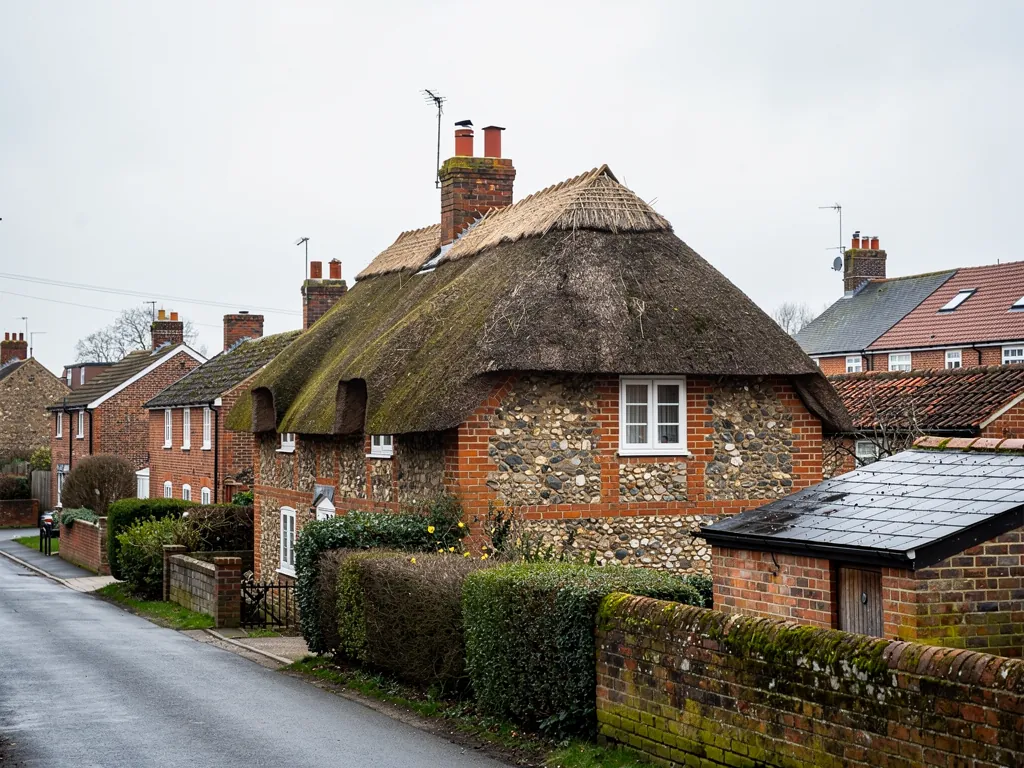
  • A thatched cottage in a Test Valley village with a brick chimney

    Garages, extensions and retail units

    Behind the houses sit flat roofs: garages, kitchen extensions, porches and bay canopies, usually felt or a single-ply membrane. Hatch Warren also has a small retail park with a Sainsbury's supermarket and petrol station, where roofs and canopies are a different scale. Each type fails in its own way, and each has a repair or re-cover that we price from photographs of your own roof.

4.1 road miles south-west of Basingstoke

Planning and building control in Hatch Warren

For both planning and building control, Hatch Warren answers to Basingstoke and Deane Borough Council, and in 2011 it formed part of a ward, Hatch Warren and Beggarwood, with 9,284 residents. Because most of the housing here is modern, conservation area limits are not the usual concern the way they are in an old village, but it is still sensible to check your address with the council's planning team before any change to materials or appearance.

Building control is the more common question. According to the Planning Portal, repairs or re-covering do not normally need a building control application if they affect less than 25% of the building envelope and less than 50% of the roof. A full re-cover goes beyond that, and the insulation of the whole roof may have to be upgraded at the same time. We handle that side for you. If a roof window is on your list, the skylight planning permission guide lays out what applies.

What we find on Hatch Warren roofs

Hatch Warren roofs are younger than most in our area, which changes what goes wrong. You are less likely to find rotten timbers or nail sickness and more likely to find a loosening ridge, a split roofline plastic or a flat roof that has begun to pond.

Chapter 1: Why are the ridge tiles on our Hatch Warren house loose when the roof is barely thirty years old?

What we find

Concrete tiles themselves last a long time, but the mortar that held the ridge was never expected to last as long as the tiles. On houses from the 1990s the ridge (the capping tiles running along the very top), was bedded on sand and cement mortar, and the verge at the gable end was finished the same way. Mortar shrinks as it cures, then cracks as the roof moves through hot summers and freezing winters, until the tile can rock and water can get in beneath it.

On a roof this age, the first sign is often a hairline crack running along the pointing beneath the ridge tile, or small pieces of mortar in the gutter. Later, a ridge piece may sit at an angle, or a verge tile may lift in a gale. Indoors, a damp mark high on a landing wall or a stain on the ceiling by the gable can be the first hint that rain is getting in at the ridge.

What we fix

Where the tiles prove sound and just the bedding has gone, we refix them rather than replace them. BS 5534 calls for mechanical fixing of ridge, hip and verge components, with mortar not relied on alone, so the neat way to do it is dry-fix. A batten is screwed along the ridge line, the capping tiles are secured to it with a breathable roll underneath, and clip-on verge caps cover the tile ends at each gable. BS 8612 is the benchmark for these kits, and the finished ridge has no mortar to maintain.

On a semi, cost guides show a typical UK range of £900 to £1,600 for a dry ridge, plus £300 to £900 for scaffold. Your fixed quote follows the survey. When the scaffold is up, it is cheaper to deal with the fascias and gutters in the same visit. See our ridge, verge and dry-fix page for how each system works.

Chapter 2: There is a damp patch where our extension roof meets the house wall. Is that the flashing?

What we find

Very probably. Where a pitched roof or a flat extension roof butts up to a house wall, the joint is sealed with a flashing, a strip of lead or other metal folded into the wall and dressed over the roof covering. On newer estate houses a mortar fillet was sometimes used instead, a sloping bead of cement along the junction. Mortar does not move with the roof, so it cracks and lets go, and rain then runs behind it into the wall head.

The signs are a stain on the wall inside, on the ceiling near the junction or on the plaster beside a chimney breast. Outside, look for a gap between the fillet and the brick, mortar crumbs below it, or a sheet of lead that has lifted and curled at one edge. The leak may appear only in driving rain from one direction, which makes it hard to trace without a close look from the roof.

What we fix

We trace the water from the stain back to the joint, checking the flashing, the tiles beside it and the cavity tray where the wall is built. Where a mortar fillet has failed, the lasting repair is to cut a chase (a narrow groove) into the brick joint and fit lead flashing tucked into it, then dress the lead over the tile or the edge of the flat roof. Our guide to lead flashing against a mortar fillet explains the difference.

If an old lead flashing is simply lifted at one edge, it may need only refixing and re-pointing. We show you the failed section in the survey photographs, so you can see which one you have. For a new-build extension that is still under a builder's warranty, check the paperwork first., and the repair carries our written guarantee. Our lead roofing page has more.

Chapter 3: The flat roof on our garage in Hatch Warren holds water after rain. Should we repair or replace it?

What we find

Water that stays on a flat roof for more than a day or two after rain is called ponding. It happens when the deck has sagged between its joists, or when the roof was laid with too little fall, the slope that should carry water to the edge. Standing water ages the membrane faster, because it freezes and thaws in the same spot and it carries dirt and algae that eat into the surface.

On a garage or extension from the 1990s, the original covering is often felt, and felt tends to blister, split along its seams and crack at the upstand, the short upturned edge where the roof meets a wall. From inside, look for dark stains on the garage ceiling, damp in the corners or soft patches in the boards. If you can see daylight at the eaves, the deck needs checking before any covering goes on.

What we fix

A small split in an otherwise sound felt roof can be patched, and we say so after the survey if that is all it needs. Where the covering is failing generally, or the deck is soft, the sensible route is to strip back, replace any rotten boards, correct the fall and re-cover in EPDM (a single-sheet synthetic rubber membrane) or GRP (fibreglass matting set in resin on site, which cures into one hard shell). Cost guides put EPDM on a single garage at a typical UK range of £1,200 to £2,500, and the fixed quote follows once we have seen the roof.

Our ponding guide explains the causes in more detail, and EPDM, GRP and felt compared helps you pick a material. If the garage has an old corrugated roof, ask us to look at it before anyone drills or jet washes it.

Chapter 4: Our uPVC fascias and gutters have cracked and sagged. Can they be renewed without a new roof?

What we find

Yes, the roofline is separate from the roof covering, and a cracked roofline does not mean the tiles are finished. On many houses built from around 1990, the fascia (the long board across the rafter ends that the gutter hangs from) and the soffit (the board that closes the gap beneath the overhang) are often plastic, either original or fitted since. Plastic goes brittle in the sun, the joints between lengths open and the gutter brackets pull loose, so the gutter sags and the joints weep.

A sagging gutter is more than a cosmetic fault. When water cannot run to the outlet, it overflows against the wall or drips behind the fascia onto the rafter ends. You may notice green stains below a joint, water pouring over the front edge in heavy rain or a gutter that no longer follows the line of the eaves. A cracked soffit also lets birds and wasps into the roof space.

What we fix

We check the rafter ends and the wall plate behind the old boards first, because that is where hidden damp shows up. Sound timber stays. The old fascia, soffit and gutters come off, and new boards, ventilated soffits and gutters go on with fresh brackets at the right spacing and a fall towards the outlets. A full uPVC roofline on a semi has a reported typical UK range of £1,800 to £3,500, and scaffold hire adds anything from £200 to £2,600.

The ventilation in the new soffit matters for the roof space, and our guide to soffit ventilation explains why. See the guttering, soffits and fascias page for the options.

Hatch Warren roofing questions

Should plastic fascias and soffits on a 2000s Hatch Warren house be repaired or replaced?

Roofline plastic from the 2000s can split, sag at the joints or lose its fixings. A single cracked board or joint cover can usually be re-fixed or swapped for a matching one. If boards are warped, or the timber behind them is damp, we replace a longer run. The fascia is the board under the gutter and the soffit closes the underside of the eaves. We photograph each section so you see the fault.

Is my 2000s-built roof still covered by a builder's warranty?

That is something to check in your paperwork before you pay anyone. If a warranty from the original builder or developer is still running, a roof fault may fall under it. We can survey the roof and supply photographs to show the cause of the fault, which helps with any claim, and where no cover applies, our own repairs carry a 10-year workmanship guarantee in writing.

Do you work on commercial roofs at the retail park?

Yes, we cover business premises as well as homes, from shop units and canopies to warehouses. The work differs from a house, with larger flat areas, single-ply membranes and safe access to think about. Our commercial roofing page explains what we do, and we survey a commercial roof with photographs in the same way as a domestic one.

Can I add a roof window to a Hatch Warren house?

In many cases, yes. On a modern estate house a roof window is usually a straightforward job, though you should check your address with Basingstoke and Deane's planning team first. Read our guide on roof windows for loft conversions, because a loft conversion also brings means of escape and building control questions that we can talk through.

Why does moss grow on our roof when the houses are fairly new?

Moss needs damp, shade and a rough surface, and concrete tiles provide the surface within a few years. A north slope that is shaded by a neighbour's house or a mature tree dries slowly, and spores settle in the laps between tiles. We clear moss by hand and apply a biocide, because a pressure washer can strip the tile surface, and we clean the gutters in the same visit.

Get your free roof survey in Hatch Warren

Tell us what’s happening and we’ll call you back to arrange a visit. You’ll get photos of your roof and a fixed written quote.

  • No obligation
  • Photo report of your roof
  • 10-year workmanship guarantee

Rather talk? 01256 213956

Call Free survey