


Chapter 1: Why are mortar crumbs and loose ridge tiles turning up on our Kempshott estate house?
What we find
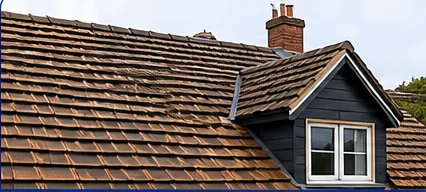
In the 1970s and early 1980s a ridge, the run of cap tiles that closes the roof at its peak, was bedded on mortar and nothing else. The verge, where the roof stops at a gable wall, was treated the same way. Mortar is a rigid material fixed to tiles that expand and contract with the temperature, and after decades the bond breaks. Frost gets into the hairline cracks and lifts the mortar away in lumps.
The evidence is usually underfoot before it is overhead: grit on the path, sand in the gutter or on the car roof, a ridge tile that has shifted in its bed. The Old Down end of the suburb is open to the weather coming off chalk grassland, and a gust can finish what the frost started. From the loft, you may see daylight along the apex or a darkened rafter where water has crept in.
What we fix
We lift a sample of the ridge to see whether the tiles themselves are sound, which on concrete tile of this age is the normal finding. They can be reused, but the standard BS 5534 now expects ridge, hip and verge units to be fixed mechanically, so mortar is not relied on alone. On a Kempshott estate roof, that usually means a dry-fix system: a batten, a vented roll and clips or screws holding each tile, all of it covered by BS 8612.
Dry verge units go on at the same visit, so the whole perimeter is done together. A dry ridge on a semi usually falls between £900 and £1,600 across the UK, with scaffold between £300 and £900 extra. The fixed quote comes after the survey. The choices are set out on our ridge tile repairs page.
