A landlord rarely sees the roof. Tenants live under it, a letting agent visits the rooms, and the first anyone hears of a problem is a phone call about a stain on a bedroom ceiling. By then the water has been getting in for a while, the plaster is damp, the insulation may be soaked and a repair that would have cost a modest amount has become a larger job with redecoration on top. Inspecting roofs on a schedule moves the cost to the cheap end of that curve. This page is for private landlords with a few properties and for managing agents with a portfolio or a block. It sets out what an inspection routine looks like, how to deal with tenants, what to record and how the findings feed a maintenance budget.
Why a landlord's roof needs a routine
Owner-occupiers notice roof trouble because they live with it. A landlord depends on someone else to notice and report. Tenants may not realise that a slow drip in the loft is a problem, may not be able to see the loft at all, or may hesitate to report a fault for fear of the rent or a dispute. The result is that roof defects in let properties tend to be found late.
The financial case is straightforward. Water entering a roof does three kinds of harm in sequence: it rots timber and corrodes fixings, it soaks insulation and plaster, and then it produces damp and mould that affect the tenants' health and the property's value. Each stage costs more than the one before. A scheduled inspection finds the first stage while a repair is still small, and it gives you a dated record that you looked.
Responsibility is the other half of the case. For most residential lettings the structure and exterior of the building, which includes the roof, is the landlord's to keep in repair rather than the tenant's, though the exact position depends on the tenancy or lease, and you should check your own agreement and take advice from a solicitor or your professional body if you are unsure. For blocks of flats, the responsibility often sits with a freeholder or management company and is paid for through service charges. In every case, someone is expected to know the roof's condition, and a written inspection is the best evidence that they did.
How often to inspect
There is no single interval that suits every roof, but a few sensible rules apply. A visual check from the ground and the loft once a year is a good baseline for most pitched roofs. Add an inspection after a severe storm, because wind damage is quick and rain follows. Older roofs, roofs in exposed positions, roofs with trees overhead and any flat roofs justify more attention, often a check in autumn before the wet season and another in spring. A roof that has just been repaired benefits from a check after the first heavy rain to confirm the fix.
It also helps to inspect at natural points in a tenancy: before a new tenant moves in, when a tenant leaves and before you refinance, sell or renew the buildings insurance. Our short answer on how often a roof should be inspected goes into the reasoning in more detail.
Handling access and tenants
An inspection needs access to the outside of the building and often to the loft, and the loft hatch may sit inside a tenant's flat or bedroom. The process is easiest when the tenancy agreement already allows access for inspection and repair on reasonable notice. Follow whatever notice your agreement and the law require, put the date and time in writing, and explain what the visit involves and how long it takes. A short, polite note that says a roofer will check the roof and the loft for leaks usually gets a cooperative response.
Where possible, arrange for the agent or the roofer to be accompanied only if the tenant wishes. Tell tenants who is coming and what the person looks like. Ask them about any leaks, stains, noises and draughts, since they know the property better than anyone. Document their answers, and make sure the tenant knows how to report a problem between inspections. A simple message to a named contact, with a photo, is often enough. Be clear that reporting a leak quickly will not be held against them.
For emergencies, such as an active leak, a damaged chimney or a lifted section of roof, access cannot wait for a booked slot. A tenant who calls to say water is coming through a ceiling needs a fast answer. We prioritise leaking roofs and make them safe first, then plan the permanent repair, and our emergency roof repairs page explains how that works.
What a landlord's inspection should include
The checks are the same as for any roof, covered in our roof inspection checklist, but the report is set up for different readers. Each property should have its own page with address, date, access method, a description of the roof and covering, a list of findings tied to photographs, a priority for each and a recommended action with an indicative cost. Add the condition of the gutters, fascias and soffits, the loft and its insulation, any flat sections and chimneys. Mention anything that needs a different trade, such as a leaking pipe or a faulty extractor.
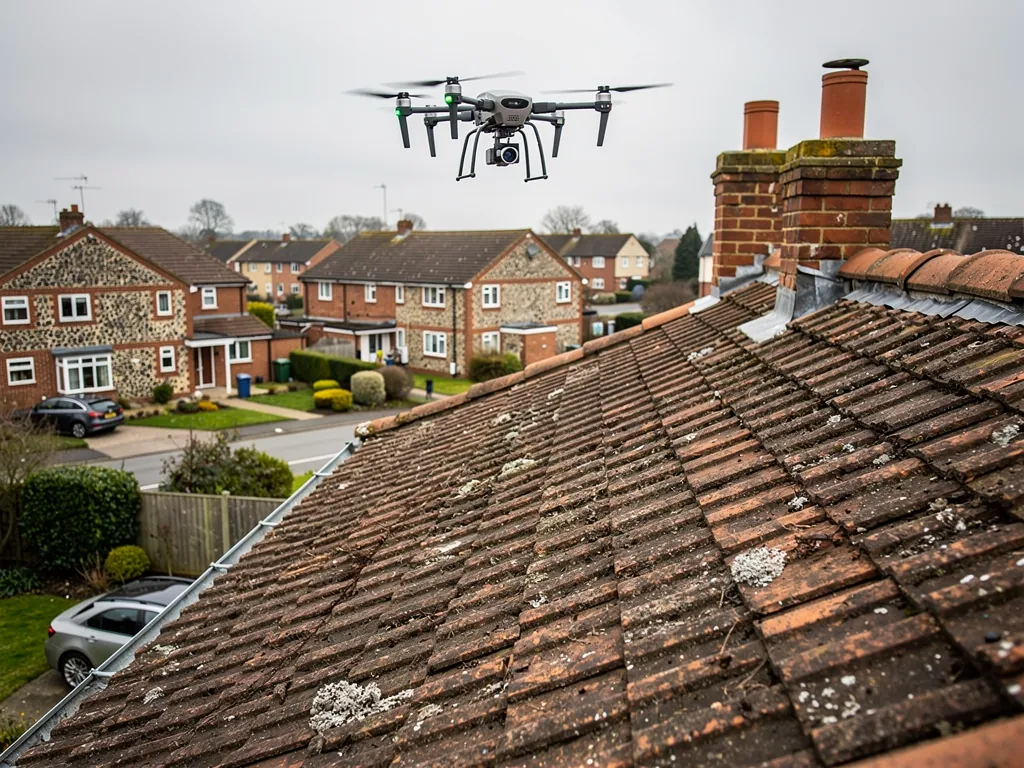
Where the building has solar panels, satellite dishes, aerials or rooflights, include them. For multi-storey blocks, high roofs or roofs that are awkward to reach, a drone can supply the overview and cut the cost of access, though it does not replace a close look at junctions; see our guide to drone roof surveys.
Keeping records that stand up
Keep an inspection file for each property. In it, hold the dated reports and photographs, the invoices for repairs, any guarantees and a note of who attended. A pattern of regular checks and prompt repairs demonstrates that you take the building seriously. It helps in conversations with tenants, with leaseholders who pay service charges, with mortgage lenders and with insurers. If a claim is made after a storm or a long-running leak, a record of the roof's condition before the event is far better than recollection. Our page on roof reports for insurance claims covers what insurers tend to want to see.
Photographs should be taken from the same positions each time, so that changes show up. Store them with the date in the filename. If you use property management software, attach the report to the property record, and set the next inspection date as a reminder rather than relying on memory.
Turning findings into a budget
An inspection report should end in a plan, not a list of worries. Sort the findings into three groups: do now, do this year and monitor. Items that let water in or put people at risk go in the first group. Items that will worsen if ignored, such as worn flashings or ridge bedding, go in the second. Normal ageing goes in the third, with a date for the next look. Price each group and set aside the money. For older roofs, ask the roofer how many years remain, then compare the cost of repeated repairs with a replacement at a planned date.
Planned replacement is far cheaper than emergency replacement. It lets you choose the covering, price it properly and schedule it between tenancies. For the cost of a whole roof, our guide to what a new roof costs sets out typical UK ranges, and each of our quotes is fixed and written once the survey is done.
What differs between property types
A single terraced house, a converted house split into flats and a purpose-built block all call for different handling. In a terrace, shared party walls and chimneys mean the roof is bound up with the neighbours' roofs, so lead flashings and the stacks need careful attention and any repair may touch next door's side. In a converted house, the loft may serve more than one flat, and a leak in one top-floor flat may start above another. Mapping which part of the roof sits above which unit is the first job.
In a house in multiple occupation, wear on the property is generally heavier and the loft is less likely to be visited by anyone. Check that hatches are accessible, that stored items are not blocking the eaves and that nobody has been using the loft for something it was not designed for. For purpose-built blocks, the roof is often flat or low-pitched, with a membrane that has a known life; ask for the age of the covering and plan its replacement as a project, not a reaction to leaks. For older terraced and period houses, the roof timbers and coverings tend to be the point of interest, and the inspection is as much about the structure as the surface.
Finally, think about the neighbours and the street. A tile that falls from your roof lands on someone's car or path, and a chimney that sheds brick is a hazard to passers-by. An inspection that spots those risks early is a maintenance matter and a sensible way to protect people and avoid disputes.
Commercial and mixed-use property
Landlords of shops, offices and units have a different set of roofs: large flat areas, profiled metal or single-ply membranes, rooflights, walkways and many penetrations. They also have duties towards people working on the roof, because anyone who goes up for maintenance is working at height, and the HSE publishes guidance on that at hse.gov.uk. Roof access points, edge protection and fall-arrest anchors should be checked as part of the inspection, and access should be limited to people who are competent to use it. We cover that side of the work on our commercial roofing page.
For managing agents, a single report for a block or an estate should be broken down by roof area, with a summary at the start and a five-year view of likely work. That is what a freeholder, a residents' association or a board will want to see. Photographs matter more, since the readers may never visit the site.
Setting up a regular arrangement
If you own several properties, the simplest approach is a rolling programme: a fixed date each year for each building, with the same roofer attending where possible, so the reports line up and the roofer knows the history. We offer free surveys with photos of the actual roof and a fixed written quote for any repair, and you can read about the service on our roof inspections in Basingstoke page. To talk through a portfolio or a block, phone 01256 213956, or message the addresses to us on WhatsApp.
