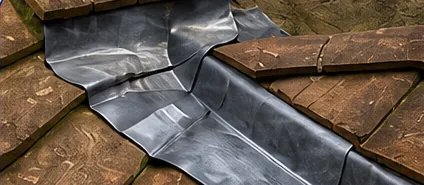
Lead has sealed British roof junctions for centuries, so any alternative has a lot to live up to. Yet there are good reasons to ask. Lead is heavy, soft and attractive to thieves. It has to be worked by hand by someone who knows the craft, and the price of the metal moves with the market. Manufacturers have responded with a range of lead-free flashing products, and some of them are very good at particular jobs. Others are marketed as a like-for-like swap and are nothing of the kind. This page looks at each main alternative honestly, says where it works and says where we would stay with lead.
What a flashing material has to do
Before comparing products, it helps to be clear about the job. A flashing bridges the gap between the roof and a wall, a chimney or a dormer cheek. It has to be flexible enough to move with the building as it warms and cools, durable enough to survive years of sun, frost and running water, and formable enough to be shaped around steps, corners and tile profiles. It has to stay in place in a gale and not pull away from the brickwork. And it has to be fixable by a capable roofer without specialist plant.
Lead scores well on nearly all of these. It is dense so it stays put, soft so it can be dressed tight against any surface, and it forms a protective oxide skin that keeps it going. Its drawbacks are weight, theft risk, and the skill needed to make a good detail. Every alternative gives something up to improve on one of those.
Self-adhesive flashing strip
This is the product most people mean by lead-free flashing. A roll of bitumen-based, aluminium-faced strip is pressed over the joint, the backing is peeled off and the adhesive sticks it to the surface. It is cheap, quick to fit and needs no special tools. The aluminium or coloured foil face is sometimes finished to mimic lead.
It works well for a short-term repair, for a low-visibility junction such as a flat extension's upstand against a wall, and for places where lead is likely to be stolen. It does not last like lead. The adhesive layer can degrade with sun and heat, the bitumen softens in summer and the bond loosens at edges as the building moves. On a clean, dry, sound surface it can serve for some years. On damp, dusty or crumbling brickwork it can fail early. We would use it as a stopgap or in a hidden location, not on a chimney that has to last, and we say so when we quote.
Aluminium
Pre-formed aluminium flashings are lightweight, corrosion-resistant and cheaper than lead sheet. They come as step flashings, cover flashings and trims in standard profiles, and can be powder-coated to match a roof. They are widely used on new-build and on commercial work, where the details repeat and speed matters.
Aluminium is stiffer than lead. It does not dress itself into irregular brickwork the way lead does, and it can be harder to seal on old buildings where the joints and the wall face are uneven. It also expands and contracts more than lead and can work loose without the right fixing. A further risk is contact with other metals: aluminium and copper in damp conditions corrode each other, and fresh lime or cement mortar attacks bare aluminium, so it needs protection where it is bedded in. On the right job, such as a new gable wall with a purpose-made cavity tray detail, it is a sound choice. On an old chimney with wandering joints it is a poor match.
Zinc and copper
Zinc and copper are real roofing metals with long histories, and both outperform the cheaper options. Copper lasts a very long time and weathers to a green patina that suits some buildings. Zinc gains a grey layer and suits modern, contemporary designs. Both can be soldered or welted into strong joints.
They are more expensive than aluminium and, in copper's case, more expensive than lead. They must also be kept apart from other metals: copper washing over lead or galvanised steel causes corrosion, and rainwater running off copper can stain masonry and attack aluminium gutters below. They also need the right skills. For most houses they are overkill for a flashing, though they have a place on bespoke work, standing seam roofs and where the architect specifies them.
Rubber and synthetic membranes
EPDM, the synthetic rubber used on flat roofs, is also made as a flashing strip and as a preformed corner or upstand piece. It is flexible and tolerates movement better than rigid metals. It is useful at the junctions of EPDM flat roofs, around rooflights and on extension abutments. We use it routinely there, because it is the same family of material as the roof it joins.
It is not a replacement for lead at a tile or slate abutment. The membrane needs a bonded top edge and a cover trim, it can look out of place against period brickwork, and it is not the right answer on a listed building. On flat roof details, though, it is often the better material.
Lead-substitute and polymer flashings
A newer group of products sells itself as lead without the lead: layers of polymer, metal foil and fabric formed into a malleable sheet. They can be dressed by hand and have a matt grey finish. Performance varies by product and by brand, and long-term data is shorter than for the metals. The practical points are the same as for any new material: check the manufacturer's installation instructions, ask for the guarantee in writing and be wary of claims of equivalence. Lead has centuries of evidence. These products have years.
| Material | Best use | Main drawback |
|---|---|---|
| Lead sheet | Chimneys, abutments, valleys, period buildings | Weight, theft risk, skilled labour |
| Self-adhesive strip | Short-term repairs, hidden junctions | Adhesive and bitumen age in sun and movement |
| Aluminium | New-build and repeated details | Stiff on irregular brickwork, reacts with mortar and copper |
| Zinc or copper | Bespoke and architectural work | Cost and metal compatibility |
| EPDM | Flat roof upstands and rooflight edges | Not suited to tile or slate abutments |
| Polymer lead substitute | Occasional use where lead is a theft target | Shorter track record |
Fixing and compatibility: the details that sink a good material
Most failures of lead-free flashings come from how they are fixed and what they touch, not from the material itself. Aluminium needs stainless or compatible fixings and a protective coat or isolating layer where it is bedded into fresh mortar. Copper should never sit upstream of lead or galvanised steel, because the run-off carries dissolved copper that corrodes the metal below. Adhesive strips need a primer on porous brick and a dry, clean surface, and the top edge should be tucked into a chase or covered by a cover trim so rain cannot get behind it. Where two products meet, for instance an EPDM upstand beside a short run of lead, the overlap and sealing method should be specified, not improvised on the roof.
It is worth asking the installer which standard or manufacturer's guidance the detail follows. A roofer who names the guidance and can show a finished example has done it before. A roofer who says "it is all the same" has not.
Where lead still wins
On chimneys, on tile and slate abutments, in valleys and on period roofs, lead remains our first choice. It can be dressed into irregular masonry, it lasts if specified and fitted properly, and a competent repair is straightforward years later. For a house in a conservation area or a listed building, like-for-like materials are usually expected, and changing how a roof looks can need consent, so ask your council's conservation team before any material is swapped. Our guide to leadwork on period and listed homes goes into that.
If lead has been stolen from your roof, a lead-free replacement can be a practical answer. The metal is worth stealing and a substitute is not, so the risk drops. Our page on lead theft from roofs covers prevention and what to do after a theft. Where the roof is not exposed and the building is not protected, we will quote both options and explain the trade-offs.
Asking the right questions about an alternative
If a roofer proposes a lead-free material, ask what it is, who makes it, what guarantee comes with it and how the top edge will be sealed. Ask why it suits this junction better than lead. A good answer refers to the roof and the wall and not a general claim. Ask whether the fixings and the mortar bedding are compatible with the metal. Ask how long the roofer expects it to last in this position, and whether you can see a finished example. A flashing that sticks well on day one and peels in year three has not saved you anything.
It is also fair to ask about the cost of each option, written side by side. Published UK guides put replacing chimney leadwork at an average near £570 within a range of £350 to £920, and a four-sided chimney flashing at around £525 without scaffold. Those are typical UK ranges, not Beacon prices, and the figure you are held to comes only after the survey. Lead-free options come in below that figure in some cases and not in others, once labour is counted.
What we do
We look at the junction first. We check the wall, the pointing, the tile or slate profile, the movement and the exposure, then tell you which material suits it. If lead is the right answer we say so and explain why. If a lead-free product is the better call, for a flat roof upstand or a theft-prone spot, we will use it. You get photographs of your own flashing, a fixed written quote, with the 10-year workmanship guarantee set down in the paperwork. Everything else we do in sheet metal sits on our lead roofing and leadwork page. If you would like a view on a specific junction, WhatsApp us a photo or phone 01256 213956.
