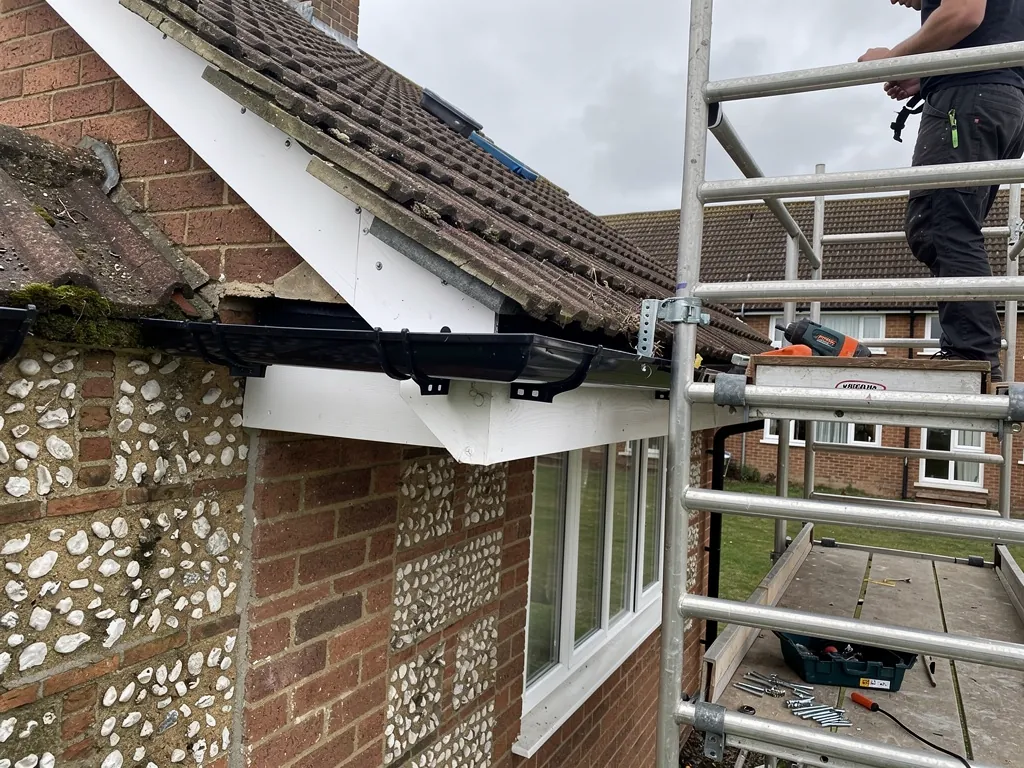
Choosing a guttering material is less a matter of which is best than of which suits the house in front of you. Plastic is light and cheap and fits most modern homes. Aluminium lasts longer and keeps its colour. Cast iron belongs on older buildings and is heavy, handsome and demanding. Each does the same job of collecting rain and moving it to a drain, and each can do that job well for years if it is fitted properly on a sound board. Where they differ is in cost, weight, how they age, how they are repaired and how they look. This guide compares them one at a time and then sets out which tends to suit which kind of house.
uPVC: the everyday choice
uPVC, or unplasticised polyvinyl chloride, is the standard guttering on most British homes built or re-guttered in recent decades. It is made in short lengths that clip into brackets, joined by seals, and it comes in half-round, square, deep-flow and ogee profiles, in black, white, grey, brown and a few other colours.
Its strengths are cost and simplicity. It is the cheapest of the three to buy, light enough for one person to lift, easy to cut and to fit, and it does not rust. A damaged length can be swapped in minutes. It needs no painting. It suits a house with a sound fascia, a normal roof and a plain roofline, and for most semis and terraces in the newer parts of Basingstoke it is the sensible default.
Its weaknesses are age-related. Sunlight breaks down plastic over many years, turning white and black finishes chalky and making the material brittle. The joints depend on rubber seals that harden and shift. Long runs expand and contract with temperature, which can work joints loose. Poor-grade plastic, thin walls and too few brackets make all of this worse, so quality matters as much as the material itself. Our page on how long uPVC fascias last deals with the same family of plastics on the boards.
Aluminium: longer life, fewer joints
Aluminium guttering comes either in sectional lengths like plastic or formed in long continuous pieces. The metal is light, does not rust and holds a baked-on colour well. It is made in half-round, square and several moulded shapes, and the choice of colours is wide.
Its strengths are lifespan and finish. It does not become brittle in frost or chalk in sunlight, it keeps its shape over a long run and it looks neat. When formed in one length it removes most joints from the run, which removes the most common failure of the sectional system. Our page on jointless aluminium guttering covers that version in full.
Its weaknesses are cost and repair. Aluminium costs more than plastic to buy and to fit. It dents, and a dent cannot be pushed out neatly. A damaged section is harder to replace than a plastic one, and an old colour may be hard to match. Rain on metal is also louder than on plastic. It suits houses where the owner plans to stay, exposed positions and long straight runs.
Cast iron: for period character
Cast iron was the standard gutter material until the mid-twentieth century, and many Victorian, Edwardian and earlier houses still have the original or a close copy. It is heavy, with each length bolted to the next and sealed with putty or mastic, and carried on strong brackets. Profiles include half-round, ogee and moulded shapes with decorative stop ends and hoppers.
Its strengths are strength and character. A good cast iron gutter is rigid, long-lived with care, and gives a period house the look it was built with. Where a street is protected, or a building is listed, it may be the one choice the council will accept. It can be repaired, with replacement sections, new bolts and fresh sealant, and a well-kept run can last a very long time.
Its weaknesses are weight, upkeep and cost. It needs sound brackets fixed into a strong board or the masonry, and it needs painting every few years to keep rust at bay. It rusts from the inside as well as the outside, so a gutter that looks sound can be thin at the back. It is the dearest to buy, the heaviest to fit and the slowest to repair. If you own an older house, the separate page on period homes and their cast iron goes into repairing against replacing.
Cast aluminium: the lookalike
A fourth option sits between the three. Cast aluminium gutter is made in the same profiles as cast iron, with the same mouldings and fittings, at a fraction of the weight and without the rust. It is widely used where a period look is wanted but the building or the board cannot carry iron, or where the owner does not want a painting routine. It is more costly than plastic and sometimes more than iron to buy, though it lasts. In a conservation area, ask the council's planning team whether a lookalike will be accepted before you order.
Cost, in plain terms
We do not have a sourced per-metre price for each material and will not quote one. As an order of magnitude, plastic is cheapest, aluminium sits in the middle, and iron and cast aluminium cost most, with scaffold the same whatever you fit. For scale, a published guide prices a complete uPVC roofline at the lower end of a few thousand pounds for a semi and nearer to £6,000 at the top for a detached house, and aluminium or iron will sit above that. Your fixed quote follows the survey, with the material named. Our page on gutter replacement cost explains what moves the price.
Lifespan and what shortens it
We avoid quoting a number of years for any material, because the figures depend on exposure, quality and care, and no published source we trust gives one for gutters as a class. What can be said is how the order runs. Well-kept iron and good aluminium can last the longest. Plastic usually gives the shortest life of the three, but a good-grade, well-fixed run in a sheltered spot can serve for a long time. What shortens any of them is the same: too few brackets, a poor fall, a soft board, standing water and neglect. Our gutter maintenance guide shows how to look after whichever you have.
How fitting differs
The three materials go on the house in different ways, and that affects labour and risk. Plastic is clipped into brackets and joined with seals, so a competent pair can fit a long run in a short time, and a mistake is quickly corrected. Aluminium sectional gutter is fitted in much the same way, while the continuous version is formed to length and lifted into place whole. Cast iron is slow: each length is lifted, bolted to the last with a sealed joint, and checked for fall before the next, and the weight means two people on the scaffold at every stage. If the old gutter was iron and the new one is plastic, the brackets, fascia fixings and sometimes the downpipe connections all change.
Mistakes people make when choosing
Choosing on price alone is the first. A cheap, thin-walled plastic with brackets too far apart can cost more over a few winters than a better one. The second is choosing a heavy material for a weak board, which turns a good gutter into a falling one. The third is ignoring the roof: a gutter sized by the width of the house, not the area of roof that drains into it, will overflow. The fourth is picking on looks and forgetting upkeep, so that iron is fitted by someone who will never repaint it. The fifth is mixing metals, because aluminium and iron or steel in contact can corrode where they meet. A fitter who asks about your roof and your board before naming a material is thinking about the right things.
Weight and the board behind
A gutter hangs on its fixings, so the weight of the material and the water it holds decide what the board must carry. Plastic is the lightest and puts the smallest load on the fascia. Aluminium is light too. Cast iron is heavy, and a full run of it in a storm weighs a good deal, so it needs a strong board, close bracket spacing and often masonry fixings. Fitting iron to a soft fascia is a recipe for a gutter that drops in the first winter. In every case the board comes first, and our guide to rotten fascia boards explains how to check it.
Profile and capacity
The shape matters nearly as much as the material. Half-round is the plainest and the easiest to clean. Square gives a larger channel for the same width and a modern look. Ogee adds a moulded front that suits Victorian and Edwardian houses. The size has to match the roof: a large area or a steep pitch sends more water at once, and a gutter that is too small overflows whatever it is made of. Our answers on square, half-round or ogee guttering and on what size guttering you need explain how to choose.
Matching the gutter to the fascia and soffit
Gutters, fascias and soffits do not have to match in colour or material, but they should look as though they belong together. Black gutters on white boards is a common pairing, and many houses mix finishes. Our answer on whether gutters should match the fascia and soffit goes through the choices.
Which suits which house
| House or situation | Usually suits | Reason |
|---|---|---|
| Modern estate semi or terrace | uPVC | Low cost, light, easy to repair |
| Long, exposed detached house | Aluminium | Few joints, stable in frost and wind |
| Victorian or Edwardian terrace | Cast iron or cast aluminium | Matches the original profile and fittings |
| Listed or conservation area | Like-for-like, as the council allows | Material and appearance may be controlled |
| House you may sell soon | uPVC | Lowest outlay for a sound result |
| House you will keep for decades | Aluminium | Longer life and a lasting finish |
How we help you choose
We give a straight opinion on the survey, based on the house, the board and the length of run. Where plastic is the honest answer we say so, and where iron or aluminium makes sense we explain why, with photographs of what is there. The quote then names the material and lists it apart from the access and any board repairs. Everything we fit comes with our written ten-year workmanship cover. Our guttering, soffits and fascias page gives the wider picture, and you can ask us about your own roofline on 01256 213956.
