Searching for the cost of soffits and fascias turns up a lot of confident numbers, most of them per metre, and most of them for the boards alone. Boards are the cheap part. What you actually pay for is a team at height with scaffold, the removal of the old timber, the repair of whatever is behind it, new boards, vents and fixings, a tidy finish, and a skip. This guide sets out the typical UK ranges that have been published for whole jobs, then explains each factor that moves a figure up or down, so that when a quote arrives you can read it line by line.
The typical ranges, and their limits
One UK cost guide reports a full uPVC roofline for a three-bedroom semi in the range of £1,800 to £3,500, and for a detached house £3,000 to £6,000. A full roofline here means fascia boards, soffit boards, bargeboards where the house has them, and in most guides the guttering too. Scaffold hire is quoted separately by another source at anything from £200 for one side of a bungalow to £2,600 for a two-storey detached house with scaffold on all four sides. Treat all of these as typical UK ranges for orientation, and not as Beacon prices. Your fixed quote follows the survey.
| House | Typical UK range reported | What it usually covers |
|---|---|---|
| Three-bedroom semi | £1,800 to £3,500 | Full uPVC roofline: fascias, soffits, gutters and downpipes |
| Detached house | £3,000 to £6,000 | Full uPVC roofline on a larger perimeter |
| Scaffold, roofline only | £200 to £2,600 | One side of a bungalow up to all four sides of a two-storey detached |
The ranges are wide because the jobs are. A narrow terrace is mostly two straight elevations. A detached house with a garage, a bay and a porch has several roof edges at different heights, many corners and a good deal more cutting. Neither is an unusual house in Basingstoke.
Why the board is the smallest part of the bill
Plastic boards are inexpensive for the quantity needed. What costs money is the time, and the time is mostly in the access, the removal and the finish. Taking down old gutters and boards without damaging the tiles above, cutting new boards to fit round corners, fixing them to sound timber, forming neat mitres at the corners and sealing every joint takes careful hands. Our guide to what happens during a roofline replacement goes step by step through that work.
Material: uPVC, timber, aluminium and composite
uPVC is the default for good reason. It does not rot, needs no painting and is the lowest price per metre of the common choices. Hardwood or softwood timber costs more to supply, and it needs priming and painting both before fixing and every few years afterwards. It makes sense on a period house or in a conservation area where plastic would look wrong. Aluminium and composite boards are dearer again, and they suit people who want a particular finish or a very long maintenance-free life. For gutters, the material question has its own page, and our comparison of uPVC, aluminium and cast iron guttering sets out how they differ.
Within uPVC there are choices that affect price. Solid board against hollow-core board, plain white against woodgrain foil, and a standard square profile against a deeper or moulded one all change the figure. A good fitter should say which is quoted. Our answer on how long uPVC fascias last explains what lifespan to expect from different grades.
Scaffold and access
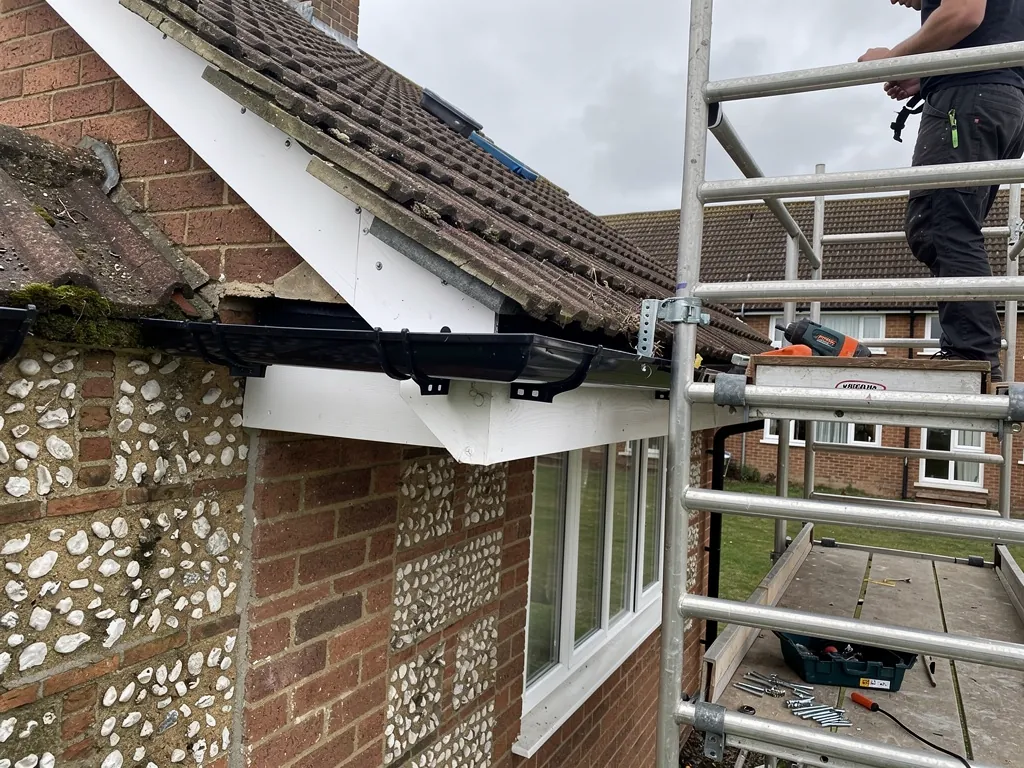
Work on a fascia is work on the edge of a roof, and that edge is out of safe ladder reach on any house above a single storey. Scaffold or a mobile tower is therefore a standing cost. It is charged by the size of the structure and by how long it is up, which is why a bungalow is at the bottom of the range and a big detached house at the top. A tower can serve a bungalow, a garage or a single storey extension at much lower cost, but a full scaffold is the safe choice on two storeys.
Access that is hard also raises the price: a narrow side passage, a conservatory in the way, a steep drive, or a boundary wall with neighbours who need to agree to scaffold on their side. These are worth mentioning at the survey. The answer to whether you need scaffolding to replace fascias explains when a tower is acceptable.
What is behind the old boards
This is where quotes diverge. A quote that assumes nothing is wrong behind the boards is cheaper than one that allows for repair, but it only stays cheap if nothing is wrong. Once the old fascia is off, the rafter ends, the wall plate and the back of the soffit are visible. Wet rot in a rafter end, a missing section of felt, a gap where birds or squirrels have been getting in, or an old soffit with no ventilation are all common findings, and each adds time and materials. Rafter ends can often be repaired in place with a spliced section of treated timber rather than a re-roof, but that is labour.
That is why we survey before quoting, and why the report includes photographs. If the boards are rotten we show you, and the quote states what the repair is. If the timber is sound we say that, and the figure falls. Our page on rotten fascia boards explains the signs we look for.
How the shape of the house changes the sum
Around Basingstoke the housing is mixed, and the roofline differs with it. A Victorian or Edwardian terrace near the town centre has a short front edge and a rear gutter that may be reached only through a neighbour's passage, so access dominates. A 1930s semi has deep eaves and often a hipped roof, which means more corners and more mitred joints. The estates built from the 1960s onwards frequently have shallow-pitched roofs, flat-roofed garages and porches with their own short fascias, and a bay with its own little roof. Each of those small edges costs time out of proportion to its length, because every end must be finished neatly. A bungalow is simple to reach, but a long hipped bungalow has a lot of perimeter. Count the corners, not just the length, when you compare house to house.
Keeping what is sound
A fair quote does not replace parts that are still good. Bargeboards in perfect condition on a gable, a soffit that is sound and vented, or a run of gutter that falls well and sits tight can stay, with only the failed lengths replaced. The result is a mixed roofline, and a good fitter will match the colour and profile so the join does not show. Doing less is cheaper, and we say so where it is the honest answer. The risk is on the other side: a firm that quotes to replace everything on every house is selling the boards, not judging the roof.
Gutters, vents and the extras
Gutters are usually replaced with the boards, because the gutter has to come off anyway and the brackets are fixed into the fascia. A new run adds material, and it adds a few more hours. If your gutters are sound and you want to keep them, they can be refitted, though old brackets and old plastic do not always survive being taken down. That is a conversation for the survey.
Ventilation is another extra worth having. Soffit boards with built-in vents, or discreet over-fascia vents, cost little to add while the boards are off and cost more to retrofit later. Our guide to soffit ventilation explains why a loft benefits. Bargeboards, which run up the gable ends, are priced as extra length, and a house with several gables will cost more for that reason.
Capping versus replacing
If the timber is sound, capping over the boards is cheaper in labour than replacement, though scaffold is unchanged. It is a sensible saving only where the wood is dry and solid, and the comparison of fascia capping and full replacement explains how to tell. Where the board is soft, capping postpones the bill and may enlarge it.
A note on asbestos and old soffits
Houses built before the year 2000 sometimes have soffit boards made of asbestos insulating board. Nobody should drill, saw or snap such a board. If we suspect one, we stop, say so, and arrange testing before anything is disturbed. Removal of this type of material can need licensed specialists, and that is a different budget from an ordinary roofline job. See our answer on whether your soffits could contain asbestos.
Timing and disruption
A roofline job is mostly outdoor work, and weather matters more for painted timber than for plastic, which can be fitted in most conditions short of high wind. Scaffold in high wind is a concern on any tall house, and work stops until it is safe. You do not need to be at home all day, but access to the garden and side passages should be clear, and cars moved off the drive. Neighbours should be told that scaffold is coming, particularly if it crosses a shared boundary.
Reading a quote properly
A trustworthy roofline quote names the board material and colour, the length of fascia, soffit and bargeboard, the gutter and downpipe type, how access is provided, what is done about rot, whether vents are included, and what is taken away. Compare the same list across quotes before you compare the totals. A lower figure that excludes scaffold or removal of the old timber has not saved you anything, because the missing items turn up later as extras.
Ask also what happens if the work uncovers a problem. A fixed quote should say how repairs found behind the boards are priced, and who tells you before they are carried out. With us, nothing is added without you seeing the photograph first.
Getting a figure for your house
We would rather survey your roofline than guess at it. The survey is free, the photographs are of your own house, and the quote that follows is fixed and in writing, with boards, gutters, access and any repairs listed apart. The work then carries a ten-year guarantee on the workmanship, on paper. You can read more about the range of jobs on our guttering, soffits and fascias page, and the number to ring is 01256 213956.
