
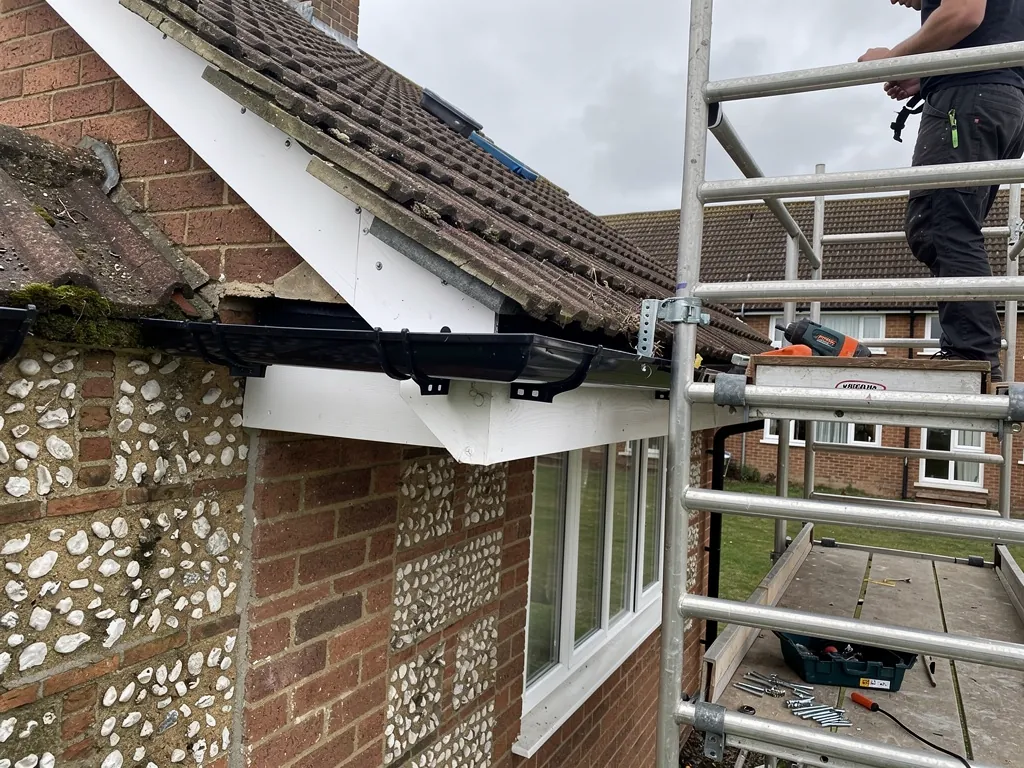
Most gutter failures are failures of the joints. Sectional gutter, the kind sold in lengths of a couple of metres and clipped together, has a joint every time a length ends, and each joint has a rubber seal that hardens, shifts or lets go in a few winters. Continuous aluminium guttering takes a different route. The channel is formed from a roll of flat aluminium coil into a long length cut to the size of the run, so the only joints that remain are at corners and outlets. That sounds like a clear win, and for some houses it is. For others the extra cost buys little. This guide explains how the system works, what it is good at, what it is not, and how to decide.
How continuous aluminium gutter is made
The metal comes as a coil of painted aluminium sheet, usually with a baked or powder-coated factory finish. A roll-forming machine bends it into the gutter profile, either half-round, square or a moulded shape, and the length is cut to measure. On site the pieces are fixed to brackets on the fascia, with sealed corner pieces and outlets at the ends. A run of any ordinary length becomes one piece, not a string of lengths clipped together. The metal itself is light, does not rust and does not become brittle in frost, which is why people choose it for exposed houses and long runs.
Because the profile is formed to order, the colour range is wide. Black, white, grey, brown and several greens and creams are common, and the finish is applied before forming, so the cut ends and corners get a matching sealant and trim.
What it does better than sectional plastic
The first gain is fewer joints. A long run of sectional gutter has a joint at the end of every length, each one a place where water can weep, a seal can fail and silt can lodge. A single formed length has none along the run. Corners and outlets still need sealing, but there are far fewer places to go wrong, and a joint that was well made at the start does not usually open up with the seasons.
The second is rigidity. A single length of aluminium holds its line better than a string of clipped plastic sections, so a well-bracketed run keeps its fall. The third is lifespan. Aluminium does not go chalky and brittle in sunlight as plastic can, and it does not rust. The fourth is the finish. A factory colour holds well for many years, and a long, unbroken line looks neat on a modern house.
Where it falls short
Cost is the main drawback. Aluminium material is more expensive than plastic, and the forming and fitting take skill and equipment, so the job usually costs noticeably more than a sectional uPVC run. The saving in repairs and replacements has to be set against that over the years you expect to stay in the house.
Repairs are different too. A dent in aluminium cannot be pushed back and a damaged piece is hard to patch neatly. A ladder knocked against the front lip leaves a mark. A section of plastic can be swapped for a new length in minutes, while a continuous run needs the damaged part cut out and a joint made, which brings back the very weakness the system was meant to remove. Matching an old colour later can also be hard.
Delivery and access are practical limits. A machine that forms the gutter has to be brought to the house, so the job suits detached and semi-detached houses with clear access at the side better than a terrace with a narrow passage. A very long, straight run is easy. A roof with many short facets and tight corners gains less because the corners multiply.
Expansion matters as well. Aluminium expands and contracts with temperature more than many people realise, and a long run must be bracketed and fitted so it can move. A professional fitter allows for this. A poor fit shows as a gutter that rattles or buckles on a hot afternoon.
Seam for seam: when the extra pays
Continuous aluminium earns its money in a handful of situations. One is a long, straight roof edge, such as the back of a detached house or a run along a rear extension, where a sectional run would have several joints. Another is an exposed position, where wind, frost and falling leaf litter strain joints more than in a sheltered street. A third is a house where you plan to stay, so that the extra cost spreads over many years of fewer repairs. A fourth is a roof where earlier joints have leaked and stained the wall.
It earns less on a short roof, on a house you may sell soon, on a roof with many corners, or where the fascia behind is weak. A sound board is the first requirement, because any gutter is only as secure as its fixings. Our guide to rotten fascia boards shows how to check.
How it compares with uPVC and cast iron
Plastic is the cheapest, easiest to repair and the most common. It is sound where the joints are well made and the sun is gentle, but it can fade and become brittle after many years. Cast iron is the traditional material on older houses, heavy and handsome, and it needs paint and sound brackets. Aluminium sits between them: lighter than iron, longer-lasting than plastic, and more expensive than either in its continuous form. Our full comparison of uPVC, aluminium and cast iron guttering goes through them one by one, and the page on cast iron guttering on period homes covers listed and older houses.
What happens on the day
The old gutters and brackets come off and the fascia is checked, as with any gutter job. Brackets are fixed to the board at a regular spacing with the fall set out by line, which matters more with a rigid length than with a flexible plastic one. The formed length is lifted into place, usually by two people, and fixed to the brackets. Corner units, stop ends and outlets are then added and sealed, and the downpipes are lined up under the outlets. Water is run through the finished gutter to prove the fall and check the corners. The whole thing is visible at once, so the neatness of the setting-out shows. If the fitter has been careless, you will see the line wander. Our description of a roofline replacement follows the rest of the work.
Which Basingstoke houses gain most
The newer estates around the town, from Chineham and Kempshott to Hatch Warren, tend to have long plain roof edges on the back of detached and semi-detached houses, and these are the runs where a continuous length makes the most sense. A short terrace frontage, a porch roof or a small garage gives it little to do. Houses that back onto trees, such as those on older roads with mature oaks, benefit less from the material than from a good leaf guard and regular clearing, because the trouble there is debris, not joints.
Keeping it in good order
Aluminium needs less upkeep than iron or painted timber, but it is not free of it. Leaves and silt still collect, and the trough still needs clearing once or twice a year. A soft cloth and a mild detergent restore the finish, and a pressure washer should be kept away from it. Look at the corners and outlets after storms, since those are the sealed joints that remain. Our gutter maintenance guide covers the routine. Noise is the other point people raise: rain on any metal gutter is louder than on plastic, though a well-fixed run with no loose brackets is quieter than a rattling one.
Profile, size and capacity
Choose the shape for the house and for how much rain the roof delivers. Half-round suits older houses and is easy to clean. Square and box profiles look modern and hold more water. Moulded profiles that imitate cast iron suit period houses. Size depends on roof area, pitch and the number of downpipes, not on the width of the house. A big roof draining to one outlet needs a wider channel than a small one. Our answer on what size guttering you need explains the choice, and the one on square, half-round or ogee guttering compares the shapes.
What it costs
We have no sourced per-metre price for continuous aluminium and will not invent one. What can be said is that it sits above sectional uPVC in cost, and that the difference widens on short runs with many corners and narrows on long straight ones. The published UK ranges for a whole roofline are £1,800 to £3,500 for a three-bedroom semi and £3,000 to £6,000 for a detached house, but those figures assume uPVC, so use them as a floor and not a quote. Scaffold is a separate item. Your fixed quote follows the survey. Each quote should name the material, so that two of them can be compared fairly. Our page on gutter replacement cost shows what drives the price.
Questions to ask before you commit
- How many joints will the run have, and where are they?
- What is the coating, and is the factory finish guaranteed against fading?
- What are the brackets made of, and how far apart are they?
- How is movement from heat allowed for?
- What happens if a section is damaged later?
- Is the fascia being renewed at the same time?
A fitter who cannot answer these is not ready to quote for the job. The last question matters most, since a new gutter on a tired board is a gutter waiting to drop.
Our view, and how we decide
We do not push a material. On the survey we look at the length of runs, the corners, the exposure, the board and your plans for the house, and recommend whichever gives you the best result for the money. For some houses that will be continuous aluminium. For many it will be a good uPVC gutter fitted properly, with enough brackets and a clean fall, and we will say so. Either way you see photographs of what is there now, a fixed written quote and written backing for the workmanship that runs for ten years. Our guttering, soffits and fascias page lists the full range of work, and the office number is 01256 213956.
