
People ask this as if a roof had a service interval, like a boiler or a car. It does not. A roof is a layered system of covering, battens, underlay and structure, and each layer ages at its own pace, in its own weather, with whatever care it has been given. One roof is stripped after decades of good service. Another, laid badly, needs attention within a few winters. The useful question is not how often roofs need replacing, but how to tell when yours has reached the point where replacing is cheaper and safer than patching. This guide explains the pattern, material by material, and the checks that give you a straight answer.
Why we do not give a number of years
Most online articles offer a table of years for each material. We have not found a source for those figures that we trust for a Basingstoke house, and a figure that ignores the quality of the original work, the exposure and the maintenance can mislead in either direction: a roof written off too early, or one left until it fails. What can be said is the order in which things tend to go, and what to look for. Our pages on how long a new roof lasts, how long a slate roof lasts and how long concrete tile roofs last go into each covering in more detail.
The layers that age at different speeds
A pitched roof has four parts that matter. The outer covering is the part you see, whether tiles or slates. Underneath, the battens are small timbers that the tiles hang on. Below those is the underlay, the waterproof layer that catches anything that gets past the tiles. Beneath that is the structure of rafters and trusses. The covering often outlives the underlay. Old bitumen felt can become brittle and torn long before concrete tiles wear out, and a roof can look fine from outside while the felt beneath it has failed. That is why age alone is a poor guide, and why a loft inspection counts for as much as a view from the street.
Slate
Natural slate is the longest-lived of the common coverings, and a slate roof can outlast generations when the slate itself is sound. What fails is usually the fixings, as the iron nails rust and slates slip, and the occasional slate delaminates or cracks. A slate roof therefore tends to need repair of individual slates long before it needs replacing, and replacement is often a case of stripping and re-fixing good slate with new nails or hooks and new battens and underlay. Quality varies with the origin of the stone. Our pages on signs a slate roof needs replacing and when mending slate pays off explain the decision.
Clay tiles
Clay plain tiles and pantiles are durable, and the best of them last a very long time. The usual faults are frost damage, where water in the surface freezes and flakes the face, and loss of nibs or fixings that lets tiles slip. A clay roof with good tiles can be re-laid and kept going, while one with widespread flaking is near the end. Matching old clay tiles is a craft in itself, and the question of putting sound old tiles back on is dealt with in reusing old roof tiles.
Concrete tiles
Concrete tiles became the standard covering from the mid-twentieth century and cover most of the estates built around Basingstoke from the 1960s onwards. They are heavy, strong and cheap, and they are long-lived, but they weather. The surface wears, the colour fades, moss takes hold, and over a long time the tile can lose some of its strength. The concrete rarely fails first. The ridge mortar crumbles, the felt perishes and the verge mortar cracks, and these are repairs, not signs the roof is finished. When many tiles are brittle, cracked or breaking when disturbed, or when the underlay has failed across the roof, replacement becomes the sensible course.
Flat roofs
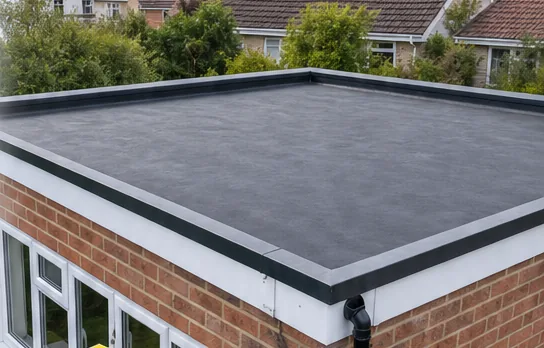
Flat roofs age faster and fail more suddenly, partly because water lingers on them. Traditional built-up felt has the shortest life of the common coverings. Modern reinforced felt, EPDM rubber and GRP last considerably longer when laid properly with sound falls and good detailing. The covering is rarely the only issue. A roof that holds water, a deck that has softened or insulation that has become wet all point towards replacement, not another patch. Our page on how long a flat roof lasts sets out what shortens and extends the life.
Lead, ridges and the details
The parts of a roof that are not the main covering have their own lives. Lead flashings and valleys can last a very long time but tear, lift and crack at the folds, and our page on how long lead flashing lasts explains the pattern. Mortar-bedded ridges and hips crumble and are now commonly renewed with dry-fix systems, as the standard BS 5534:2014 calls for mechanical fixing. Chimney stacks need repointing and new flashings from time to time. A roof can need a lot of attention at its details while the main covering is perfectly sound, and fixing the details can add many years.
What shortens a roof's life
- Poor original workmanship. Badly lapped tiles, nailing too few, missing fixings and thin flashings.
- Exposure. A roof on high ground, facing the prevailing south-westerly wind, or beneath trees sheds and ages faster.
- Moss and lichen. They hold water against the surface and, in frost, can lift and flake it.
- Blocked gutters. Overflow soaks the eaves, fascia and the lowest tiles.
- Lack of ventilation. Condensation in the loft rots timber from the inside.
- Foot traffic. Tiles crack when walked on, and cleaners and aerial fitters are common culprits.
- Heavy cleaning. Pressure washing can strip the surface and push water under the tiles.
What extends it
Regular checks, quick small repairs, clear gutters, controlled moss, good loft ventilation and sound ridge and flashing details extend a roof's life more than anything else. A roof that is looked at every year and mended as it goes will outlast the same roof left alone until it leaks. Our annual roof maintenance checklist sets out a routine, and the page on how often a roof should be inspected deals with timing.
Signs it may be time
A single sign is rarely a verdict. A cluster is. Look for these:
- Leaks that return after repair, or appear in several places.
- Many cracked, slipped or missing tiles across more than one slope.
- A sagging ridge or a visible dip in the roof line.
- Daylight in the loft, or wet and stained timbers and felt.
- Brittle felt that tears when touched.
- Widespread flaking, crumbling or delamination of the covering.
- Repairs that have become a yearly event.
Our guide to signs your roof needs attention goes through them, and repair or replacement explains the way to weigh the two.
Repair or replace: the sums
A roof with one or two local faults is a repair. A roof whose covering is sound but whose felt has failed may be a strip and re-lay, keeping the tiles. A roof where the covering, the felt and the battens are all worn is a full replacement. The price of each differs, and the published ranges are broad: concrete tiles on a typical semi are reported at £6,500 to £10,500 in one place, while a wider guide for semis and detached houses spans £4,000 to £13,000. Treat both as orientation only. These are typical UK ranges. Your fixed quote follows the survey. What pushes a figure up or down is covered in the new roof cost guide.
Garages, porches and outbuildings
The main roof is not the only one. Garage roofs, sheds, porches and lean-tos have their own coverings and their own lifespans. Corrugated cement sheets on older garages may contain asbestos, which changes how they are handled, and our page on how long a garage roof lasts looks at the options. Felt on small roofs is cheap to renew and is usually renewed on a shorter cycle than a house roof, which is a fair trade for its cost.
Timing a replacement
A roof does not have to be replaced the day you decide it should be, but it should not be left until it leaks heavily either. The best time is when the faults are clear but the structure is still dry, because that is when the choice of covering and the schedule are yours. Late spring to early autumn gives the driest working weather, though good roofers work through the year, and our answer on the best time of year for roof work weighs it. Scaffold, lead times for materials and any Building Regulations application add to the timetable, so allow weeks, not days, between a decision and a start.
Roofs and selling
If you plan to sell, the age and condition of the roof will come up in the buyer's survey. A sound roof with paperwork is a selling point. A roof that is obviously tired can reduce an offer by more than the cost of mending it. Sometimes the best course is a targeted repair and a survey report that shows the roof is sound, which costs far less than a new one. Our page on whether a new roof adds value looks at the economics.
Rules that come with a re-roof
A full replacement is usually more than a repair in the eyes of the regulations, because it affects more of the roof. Our guide to Building Regulations for roofing work explains the tests, including the insulation upgrade that can follow, and planning permission for roof work covers the separate planning side.
How we help you judge
We go up and look. The free survey covers the covering, the ridge, the flashings, the gutters and, where we can, the loft, and pictures of your own roof are taken along the way. The report then says honestly whether it has years left, whether a repair will do or whether replacement is the better spend, and the quote is fixed. A roof that can be saved is saved. Work we carry out comes with a written guarantee on our workmanship lasting ten years. To start, visit the homepage or ring 01256 213956.
