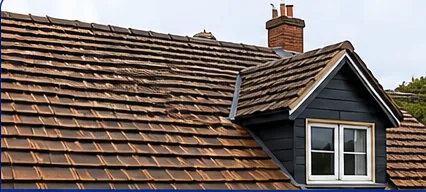
A slate roof gives plenty of warning before it fails, but the warnings are easy to misread. A few slipped slates do not mean the roof is finished, and a roof can look tidy from the pavement while the battens underneath are rotting. The real signs of an ageing slate roof fall into three groups: what you can see from the ground, what you can see from inside the loft, and what a roofer finds up close. This guide goes through all three, separates the signs that mean replacement from the ones that mean repair, and explains what to do once you have spotted them.
What you can see from the garden
You do not need to climb anything to start. Stand across the road in good light, ideally with binoculars, and look along each slope.
Slipped slates in many places
One slipped slate is a repair. A scatter of them across several slopes, with gaps showing the dark underlay or battens, is different. It means the fixings are failing widely, and each slate that drops leaves its neighbours with less to hold them. We cover how to tell the two cases apart in our guide to slipped and cracked slates.
Slates that look layered, flaky or pale
Healthy slate looks dense and even. Slates breaking down show lifted edges like the pages of a damp book, a rough or chalky face, or a bleached patch where the surface has begun to crumble. Delamination is a sign of the stone itself deteriorating, not just its fixings, and it is the clearest sign that new slates are needed. Our page on why slates delaminate explains the causes.
A sagging or wavy roof line
A slate roof should have straight ridges and level courses. A dip in the ridge, a belly in the slope or a ripple in the courses points to a structural problem: weakened rafters, a failing purlin or a sagging wall plate. This is not a slate fault, but it changes the answer, because the structure has to be dealt with while the covering is off.
Stains and debris at ground level
Fragments of slate in the gutter or on the path are a clue. So is a line of rust-coloured streaks below the eaves, which suggests that nails are corroding and bleeding iron down the face of the slate.
What you can see from inside the loft
The loft tells the truth about a roof more reliably than the outside does. Take a torch, check that it is safe to go in, and step only on the joists or boards.
- Daylight through the covering. Pinpoints of light between slates mean gaps or missing slates, or an underlay that has deteriorated.
- Damp or darkened timber. Rafters and battens that are dark, soft or marked by water show that rain has been getting in for a long time. Push a screwdriver into the timber: it should resist, not sink.
- Rotten or broken battens. Slates are only as secure as the laths they hang from. If the battens are crumbling, the slate fixings are useless.
- Perished underlay. Old felt that is torn, brittle or hanging down in folds no longer does its second-line job.
- Rusted nail tips. Look for nail points poking through the battens. Orange, flaking tips are a sign that the iron is rusting out of the slates.
- Fallen debris on the insulation. Slate chips and grit in the loft insulation show that slates are breaking down above.
If the loft is cluttered or has a boarded floor, take photographs before you move anything and keep them. They are useful for the survey and for any later claim.
What a roofer finds up close
Some signs only appear when someone is on or at the roof. A survey checks them in order.
Slates come off in the hand when lifted. A sound slate resists. A tired one slides out because its nail has gone, or comes away in flakes. We also test by tapping: a clear ring means dense stone, a dull sound means cracks or layers.
The lead is checked next. Cracked, split or lifted flashings around chimneys, valleys and dormers are common on old roofs, but when they fail across the whole roof at once, they usually mean the covering is of similar age and the job should be treated as a whole.
Moss and lichen are looked at last. A mossy roof is not a failing roof, and moss alone is not a reason to replace anything. It matters when it is thick enough to hold water against the slates and block the gaps between them, or when it hides slipped and cracked slates from view. Our page on whether moss damages slate roofs explains the difference.
Why slate roofs reach this point
Knowing the usual causes helps you read the signs. Most slate roofs that need replacing have failed in one of four ways, and often in more than one.
The first is corroded fixings. Iron nails, or copper nails of poor quality, rust or wear through over many decades, and the slates they held start to move. This is the commonest reason for a roof with sound-looking slates to leak. The second is delamination, where the stone itself splits into layers. It is a property of particular beds of slate, and it tends to show first on the exposed faces of the roof. The third is rot in the timbers beneath. Years of small leaks, condensation or a blocked gutter feed fungus in the battens, rafter feet and sarking, and slate roofs are heavy enough that weakened timber starts to sag. The fourth is neglect of the details. Cracked lead, perished ridge bedding and open joints around chimneys let water in that tracks down the rafters, away from the original hole.
These causes interact. A slipped slate lets in water, the water rots a batten, the batten then loses its grip on the next slate, and the damage spreads sideways. That is why the signs tend to come in clusters, and why a small repair left alone can turn into a large one.
What waiting costs
It is rarely sensible to ignore the signs, but it is also true that most slate roofs do not need replacing in a rush. The cost of delay is in the damage underneath. A leak that wets insulation reduces its performance, and wet plasterboard stains and can develop mould. Timber that stays wet can rot, and replacing rafters and plates after the event adds to the bill. Failing slates can also slide off, which is a danger to anyone below.
Against that, a roof with a few years left should not be replaced early out of anxiety. A good survey sets out how much time the covering has, what needs doing now to keep it dry, and what can be planned for. If you plan to sell, a clear report with photographs also helps a buyer and their surveyor see the condition for themselves, which tends to avoid last-minute renegotiation.
Published guides give typical UK ranges for a replacement of £120 to £180 for each square metre of natural slate, falling to between £90 and £130 for man-made, with a single slate repair at £100 to £250 in labour plus the slate, and the access cost on top. Those are for orientation; a firm figure only comes after the survey.
Signs that are not as bad as they look
Several things alarm owners that are not, on their own, signs of a failing roof.
Age alone is not a verdict. A hundred-year-old slate roof in good condition is worth keeping, and a twenty-year-old one laid with cheap nails may be in worse shape. What counts is the condition of the slates, the fixings and the timbers. Our guide to how long a slate roof lasts sets age in context.
A single leak is not a verdict either. Many leaks on slate roofs come from lead flashings, ridge bedding or a blocked gutter, and they can be fixed at modest cost without touching the slates. A damp patch under a chimney points to the flashing before it points to the slates.
A few cracked slates from a fallen branch or a footstep are also repair jobs. The test is whether the problem is local or widespread. Local problems get local repairs.
When the signs add up to replacement
Replacement becomes the sound decision when several of these are true together:
- Slates are slipping or breaking in many places, across different slopes.
- A good share of the slates that are lifted turn out to be delaminated, soft or dull when tapped.
- The battens are rotten, or the underlay has failed, so any repair means stripping big areas.
- The same leak has been repaired more than once and returns.
- The structure shows sag or rot that has to be fixed while the covering is off.
The decision then is between re-covering in the same type of slate, in a different one, or a mix of salvaged and new stone. The regulatory thresholds mean that a whole-roof job is usually notifiable to building control, and the insulation may need to be improved at the same time; the Planning Portal's re-roofing guidance explains the tests. Our guide to re-slating a roof walks through what happens once you commit.
What to do next
Do not climb onto the roof yourself. Slate is brittle and slippery, and a fall through a rotten section can be serious. Take photographs from the ground and from the loft, note where and when you noticed stains, and book a survey. We go up, photograph the roof close to, and send you a written report that sorts the findings into leaking now, likely to fail soon and able to wait. If the roof has years left, you will hear that from us plainly, with a price for a repair in writing. If it does not, you will see the evidence on your own screen before a figure is mentioned.
A signed ten-year guarantee covers the labour, and the old materials leave with us. For the full range of work, see slate roofing in Basingstoke, or message us on WhatsApp or phone 01256 213956 to arrange the survey.
