
Beacon Basingstoke Roofing

Roofers in Stockbridge

Stockbridge is 24.2 road miles south-west of Basingstoke, a town made almost entirely of one long, wide street on the River Test. Much of it falls inside a conservation area full of listed buildings, so roof work here means matching old materials. Your roof gets photographed before any figure goes on paper.

Clay tiled pitched roof gable on a red-brick house

Roofs we see in Stockbridge

  • Clay tiled pitched roof gable on a red-brick house

    Listed buildings on the main street

    The conservation area covers about 80.4 hectares and holds 43 listed buildings, four of them Grade II*, including the Grosvenor Hotel, the Old Town Hall and the remains of the old parish church. Many roofs of that age carry plain clay tile or slate on timber that has moved over centuries, so ridges dip and slopes undulate. Repairs have to respect that and use matching materials, which is slower work than on a modern house.

  • Slipped and cracked clay roof tiles

    Ranges behind the frontage

    With the town laid out along a single wide street, many buildings stand shoulder to shoulder, some with ranges running back from the frontage. That produces valleys where roofs meet, parapet and party-wall gutters between neighbours, and lead-lined gullies that nobody sees from the street. When one of these gutters fails, water finds its way into a neighbour's property as readily as your own.

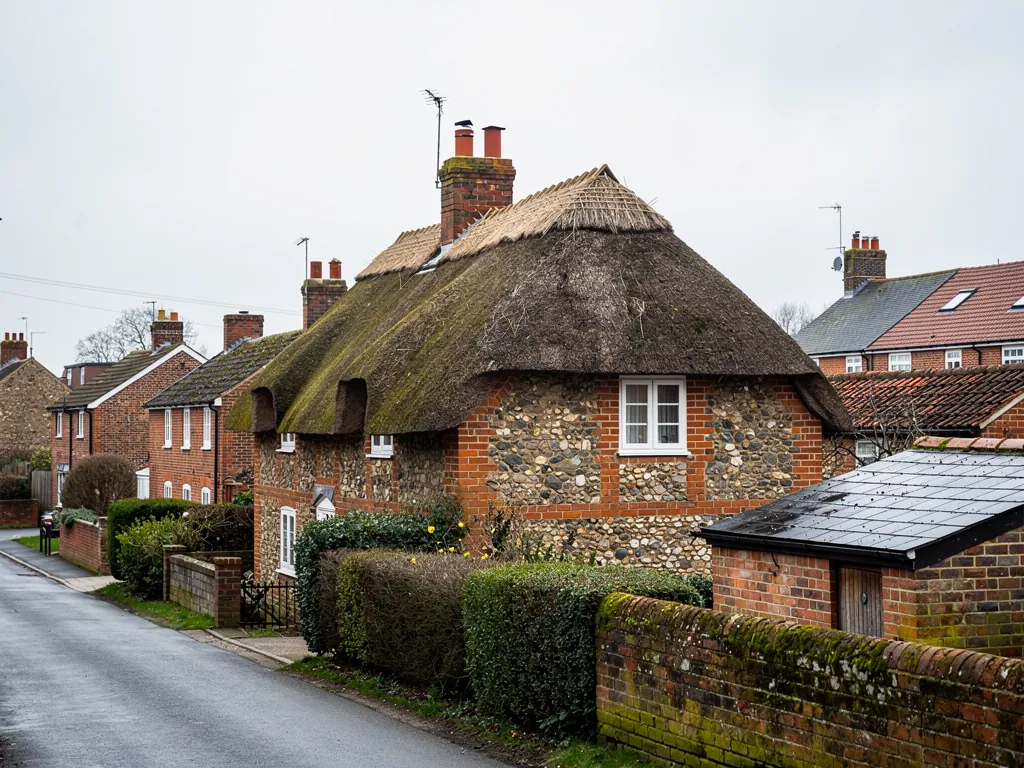
  • A thatched cottage in a Test Valley village with a brick chimney

    Riverside and downland houses

    The River Test runs through the town, with five smaller channels beside it, and Stockbridge Down rises behind. Houses near the water sit in damp air, and roofs under trees dry slowly after rain, so moss and algae take hold on tiles and clog gutters. Newer houses and rear extensions on the edge of town bring flat roofs, felt, and concrete tile that we repair or replace in the ordinary way.

24.2 road miles south-west of Basingstoke

Planning and building control in Stockbridge

Test Valley Borough Council is the authority for Stockbridge on both planning and building control, and a large part of the town lies inside its conservation area. Heritage records for the area describe about 43 listed buildings in the conservation area, four of them Grade II*, and that has a direct effect on roofing. A repair that copies the existing clay tile, slate or lead is normally acceptable, but a change of material or appearance on any listed building, and often elsewhere in the conservation area, may need consent. Ask the council's conservation officer before you order anything, using the council's website as a starting point.

Rules are stricter for listed buildings than for ordinary houses in the area, and this includes the buildings on the main street. That affects the roof window you choose too, and the conservation rooflights page explains the low-profile options that suit a historic roof. Our survey photographs make it easier to explain to a conservation officer exactly what is on your roof now. Where the work is notifiable under building control, we deal with it. Old roof spaces can hold roosting bats or nesting birds, and the law protects both, so timing or a survey may come first.

What we find on Stockbridge roofs

Stockbridge is old, narrow and wet, and its roofs show it. The main street is lined with listed buildings, the back plots are crowded with valleys and gutters, and the river keeps the air damp. Each answer below sets out what we find and what we do, and if you are weighing a larger project, our Basingstoke base is happy to talk it over by phone.

Chapter 1: Can a clay tile roof on a listed Stockbridge building be repaired rather than replaced?

What we find

Old clay tiles are hand-made, slightly curved and uneven, and that unevenness gives a historic roof its character. They are hung on timber laths and often fixed with oak pegs or nails that have worn out over the years. Tiles that lose their hold slip out of line. Frost gets into the porous clay and flakes the face of the tile, so a roof can look fine from the pavement but crumble when someone handles a tile.

Sagging along a ridge or a gentle dip in a slope is not necessarily a fault, because timber frames move a little. What matters is whether the roof is keeping out the weather. On the main street of a town with Grade II* listed buildings, replacing the whole covering would also raise questions about consent that a repair avoids altogether.

What we fix

Repair is the first option here, and it is usually the right one. We photograph every slope and mark the tiles that have failed, then remove only those and keep every sound tile for reuse. Gaps are filled with reclaimed or hand-made clay tiles chosen for matching colour and camber. New battens go in beneath stripped sections and the tiles are re-fixed with modern fixings, so they stay put.

We give you the survey photographs and a written description to share with the conservation officer, which helps anyone who needs to approve a like-for-like repair. Where the underlay has perished, it can be replaced with breathable felt without changing the look of the roof. Reclaimed clay is priced by the tile, so the amount of work decides the cost. See pitched roofing for how these repairs run.

Chapter 2: Why does water get into our Stockbridge terrace from the gutter between two roofs?

What we find

Where two pitched roofs meet in a V, the junction is a valley. Where a roof meets a taller party wall, it is a parapet or box gutter, lined with lead or asphalt and hidden behind the wall. On a long street of buildings standing shoulder to shoulder, these gutters are common and they are hard to reach, so they get little attention until something goes wrong. They are built to carry water along a shallow fall to an outlet, and any blockage makes them overflow.

Leaves, moss and a bird's nest are enough to turn a gutter into a pond, and the water then rises past the lead and into the wall or the roof timbers. The first sign is a damp patch on an upper-floor party wall, or a ceiling stain at the point where two houses join. Because the gutter often runs behind a parapet, it can leak for a long time before anyone sees it.

What we fix

We start by clearing the gutter so we can see the lead or asphalt properly. Then we trace the water: we check outlets, lap joints and the upstand where lead meets the wall, and flood-test if needed to see where it escapes. A split in lead can sometimes be repaired with a welded patch, but old sheets that have crept out of position are better replaced with new lead cut to the right size, with proper steps and drips to carry water along.

Outlets are enlarged or fitted with leaf guards where leaves are a problem. We agree access with neighbours when a gutter is shared, because the work may need both sides. Reported UK cost guides for chimney leadwork give £350 to £920, which is a useful guide to the scale of a small lead repair. The lead roofing page explains how we price larger runs.

Chapter 3: How do we deal with moss and algae on a Stockbridge roof close to the river?

What we find

The River Test and its channels keep the air in the valley damp, and trees along the water shade many gardens. A roof that stays damp grows green. Moss lifts the edges of tiles, packs the gaps between them, and holds water against the surface long after the rain has stopped. Algae turns the tiles black or green, and the whole slope stays wet.

Roofs under trees are hit hardest, because leaves and twigs collect in the valleys and gutters. The moss itself is rarely the real danger. It is the water it keeps in place, and the frost that follows, that breaks tiles and clogs downpipes. You can spot trouble where a gutter overflows down the wall in a storm, or where moss falls off in clumps into the garden after a wet week.

What we fix

We remove moss by hand with scrapers and brushes, then treat the tiles with a biocide that kills the remaining spores and slows regrowth. We avoid hard pressure washing on old tiles because the jet can scour the surface of old tiles and drive water under the laps. On the same trip we empty the guttering and test each downpipe for a clear run. Overhanging branches may need cutting back, which we leave to the owner or a tree surgeon.

One UK cost guide puts hand removal with biocide at £748, £863 or £978 depending on roof size, and pressure washing a little lower at £553, £638 or £723. We recommend the gentler approach on old clay. Your written price comes once we have seen the roof. See roof cleaning for more on how it works.

Chapter 4: What can be done about a flat roof on a rear extension behind a Stockbridge shop?

What we find

Behind a historic frontage, the back of the building often grows with lean-tos, storerooms and kitchen extensions, usually with a flat or low-pitched roof. Those roofs are older than they look and are hard to inspect from the street, so faults are found late. Bitumen felt cracks as it ages, joints at the wall lift, and rainwater sits where the deck has sagged. Where a flat roof drains onto a neighbour or into a shared gutter, a small fault can cause problems next door.

On a commercial property, a leak may be noticed only when stock or a ceiling is damaged. Look for ponding, blistering, loose edges and a musty smell in the room below. A flat roof in a conservation area is usually out of sight from the street, which gives more flexibility in material than a front slope.

What we fix

Our survey records the deck, the covering and the drainage, and we say honestly whether patching can carry the roof through or a full re-cover is the right answer. For a new covering, we strip to the deck, renew spongy boards, build a firm fall and lay EPDM or GRP with neat upstands at the walls. Guides to UK pricing put EPDM at £80 to £120 a square metre, which is a useful figure for budgeting.

On commercial roofs we plan the work around opening hours, protect stock and keep access clear. Because a large flat roof replacement is notifiable work, we handle building control as part of the job. Waste is cleared and taken away. Read about flat roofing or our commercial roofing service for more.

Stockbridge roofing questions

How do you deal with a lead valley between two roofs on a crowded back plot?

Valleys carry water from two slopes into a narrow channel, so a split or lifted lead lining shows up quickly as a leak. On a back plot the valley may be hard to reach, so we plan access first. We lift the tiles at the edges, check the lining and boards beneath, and renew with new lead, correctly lapped, instead of resorting to sealant.

Is my house in the Stockbridge conservation area, and does that stop me re-roofing?

Check with Test Valley Borough Council, because the area is large, about 80.4 hectares. Being inside it does not ban roof work. A repair that copies the old roof is usually fine, but a change of tile, slate or appearance may need consent. We can give you photographs and a description of the existing roof to take to the conservation officer.

My roof is on a Grade II* listed building. Can you work on it?

We can survey it and carry out like-for-like repairs, working with the owner and the conservation officer. Grade II* buildings in the town include the Grosvenor Hotel and the Old Town Hall, so the standards are high. Expect slower work, matching materials and consent before any change in appearance. We record the roof first so decisions are made with evidence.

Does flooding or the high water table affect roofs in Stockbridge?

A high water table affects walls and floors more than roofs, but a damp valley does affect them in other ways. Roofs near the river stay wet longer, which feeds moss and rot in timbers at the eaves. Gutters and downpipes matter more here than they would on a dry hill, because water has to leave the building promptly. We check them on every visit.

Can you help with the chimney on a terrace on the main street?

Often, yes. On a terrace, stacks tend to sit on party walls and are shared between neighbours, so we agree access with both households first. The usual faults are tired pointing, worn flashings and cracked flaunching. We inspect from the roof, photograph each face, and repair in lime mortar where the bricks are soft. A leaning stack is a different matter, and we say so plainly.

Get your free roof survey in Stockbridge

Tell us what’s happening and we’ll call you back to arrange a visit. You’ll get photos of your roof and a fixed written quote.

  • No obligation
  • Photo report of your roof
  • 10-year workmanship guarantee

Rather talk? 01256 213956

Call Free survey