Beacon Basingstoke Roofing

Roofers in Eastleigh

Eastleigh is 27.7 road miles south-west of Basingstoke, close to where the M3 meets the M27, and it grew up around the railway works. Its Victorian railway terraces, flat-roofed shops on the old grid of streets and later suburbs all get the same treatment from us: a photo survey of your roof, then put the price in writing before any work starts.

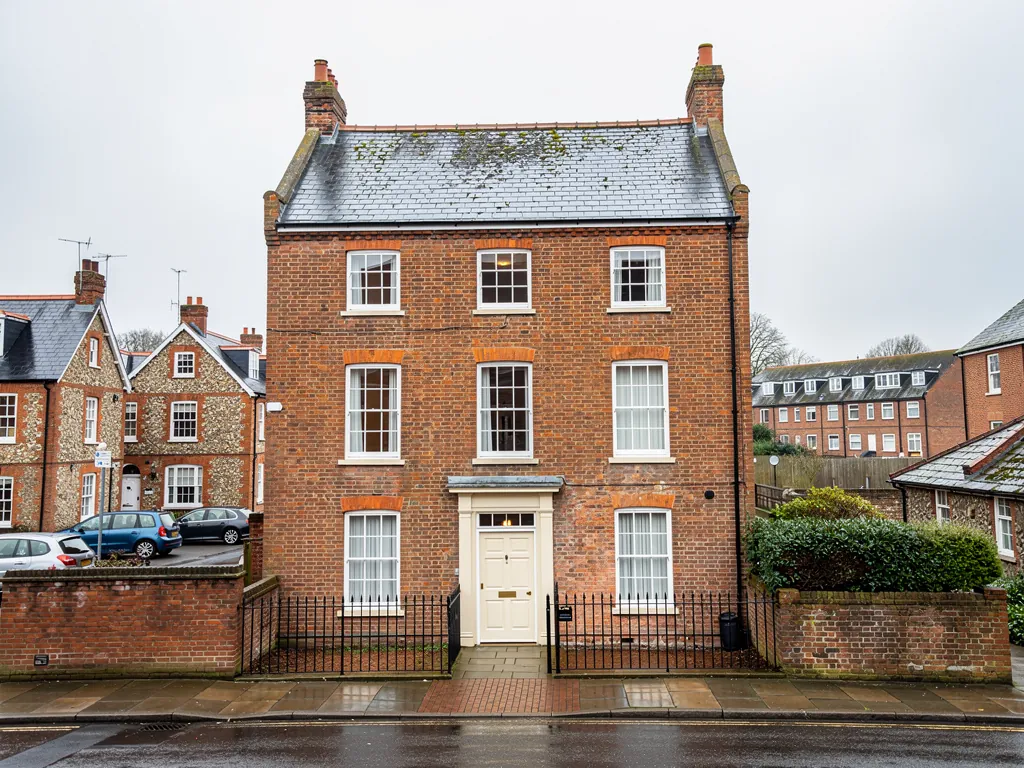
A Georgian brick town house with a slate roof and parapet in a Hampshire market town

Roofs we see in Eastleigh

  • 1960s and 70s brick semi-detached houses with concrete interlocking tile roofs on a Basingstoke estate street

    Victorian railway terraces

    Eastleigh developed as a railway town, and the council's heritage trail describes the housing built for the men at the carriage and engine works. Terraces of that era share party walls, chimney stacks and a continuous roof line, and slate, carried cheaply by rail, was a common covering for housing of the period. After well over a century, nail fixings and the lead at the stacks are what let go first.

  • An Edwardian red-brick detached house with clay tile roof and tile-hung gables in north Hampshire

    Flat roofs behind the grid iron

    The town centre keeps its Victorian grid iron layout, with the Swan Shopping Centre built into it in 1989. Behind the shopfronts and over the first-floor flats are flat roofs, parapet gutters and rear extensions, some in old felt, some already re-covered. They drain through small outlets that fill with leaf litter and grit, and a blocked outlet is the commonest reason a flat roof here starts to leak.

  • Roofer fitting roof tiles on a brick house near Basingstoke

    Suburbs, estates and business units

    Beyond the old centre, Eastleigh spreads into twentieth-century semis and estates, down towards the River Itchen and out to the airport and the motorway junction. Houses of that period tend to carry concrete interlocking tiles, with felt underlay, mortar ridges and timber or plastic rooflines. Business premises in the town often have larger sheeted or membrane roofs, which we cover under our commercial roofing service.

27.7 road miles south-west of Basingstoke

Planning and building control in Eastleigh

Eastleigh Borough Council deals with both planning and building control here. Its published heritage trail picks out the Victorian station designed by Sir William Tite and the red-brick Old Town Hall on Leigh Road, finished in 1899 and now called The Point. Buildings of that kind, and some of the railway housing around them, may have listing or other protection, so ask the council's conservation team whether yours does before any roof material is changed.

For ordinary houses the usual question is building control rather than planning. Patching or re-covering a small part of a roof is normally outside it, but stripping and re-covering a larger area can be notifiable, and the insulation of the roof may have to be improved at the same time. We handle that side, working with the council or a registered building control approver. If you want a roof window in a terrace loft, the skylight planning permission guide is worth reading first, then check with the council's planning team.

What we find on Eastleigh roofs

The roofs here split by purpose as much as by age. The railway terraces were built in rows, so a fault on one house is often worth checking for on its neighbours. The shops and extensions near the town centre have their own drainage problems, and the loft rooms people now want in the terraces raise structural questions.

Chapter 1: Why are slates slipping off the roof of our Victorian railway terrace in Eastleigh?

What we find

Slates are hung from small holes near the top edge, fixed with a nail into a timber batten (the thin timber strip the slates hang from). On terraces from the railway-works era the original nails were iron, and iron rusts with age and damp. Over a century the nail shank thins until the slate slides a few millimetres, then drops. Whole rows can go like this, because every nail on the roof is the same age.

You may notice a slate on the path or in the front garden, or a dark gap in the pattern from the street. Inside, a brown stain on the ceiling below the slope usually follows within a season or two. The slates themselves are often sound; the fixings have failed and the lower part of the roof is carrying the load.

What we fix

We start with a survey from ladders and the loft, photographing the slope, and tapping slates to hear which are cracked. Where the fault is local, we remove the loose slates, renew the battens beneath where they are soft, and re-fix with copper or stainless nails so the problem does not return. Matching replacements are sourced from reclaimed stock where the slates are old and worth keeping.

If the whole slope is failing, re-slating is the honest answer, using the old slates again where they are sound. Published UK guides put one slate repair at £100 to £250 of labour, a slate at £5 to £25 and an access tower or scaffold at £300 to £800; your fixed quote follows the survey. Our slate roofing page covers the choices in more detail.

Chapter 2: Why does the party wall in our Eastleigh terrace get damp under the shared chimney stack?

What we find

On a terrace, chimney stacks often sit astride the party wall and serve two houses. The stack stands exposed above the ridge, so it takes wind, sun and rain on all four faces. The flashing (the strip of lead that seals the stack to the roof) and the mortar between the bricks wear out, and water then runs down inside the brickwork. It shows up as damp on the chimney breast, peeling paper on the party wall, or a stain in the loft where the stack passes through.

Because the stack is shared, so is the problem. One owner may notice damp while the neighbour's side looks dry, which tends to cause disagreement about who should pay. The cause is usually simple: failed pointing at the top courses, a cracked cement flaunching (the sloped cement cap that holds the pots), or lead that has lifted off the brick.

What we fix

We photograph the stack from a ladder or tower and give you the pictures, which helps when you need to show a neighbour what has gone wrong. The repair is normally repointing the top courses, renewing the flaunching, and replacing the lead flashing and soakers (the small lead pieces that step up each side of the stack) with new lead. New lead around a stack is reported at £350 to £920, averaging £570; your fixed quote follows the survey.

Where a stack is leaning or the brickwork has shed its faces, a partial rebuild may be better than patching. For who pays and how to approach a neighbour, read party wall and roof work, and see our chimney repairs service for what the work involves.

Chapter 3: What is making the flat roof over our shop or extension near Leigh Road leak?

What we find

Flat roofs in an old town centre are often tucked between higher walls, with a parapet (a low wall rising above the roof edge) on one or more sides. Rain has nowhere to go except into a gutter or outlet set behind that parapet. Leaves, moss and grit from the neighbouring roofs collect in it, and the water backs up. A felt covering that has already aged then takes in water at its seams, its upstands (the places where the roof turns up the wall) and any cracks.

The signs inside are a stain that comes and goes with the weather, a bubbled patch of ceiling plaster, or damp running down the inside of the parapet wall. Outside, look for water that stays on the roof for days after rain, a split along the join with the wall, or weeds growing in the outlet.

What we fix

We clear and test the outlets first, since a blocked outlet can mimic a failed roof. If the covering is sound, a repair at the upstand or seam may be enough. If the felt has gone, we take the roof back to its deck, swap out damp boards, add insulation where the roof is being renewed, and fit a new single-ply or liquid membrane with proper upstands and a larger outlet where needed.

Typical UK prices reported for flat roofing are £60 to £100 per square metre in felt, £80 to £120 in EPDM (a single-sheet synthetic rubber) and £100 to £160 in GRP (glass-reinforced plastic); your fixed quote follows the survey. Shop and office roofs fall under our commercial roofing service, and house extensions under flat roofing.

Chapter 4: Can the loft of our Eastleigh railway terrace take a roof window?

What we find

Many owners in the Victorian terraces want a bedroom or study in the loft, and a roof window is the first thing they think of. The roof underneath was built for light slate and the loads of its day. The rafters are often slender and widely spaced, the ceiling joists were never meant to carry a floor, and the headroom depends on the pitch and the position of the party wall. Cutting an opening in the slope means interrupting rafters, so the structure around it needs to be designed, not improvised.

Fire safety also matters on a terrace of this height. A loft room on a two-storey house needs a protected route down the stairs, and a roof window only counts as a means of escape for storeys up to 4.5 m from the ground.

What we fix

We start with a survey of the loft: rafter size and spacing, condition of the timbers, and where a trimmed opening could sit between existing members. Adding a roof window means fitting trimmers (cross timbers that frame the opening) and a flashing set matched to slate, fitted so water runs round the frame and out. The work is notifiable, so we arrange the building control side, and the window must meet the thermal standard for replacement and new windows in existing homes.

Typical UK prices reported for a standard roof window supplied and fitted run from £680 to £1,300; your fixed quote follows the survey. A full loft conversion is a bigger project that needs its own design, and we will tell you if the roof structure suggests one is not realistic. See our roof windows service for the options.

Eastleigh roofing questions

A leak shows at the party wall of our Eastleigh railway terrace. Is that our roof or the neighbour's?

Railway terraces run in a continuous row, so the junction at the party wall, with its flashing or parapet gutter, can serve both houses. The first step is finding exactly where the water enters. We photograph the junction and the loft side, then explain what a repair involves. If the fault sits on the shared line, it is worth speaking to your neighbour before work begins.

Is it worth repairing a slate roof on a railway terrace rather than replacing it?

Often, yes, if the slates are sound and only the nails or a few battens have failed. A slate that is flaking or soft is a different case, and the survey will show which you have. We lift a few slates, check the battens from the loft, and tell you plainly how many years the roof has left. Where a re-slate is the better choice, we reuse good slates to keep the look of the street.

Can you work on a flat roof above a shop while the business stays open?

In many cases we can. The roof work happens above the ceiling, so the shop or flat below can keep trading, though noise, access and a scaffold or ladder position need agreeing beforehand. We plan the job in sections so the roof is never left open overnight, and we make a leaking roof watertight first, then fit the finished covering once the weather and the deck allow it.

Who do I speak to about a roof on one of Eastleigh's older civic or railway buildings?

Start with Eastleigh Borough Council's conservation team, because buildings of historic interest, such as those on the council's heritage trail, may have listing or other protection. We are happy to survey and photograph the roof so that you have a clear record to show them. Like-for-like repair, in matching slate, clay or lead, is usually the route that causes fewest problems.

Our roof has birds nesting under the eaves. Can the work still go ahead?

Usually, with care. Nesting birds and bats are protected, so we look before we disturb an eaves, soffit or tile edge, and a roof may need to wait or be surveyed first. We would rather change the timing than disturb a nest. If we find evidence of either during the survey, we will tell you before any work starts.

Get your free roof survey in Eastleigh

Tell us what’s happening and we’ll call you back to arrange a visit. You’ll get photos of your roof and a fixed written quote.

  • No obligation
  • Photo report of your roof
  • 10-year workmanship guarantee

Rather talk? 01256 213956

Call Free survey