


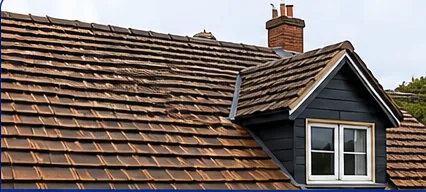
Chapter 1: The felt under the tiles of our Buckskin house looks tired from the loft. Is that a reason to re-roof?
What we find
From the loft, the underlay is the black sheet draped over the rafters beneath the battens (the timber strips that the tiles hang from). On a roof of the 1950s to 1970s it was bitumen-based, and by now it can be brittle, cracked at the laps and torn where it runs into the gutter. Light coming through between the tiles, a dusty crust on the felt or small drips onto the loft insulation after rain all point to it.
The tiles are often a separate matter. Concrete tiles of that age tend to stay sound, wearing slowly, while the felt beneath has given up. A homeowner looking at that picture can reasonably wonder whether to replace the lot or only part of it, and the answer depends on how far the felt has gone.
What we fix
If the felt has failed only at the eaves, we lift the bottom courses of tiles, fit a carrier tray that guides water into the gutter, and relay. That is a repair, and it keeps the main slope in service. Where the felt has perished across the slope, patching stops making sense, and we recommend a strip, new breathable underlay, new battens and either the existing tiles relaid or new ones.
A concrete-tile re-roof on a three-bedroom semi is reported in typical UK guides at £6,500 to £10,500; your fixed quote follows the survey. If new tiles are much heavier than the old, the roof structure may need checking, and a job of that size is notifiable, so we deal with building control. See our roof replacement page for how a re-roof runs.
