
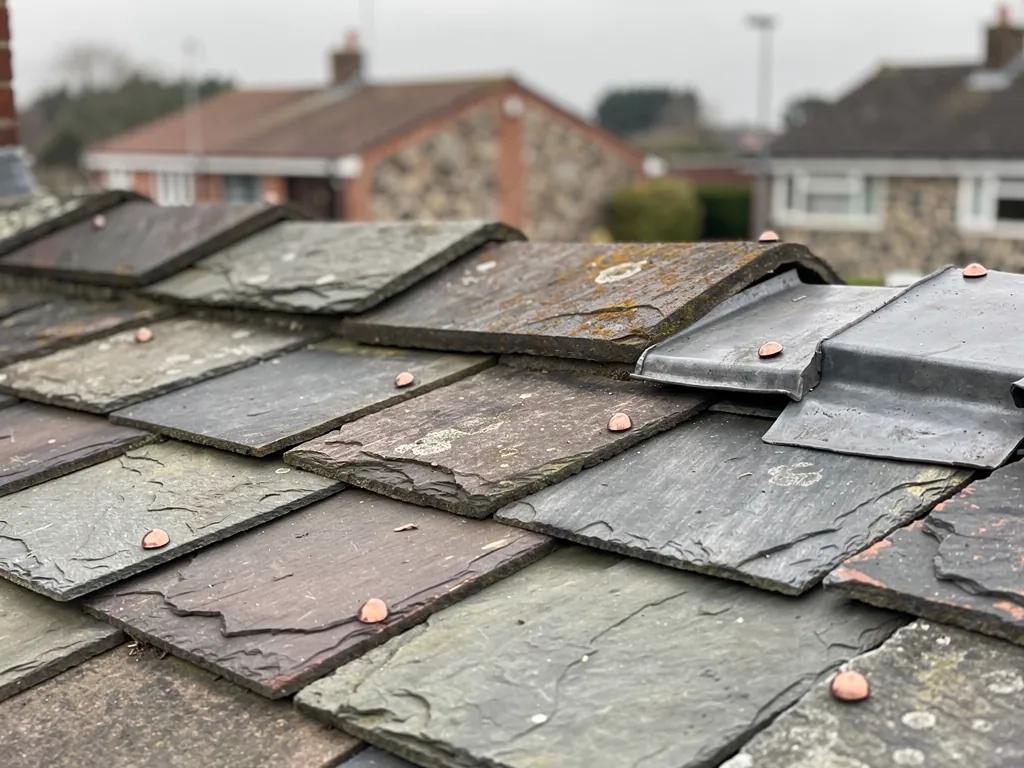
Ask three people what a slate roof costs and you may hear three numbers that are all correct, because they describe different roofs. A plain gable in imported slate, a hipped cottage roof with two dormers in Welsh stone and a single slipped slate over a porch are all slate jobs, and they sit at very different points on the scale. This guide explains where the money goes, gives the typical UK ranges published by cost guides, works through a simple example, and shows which choices move the price up and which move it down. The figures are national orientation. Nothing here is a Beacon price list, and the firm price only arrives after the survey.
The figures published guides give
Cost guides for UK roofing agree on the broad bands, though they are written by trade and lead-generation sites, so treat them as ranges and not as quotes. They are summarised below.
| Job | Typical UK range |
|---|---|
| Natural slate, strip and re-cover | £120 to £180 per m² |
| Man-made slate, strip and re-cover | £90 to £130 per m² |
| Welsh slate, installed | £140 to £180 per m² |
| Spanish slate, installed | £100 to £130 per m² |
| Single slate replaced | £100 to £250 for the roofer's time, with the slate itself at £5 to £25 |
| Tower or scaffold for a small repair | £300 to £800 |
| Dry ridge on a semi | £900 to £1,600, plus scaffold of £300 to £900 |
| Chimney leadwork | £350 to £920, averaging about £570 |
One of those guides adds that labour makes up about half to three-fifths of the cost of a slate roof, which explains why the gap between a cheap slate and a dear one is smaller on the final invoice than on the pallet. Slate is slow to lay. Each unit is holed, fixed and checked, so skilled time is the largest line.
A worked example
Take a roof with 60 m² of slope. This is an illustration built from the ranges above, not a quote. At the natural slate range of £120 to £180 per m², the covering comes to roughly £7,200 to £10,800. At the man-made range of £90 to £130, it comes to £5,400 to £7,800. Using the origin ranges, Spanish slate gives about £6,000 to £7,800, and Welsh gives £8,400 to £10,800. Then add the items that the per-metre rate may not include: scaffold, timber repairs, lead, chimney work and any ventilation changes.
For comparison, one guide puts a re-roof of a three-bedroom semi in concrete tile at £6,500 to £10,500. So slate sits near the top of the tile range or above it, with the man-made version overlapping the middle. The honest conclusion is that slate costs more upfront than concrete tile and, when the stone is good, lasts longer. Our guide to how long a slate roof lasts sets out the lifespan side of that trade.
What moves the price up
Complexity
Every hip, valley, dormer, chimney and abutment needs hand-cut slates and lead. A plain two-slope roof is the cheapest per square metre. A hipped roof with dormers and a chimney stack can cost far more for the same area, because the cutting and lead work multiply.
Access and scaffold
Scaffold is priced by size, not by the roof area, so a tall house, a corner plot or a terrace with a shared party wall costs more to cover. The scaffold alone can run to several hundred pounds even on a small job. Narrow access, a busy road needing a licence, or a steep drive can add to it.
Slate choice
Welsh slate is at the top of the range, Spanish and other imports below it, man-made below that. Reclaimed stone has a price that depends on supply, and a mixed batch needs more sorting labour. Our comparisons of Welsh and Spanish slate and of natural and man-made slate cover the choice.
Condition of what is underneath
Battens, sarking and rafters are inspected once the slates are off. Rotten timber adds to the bill, and it is the commonest source of variation between the quote and the invoice on an older house. A sound quote names a provisional sum for it and explains how extra timber will be priced.
Pitch and weight
Very steep or very shallow roofs need more care and sometimes different laps. A covering that adds 15% or more in weight can mean structural checks and building control. Heavier slates on a light roof might need rafters strengthened.
What moves it down
Several choices lower the cost without lowering the quality of the roof. Reusing your own sound slates, with new battens, underlay and fixings, saves the cost of the new stone, and it is often the best value on a period roof. Doing one slope or one phase at a time spreads the cost, though it can repeat the scaffold. Choosing a good imported slate in place of Welsh keeps the natural material at a lower price. Combining a repair with other work, such as gutters, fascias or chimney repointing, shares the scaffold.
What does not save money in the long run is under-specifying the parts you cannot see. Cheap iron fixings, thin underlay or no ventilation will cost more when the roof fails early. Our page on slate hooks and nails explains why fixing choices matter.
Repair or replace: how the costs compare
A single slate repair is the cheapest slate job, but access dominates the price. A tower or scaffold for a small repair can cost as much as the slates and labour. That makes a series of small repairs, each with its own visit, poor value. If several jobs are needed, we try to do them together.
The break-even point depends on the roof. When the slates are sound and the nails are going, a strip and re-lay with the original slates and new fixings may cost less than a new roof and far more than a patch. When the slates themselves are delaminating, re-covering is the only lasting answer. Our guide to whether it is worth repairing a slate roof sets out how to choose.
What a good quote should list
A price on its own is a poor basis for choosing a roofer. Before you accept a figure, check that the quote names the following in writing, because each one is a place where cheap quotes quietly cut corners.
- The slate: its origin, size, thickness grade and quantity, not just the word slate.
- The fixings: copper or stainless steel nails, and whether hooks or clips are included at the eaves, verges and exposed areas.
- The battens and underlay: new treated battens, and the type of underlay with its ventilation arrangement.
- The lead: which flashings, valleys and soakers are renewed, and which are left.
- The ridge and hips: the fixing method, in line with the current standard for mechanical fixing.
- Scaffold, waste removal and making good, shown as included or as separate lines.
- Timber repairs: a provisional sum, the unit rate for extras, and a promise that extra work is photographed and agreed before it is done.
Put two quotes side by side with that list and the differences usually explain themselves. A quote that is a good deal lower often leaves out the lead, the scaffold or the ventilation, or assumes thinner slate or cheaper nails.
Cost across the life of the roof
Slate invites a different way of counting. A roof that costs more at the start but needs little attention for a very long time can be cheaper per year than a cheaper covering that has to be renewed. That argument only holds when the stone is good, the fixings are copper or stainless, and the details around the slate are done to last. A cheap slate on cheap nails is the worst of both worlds: the price of natural stone, and a roof that fails like a budget one.
It also pays to think about maintenance. Slate roofs need little, but they are not free of it. Clearing gutters, checking after storms, replacing the odd slipped slate and re-dressing lead every so often protect the investment. A small repair costs very little compared with a rotten batten run, so a short survey every few years is cheaper than ignoring the roof.
Resale matters too. A well-laid slate roof with a written guarantee and photographs of the work is a selling point on a period house. A buyer's surveyor looks at the covering first, and documentary evidence of what was done removes doubt.
Regulations and extra costs to expect
A re-roof that touches more than half the roof, or a quarter of the building envelope, is normally notifiable to building control, and that can mean upgrading the insulation across the roof. The work then carries insulation costs and fees that a plain price per square metre does not capture. The Planning Portal's guidance on re-roofing explains the tests. Listed buildings and conservation areas may need consent, and may require natural slate, which narrows the cheaper options. Protected nesting birds or bats can mean work has to wait for the right season.
Also allow for the items that sit outside the roof: waste removal, which is included in our quotes, repairs to guttering or fascias disturbed by the work, and redecoration of any ceiling that was stained by earlier leaks.
How we price a slate job
We do not quote from a postcode. We begin with a no-charge survey, photographing the slopes, the loft and every junction, so you can see what each line of the price is paying for. The written report lists what each option involves, and the quote that follows is fixed, with provisional sums clearly marked and explained. If a repair is the right answer, the quote is for the repair. The finished work carries a ten-year written guarantee on workmanship, and the site is cleared and the waste removed. See our slate roofing in Basingstoke page for the full service, or message us on WhatsApp or ring 01256 213956 to book the survey.
