The risk in roof cleaning is not the chemical or the brush. It is the fall. A roof is a sloping surface at height, and a wet roof with moss on it is as slippery as a surface gets. Most of what makes roof cleaning safe is not about the cleaning at all: it is about how people get there, how they stay there and what they do when something goes wrong. This guide sets out the access choices, the hazards on the roof itself and the weather rules we follow, so you can judge whether a job is safe, and whether anyone you hire is working safely.
Why a mossy roof is dangerous
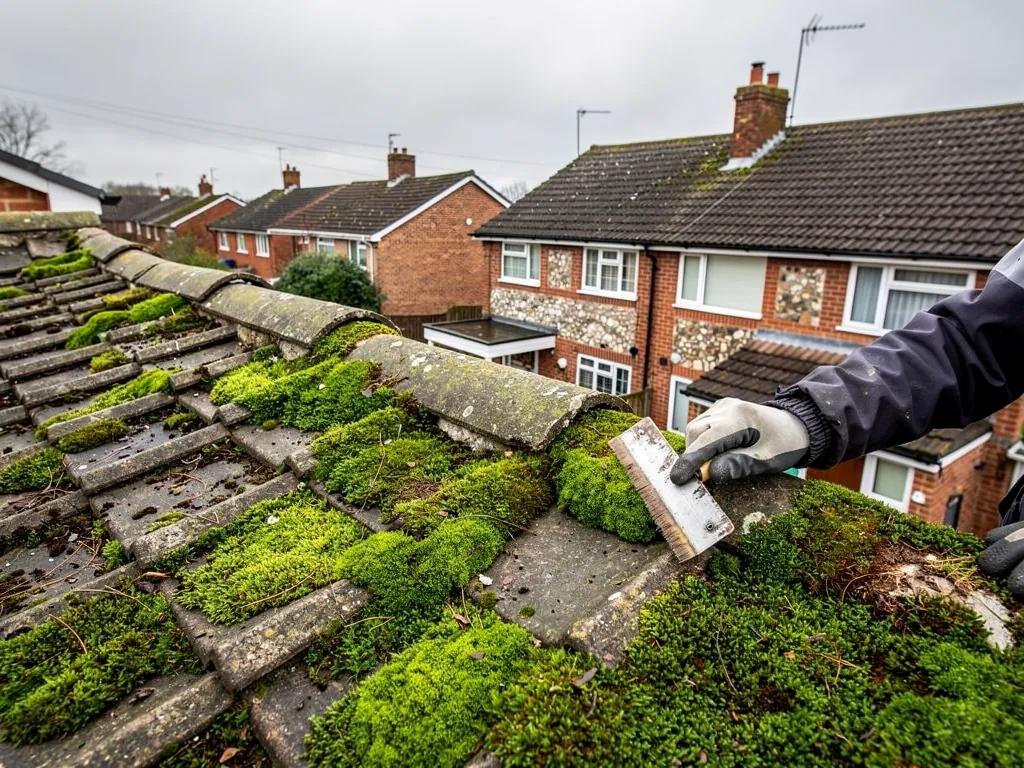
Moss, algae and lichen hold water on the tile and make a layer that is slick underfoot. Even a dry-looking roof can be slippery in the shade, on a north slope or in the early morning when dew has formed. Wet moss over smooth concrete or slate can give no grip. Tiles are not designed to be walked on, and a boot on a tile that is loose, cracked or unsupported can tip it. A tile that moves under weight can send a person sliding.
Steep pitches, valleys, dormers, chimneys and roof windows all make footing worse. Edge protection matters most at the eaves, where a slide ends in a drop. The gutter is not a barrier and will not hold a person. On a two-storey house, a slip can mean a fall of many metres onto a hard surface.
Access: the options, from least to most protective
Ladders
A ladder gets you to the roof edge and nothing more. It must be on firm, level ground, tied or footed, and extend well above the eaves so that you can step on and off safely. It is a means of access, not a work platform. Leaning out sideways to reach a gutter, or stepping from the ladder onto a slippery roof, is where many accidents happen. A ladder is fine for a quick look, and not for cleaning a roof.
Roof ladders
A roof ladder hooks over the ridge and lies on the slope, giving a surface to stand on and spreading the load across the tiles. It is the standard tool for working on a pitched roof without scaffold, and it needs a sound ridge to hook onto. If the ridge mortar is weak, which moss can hide, a roof ladder can bring a ridge tile down with it. This is another reason we look at the ridge before we use one. Our guide to the signs of failing ridge tiles shows what to look for.
Towers
A mobile access tower gives a stable platform at the eaves. It is quicker to set up than a full scaffold and suits low and medium roofs where the ground is level. It lets the cleaner work at the edge and handle gutters without leaning from a ladder.
Scaffold
A scaffold with a handrail and toe boards at eaves level is the safest option for a roof clean on a two-storey house, a steep roof or a roof with long runs. It protects the edge, lets materials be passed up and gives space to work. It is also the most expensive. Our answers on whether roof cleaning needs scaffolding and scaffolding for roof repairs go through when it is justified. Where repair work is being done as well, one scaffold can serve both.
Platforms and other equipment
On some sites, a hydraulic platform or a cherry picker is the right tool, particularly for commercial buildings or where ground access suits it. These are more common on larger jobs.
| Access | Good for | Weakness |
|---|---|---|
| Ladder | Inspection, getting on and off | Not a work platform, easy to overreach |
| Roof ladder | Pitched roofs with a sound ridge | Relies on the ridge, no edge protection |
| Tower | Low and medium eaves | Needs level ground and space |
| Scaffold | Two storeys, steep or long roofs | Cost and set-up time |
Fragile surfaces and hidden hazards
Some parts of a roof cannot bear weight at all. Rooflights and skylights, particularly older plastic ones, can crack under a person and drop them through. Fibre cement and asbestos cement sheets on garages and outbuildings are brittle and can fail without warning, and they should never be walked on or cleaned by force. The HSE explains the dangers on its asbestos pages. Conservatory roofs, glazed lantern lights and old felt-covered flat roofs over rotten decking are other hazards.
Slate needs particular care, because it is thin and brittle and a boot can break it. The reasons many slate roofs are best treated from ladders and platforms are in our slate page on walking on slate.
Moss can hide trouble. Under a thick layer there may be cracked or slipped tiles, which move underfoot. Loft boarding is not a safe place to put your weight either, and our page on whether it is safe to inspect your own roof covers that side.
Overhead and surrounding hazards
Look up before you put a ladder up. Overhead electric cables, service drops to the house, aerials and satellite dishes all matter. A metal ladder or a pole sprayer that touches a cable is a fatal risk. Keep well away from lines, and call the network operator if a job is near them. Check, too, for solar panels, which may be live, slippery when wet and not designed to take weight. Cleaning around a solar array needs its own plan.
At ground level, protect people. Cordon the area under the work, because tools, tiles and debris can fall. Keep children and pets indoors. Watch for passers-by on a public pavement, and do not leave a ladder across a doorway or a drive. A second person on the ground to foot the ladder, pass tools and watch the area makes a real difference.
Tools, chemicals and carrying loads
Anything carried onto a roof is a weight and a risk. A full tank sprayer is heavy, and a hose across a slope is a trip hazard. Keep the load low, use a hoist or a rope for tools, and never climb with something in your hands. Chemicals should be mixed on the ground and carried up in small, sealed containers. A spill on a slate or tile makes it slippery, and a splash in the face is dangerous at height. Tie off hoses so they cannot pull a person sideways, and keep tools in a bag so they do not roll off the edge into a garden or a path.
A note on pole tools and washing from the ground
Tools on long poles can reduce the time spent at height, and are useful for light work on a low roof from the ground. They have limits. A pole sprayer cannot show you what is under the moss, a pole brush can lift tiles if it is pushed against the laps, and anything held at arm's length above your head is hard to control. Keep poles clear of cables, never use a metal pole near overhead lines, and do not stand under the work. If the reach is not enough, stop and get access, instead of stretching.
Weather and timing
Do not go on a roof in rain, ice, frost or wind. A frosty roof is lethal. Strong gusts can unbalance a person on a slope and carry a tool or sheet off the edge. After heavy rain the moss holds water for a long time, so a dry spell is the better moment. Early mornings with dew can be slippery even in fine weather. The best conditions are dry, still and mild, with good light. If conditions change during the day, stop and come down.
Working alone and being ready for trouble
Do not work on a roof alone if you can avoid it. If someone slips, a second person can call for help and know where you are. Carry a phone, and do not rely on it. Wear footwear with a good sole, and wear gloves for handling wet moss. Treat each step as if the surface might move. Plan how you will get down if something goes wrong, and do not climb if you are tired, unwell or have been drinking.
Chemical safety belongs to the same plan. The product label lists the protective equipment, such as gloves and eye protection, and the rules for spray drift. Our page on roof cleaning, run-off and wildlife explains the environmental side.
Children, neighbours and the public
Risk does not stay on the roof. A tile dislodged by a boot can fall on a path, and a brush or bucket dropped from the eaves is a hazard below. We cordon the ground under the work, close off the nearest door and gate, and warn neighbours if the work could affect their side. If a pavement or shared access is involved, the area needs signs and a person to watch it. These are cheap steps, and they are the first to be skipped on rushed jobs.
When to stay on the ground
There are jobs we would rather you did not attempt. If the roof is higher than a single storey, steep, wet or covered in thick moss, hire a professional with the right access. If you cannot name every surface on the roof, do not walk on it. If there are cables, glass, skylights or sheet roofing involved, do not climb. A quote for a roof clean costs less than a hospital stay, and our page on DIY or professional roof cleaning weighs the costs. For a view of the roof without going up, a survey from the ground with binoculars or a drone can help, and our answer on whether a roof can be inspected from the ground shows what can be seen.
How we plan access on your roof
On the free survey we choose the access before we choose the cleaning method. We look at the pitch, the ground, the eaves height, the surfaces we cannot stand on and any cables or panels, and we note where a tower or scaffold is needed. Photographs go in your report, and the access shows as its own line in the fixed written quote so you can see what it adds.
Our workmanship carries a written guarantee for ten years, and the site is cleared when we finish. For more on the service, see roof cleaning in Basingstoke. If you are weighing up access for a job, we are on 01256 213956 or WhatsApp to talk it through.
