Ask five roofers what it costs to fix a tiled roof and you will hear five numbers, because they are answering five different questions. A single slipped tile that can be reached from a ladder is a short visit. The same tile on the back slope of a three-storey house needs a tower or scaffold, and the access can cost more than the repair. A cracked ridge, a run of failed fixings and a blocked valley are three more separate jobs. This page sets out the figures that can be sourced, shows what they cover and what they do not, and explains how to read a quote so you can compare like with like. Every range is a typical UK figure from a published guide, not a Beacon price list.
This guide stays with tiled roofs and does not price flat roofs, leadwork or gutters, which are covered in our general guide to roof repair costs.
Where the figures come from, and how far to trust them
The ranges below come from third-party UK cost guides, and most are written by lead-generation or trade sites with their own interests. Treat them as orientation, not as a price to hold anyone to. Where a figure is written for slate and applied to tiles, we say so. Where nothing reliable is published, we say that too and do not make a number up. Whatever you read, your fixed quote follows the survey, because a roof is priced by what is wrong with it, how high it is and how hard it is to reach.
A single tile or slate
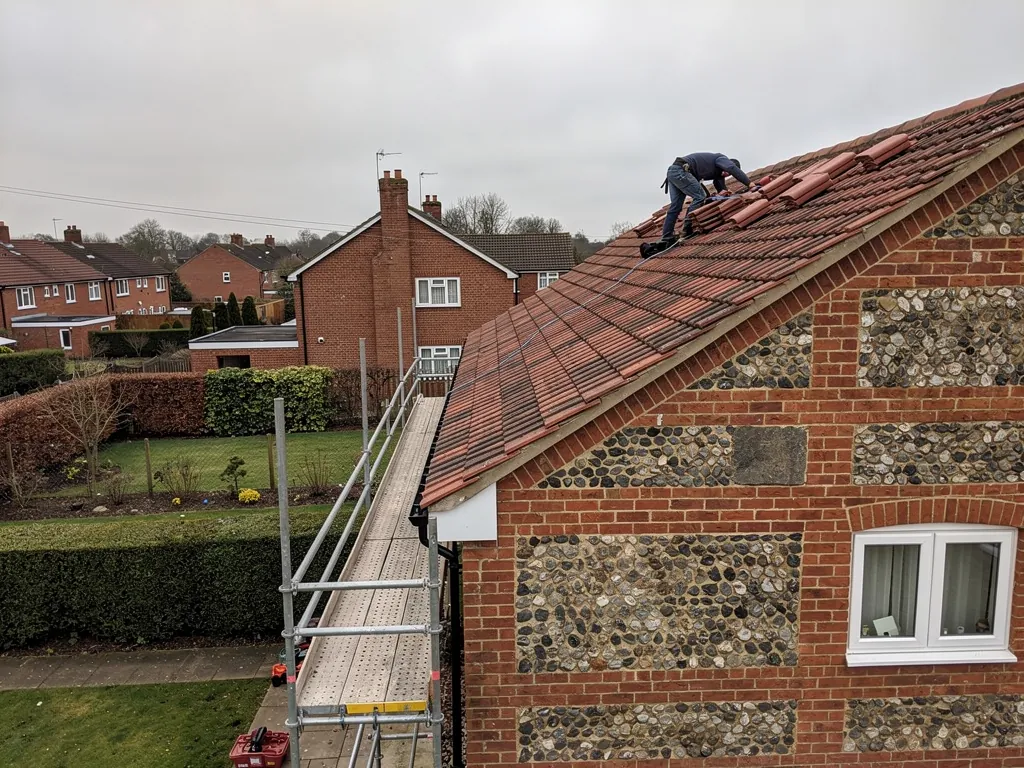
For one tile, the main cost is a roofer's time to get safely to it, lift the courses above, remove the broken tile, fit a new one and secure it. One UK guide, written for slate repairs, reports labour at £100 to £250 per slate with a few pounds of slate on top, £5 to £25. Where a tower or scaffold is needed to reach the spot, the same guide adds £300 to £800. Tile repairs follow the same shape, though the source is slate-specific and we have no tile-specific range to set beside it.
Two conclusions follow. First, the price per tile falls steeply when several are repaired in a single visit, because the access and the setting-up are shared. Second, the cost of a single tile can be dominated by getting to it. If a ladder will do, the job is small. If a scaffold is needed, it becomes a larger one. Our answer on replacing a single roof tile explains what is involved.
Emergency call-outs
If a tile has come off in a gale and water is coming in, the first job is to make the roof safe. One UK guide reports emergency call-out charges of £150 to £350 plus materials, with prices in London and the south-east running 20% to 35% higher. Basingstoke sits in that wider south-east market. The call-out buys a quick temporary repair, such as covering the gap or refixing a tile, so water stops coming in, and a proper repair follows when conditions allow. We prioritise emergency calls and make a leaking roof safe first. Our section on storm damage to roofs covers what we do on the day.
Ridge work
The ridge is one of the commonest tiled-roof repairs. For a dry ridge system on a semi-detached house, one UK cost guide reports £900 to £1,600, with scaffolding on top at £300 to £900. That covers removing the old mortar-bedded ridge and fitting a mechanically fixed system, and it explains why the ridge is usually done as a whole, not tile by tile. Our page on ridge tile repair and re-bedding costs covers the detail, and the comparison of dry ridge and mortar-bedded ridge shows how to choose.
Re-bedding a short stretch of mortar ridge is cheaper than a full dry system, though no reliable UK range is published for it, so we price it from the survey.
Cleaning and moss
Moss removal is not repair, but it appears on most tiled-roof budgets. A UK guide reports hand removal with biocide at £748, £863 and £978 for small, average and large roofs, and pressure washing at £553, £638 and £723. These are typical UK ranges, and they depend on roof size, access and how much has built up. Hand cleaning is gentler on the tiles, and hard pressure washing can strip the surface from concrete tiles and drive water under laps. Our guide to cleaning slate, clay and concrete roofs covers the trade-offs.
A whole new roof, for scale
It helps to know where repairs stop and recovering starts. For a full recover, one UK source quotes £6,500 to £10,500 where a three-bedroom semi is recovered in concrete tile, while another spreads from £4,000 up to £13,000 across new roofs on semis and detached homes. Those totals include scaffold, stripping, battens, underlay, tiles and disposal. Our guide to how much a new roof costs unpacks them.
| Job | Typical UK range reported | What it usually covers |
|---|---|---|
| Single slate or tile | Labour £100 to £250, material £5 to £25 | One unit replaced, source written for slate |
| Access tower or scaffold | £300 to £800 | Equipment to reach the repair safely |
| Emergency call-out | £150 to £350 plus materials | Making safe, 20% to 35% more in the south-east |
| Dry ridge, semi-detached | £900 to £1,600, plus £300 to £900 scaffold | Full ridge replaced with a fixed system |
| Moss removal by hand | £748 to £978 | Cleaning with biocide, by roof size |
| Full re-roof, 3-bed semi | £6,500 to £10,500 | Strip, battens, underlay, tiles, disposal |
Three worked situations
Figures are easier to grasp against real cases. These are descriptions of typical jobs, using only the sourced ranges above, and not Beacon prices.
One slipped tile on a low roof. A single tile on a garage or bungalow roof, reachable by ladder. The cost is a short visit: labour of the order of the single-unit range, a tile, and no scaffold. This is the cheapest end of tiled-roof repair, and it is where homeowners are often pleasantly surprised.
Several tiles and a ridge on a two-storey semi. Here the access dominates. A tower or scaffold adds £300 to £800, a dry ridge system adds £900 to £1,600, and the scaffold for that job is quoted at £300 to £900. If the two are done on the same scaffold, the access is paid once. Doing them in separate visits pays it twice.
A slope that keeps slipping. A roof where tiles drop every winter because the nails have gone. The repeated call-outs, each needing access, add up, and at some point stripping and refixing the slope costs less than the next three repairs. This is where the comparison with a full re-roof range helps you see the scale: refixing one slope is usually a fraction of a whole new roof, because the tiles can often be reused.
Why scaffold is shared and why it matters
Scaffold is the largest line on many small pitched-roof jobs. It is erected to the eaves, boarded and tied in, then taken down, and its price does not shrink much for a short job. Because of that, the best saving available to most homeowners is to put every wanted piece of work on one scaffold: tiles, ridge, verge, valley, chimney flashing, fascia and guttering. The roofer who finds a rotten fascia while the scaffold is up can often replace it for the cost of the board and the labour. Our page on roof replacement scaffolding explains what is involved.
What pushes a repair bill up or down
Beyond access, a handful of things change the total.
- Roof height and pitch. A steep two-storey roof needs more equipment than a low bungalow roof.
- Matching. Finding tiles that match an aged roof can mean salvaged tiles, which cost more than new ones. The page on matching new tiles to an old roof covers the options.
- Hidden damage. A slipped tile may sit on a rotten batten, and the cost of replacing battens or underlay is added once the tile is lifted.
- Number of faults. A fix is cheaper per fault when several are done together.
- Season. Emergency work in a storm costs more than planned work in dry weather.
When repair stops being the cheaper route
A repair is the right answer when the fault is local and the rest of the roof is sound. It stops being the right answer when the faults are everywhere. If tiles keep slipping because the nails have corroded, if the battens have rotted along a slope or if the underlay has perished, repeated repairs cost more than the total of one proper job, and each visit needs access again. A fair rule of thumb is to compare the cost of the repairs you will need over the next few years with the cost of recovering the affected slope. To judge which side of the line you are on, work through the warning signs of a failing tiled roof.
It also helps to know the roof's likely remaining life. A repair on a roof with many years left is money well spent. A repair on a roof about to need replacing mostly buys time, and that can be exactly the right choice if you are selling or planning a re-roof next year. We say so either way.
Reading a repair quote
A useful quote lists the work, the materials and the access separately, so you can see what you are paying for. Check for these points.
- Does it name the tile or say how a match will be found?
- Does it include scaffold or a tower, or is that extra?
- What happens if rotten battens are found, and is there a stated price for that?
- Are fixings specified, with nails or clips of a corrosion-resistant type?
- Is the waste taken away and the site cleared?
- Is there a guarantee in writing?
A quote with a single line and a single figure tells you very little. A quote that answers these questions is one you can compare.
How we price a tiled roof repair
We survey first, photograph what is wrong on your roof, and quote the repair in writing as a fixed price. If a patch will do, we price the patch. If we think the roof needs more, we explain why and show you the pictures. Any extra work found under a lifted tile is agreed with you before we carry on. Repairs carry a written guarantee on workmanship that runs for ten years, and we clear away what we remove. For more about the service, see pitched roofing in Basingstoke.
