
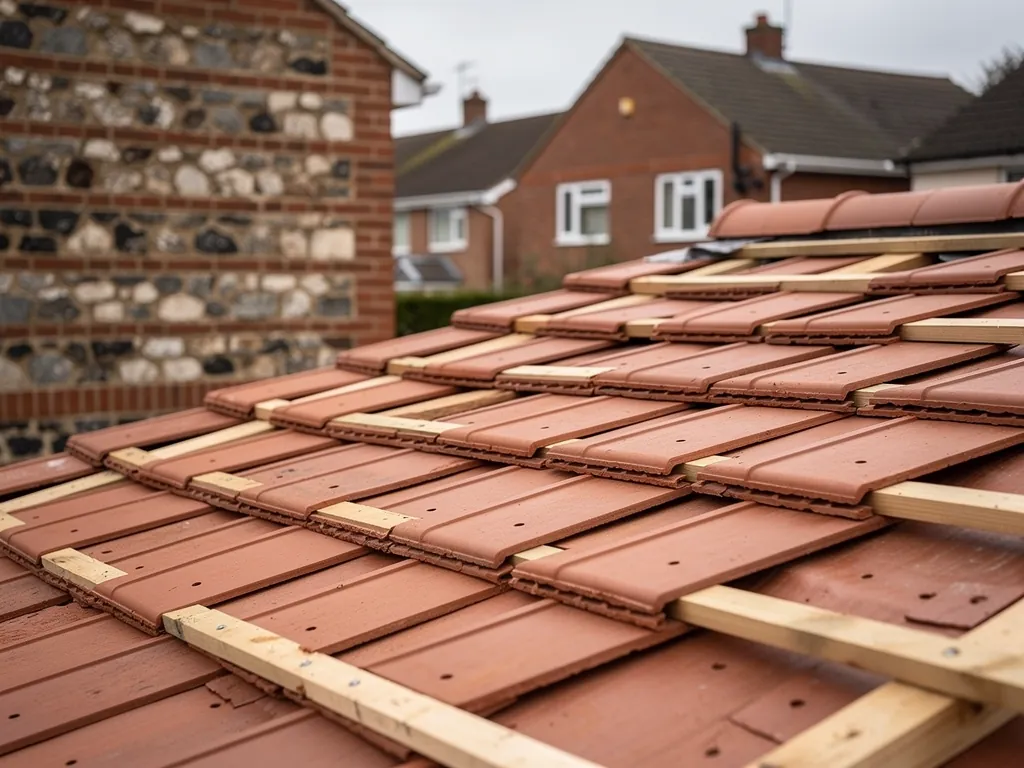
It is a fair question, and the honest answer has two halves. On the day you pay, a flat roof is frequently the lower bill, because it has less surface to cover, no ridge, hips or valleys to form and no heavy timber structure to build. Over the life of the house, a pitched roof can come out level or ahead, because a well-fitted tiled roof may go much longer between big jobs. The trouble with most comparisons is that they set a small flat extension roof against a whole house roof and call the result a cost difference. This page keeps the comparison fair, and it explains what you would have to know about your own building to answer it.
You are rarely choosing between them
Start with the building. A semi-detached house has a pitched roof because the house was designed around one, and the loft space below it is part of the home. A rear kitchen extension has a flat roof because it was designed that way, to sit under the first-floor windows and keep the height down. Neither can simply be swapped. Turning a flat roof into a pitched one is a building project with its own structure, planning questions and Building Regulations application, which our short answer on converting a flat roof to pitched covers.
So the real decision comes up in a handful of situations: designing an extension or garage, replacing a failing flat roof and wondering whether to change its form, or comparing the long-term bills of two houses. In each, the cost question breaks into two parts: the price per square metre of covering, and the price of everything that has to sit under it.
What a flat roof costs
Flat roofs are priced by the square metre of covering, and the sourced ranges are fairly consistent. One UK cost guide reports torch-on felt at £60 to £100 per m², with EPDM rubber and GRP fibreglass sitting higher: £80 to £120 for EPDM and £100 to £160 for GRP, each supplied and fitted. A trade-facing guide gives lower numbers: EPDM £70 to £100, GRP £80 to £120 and modified bitumen £45 to £75 per m². Treat all of these as typical UK ranges, national and only a rough guide. Your fixed quote follows the survey, because deck repairs, insulation, edge trims and access change the total as much as the membrane does.
A typical domestic flat roof is small. A single-storey extension, a porch or a garage is a few tens of square metres at most, which puts the whole job at a modest figure. That is the source of the idea that flat roofs are cheap: the roofs themselves are small. If you want the full breakdown, our page on how much a flat roof costs goes through it.
What a pitched roof costs
A pitched roof is usually priced as a whole, because the job involves scaffolding, stripping, battens, underlay, tiles and ridge and verge work at once. Typical ranges reported by UK cost guides put a re-roof in concrete tiles on a three-bedroom semi at £6,500 to £10,500, and another guide reports a spread of £4,000 up to £13,000 across new roofs on semis and detached houses. Natural slate is dearer, with one trade guide reporting £120 to £180 per m² against £90 to £130 per m² for man-made slate.
Those numbers look large against a flat-roof bill, and the comparison is unfair for the reason above: they cover a whole house roof, not a single extension. Per square metre of area covered, tiled roofing is not wildly different from EPDM or GRP. What pushes the total up is the sheer area and the extra work that a pitch brings, such as scaffolding to the full eaves height, the ridge, the hips, the valleys, the chimney flashings and the verge edges.
What really moves the price on either type
Whichever you have, the same few things drive the bill, and they matter more than the form.
- Size and complexity. A simple rectangle is cheap to cover. Dormers, hips, valleys, chimneys and rooflights each add labour and materials, on pitched and flat roofs alike.
- Access and scaffolding. A two-storey pitched roof needs a full scaffold. A single-storey flat roof may need only a tower or ladder access. Scaffold hire is a real line on the quote.
- Condition of the structure. Rotten rafters, weak battens or a soft flat-roof deck add repair costs before any covering goes on.
- Insulation. Re-covering a roof is a thermal element under the Building Regulations, and on larger jobs the whole roof's insulation can be pulled into the work. That adds cost on either roof type.
- Covering chosen. EPDM, GRP and felt differ, and so do concrete tile, clay tile and slate.
For the flat-roof side, our comparison of EPDM, GRP and felt shows how the material choice shifts the price. For the pitched side, the cost differences between concrete and clay tiles are set out in a separate guide.
Lifespan and upkeep: where pitched often catches up
A tiled roof that is properly fixed and has sound battens and underlay can last for a very long time, with routine repairs along the way: a slipped tile here, a ridge re-bedded there. A flat roof covering has a more limited life, and its working life depends heavily on the material and on how well the falls, edges and outlets were detailed. EPDM and GRP can last for many years when properly laid. Felt generally has the shortest life of the three. Our guide to how long a flat roof lasts goes into the differences.
Upkeep differs in character. A pitched roof needs checking after storms for slipped tiles, tired ridge mortar and blocked valleys. A flat roof needs its outlets cleared and its drainage watched, because standing water is the usual precursor to failure. Neither is maintenance-free, and a gutter cleaned once a year costs very little compared with the damage it prevents.
| Cost point | Flat roof | Pitched roof |
|---|---|---|
| How it is priced | Per m² of covering, on a small area | Whole roof, with scaffold, stripping and fittings |
| Typical UK range | £45 to £160 per m², depending on material | £4,000 up to £13,000 on a semi or detached house |
| Structure underneath | Deck and falls, which can need replacing | Rafters and battens, which often need only selective repair |
| Covering life | Shorter, and varies widely by material | Longer, with small repairs along the way |
| Common upkeep | Clearing outlets, watching for ponding | Checking tiles, ridge and valleys after storms |
The hidden costs: leaks, loft space and resale
The roofing invoice is only part of the cost. A flat roof that fails often does so at the edges and details, and a leak that runs into a ceiling can bring plastering and redecorating with it. A pitched roof that leaks may let water into the loft insulation unseen for a long time. In both cases, a survey that catches the fault early costs far less than finding it through the ceiling.
A pitched roof also gives you something a flat roof does not: loft space. It can be used for storage, and in some houses converted into rooms, which adds value that a flat roof cannot. On the other hand, a flat roof can be the right answer when a pitch would block a window, breach a height limit, or look wrong against the rest of the house. Check with your council's planning team if a change in roof shape affects the look or height of the building.
Some buyers and surveyors also notice roof condition at sale. If you are buying, our page on roof checks when buying in Basingstoke sets out what to look for on either type.
Questions that make quotes comparable
If you are collecting prices for a pitched roof and a flat roof side by side, they only help if each quote says the same things. Ask every roofer the same short list.
- What exactly is being removed, and is the old covering taken away and the site cleared?
- What is the new covering, and what is it fixed with?
- Is the deck, or are the battens, included in the price, or priced as an extra if they are found rotten?
- Is scaffolding included, and who arranges it?
- What insulation goes in, and does the job need to be notified to building control?
- What guarantee is written down, and what does it cover?
A cheaper quote that leaves out scaffolding, insulation or deck repairs is not cheaper. It is a smaller quote for a smaller job. Our guide to what affects roofing costs goes deeper into how to read the lines.
Energy and insulation across both types
Heat loss through the roof is a running cost that never shows on a roofing quote. Pitched roofs usually take loft insulation laid between and over the joists at ceiling level, with the roof space kept cold and ventilated above it. Flat roofs usually take rigid insulation boards, either above the deck in a warm roof or between the joists in a cold one, and the build-up needs more care to avoid trapped moisture. The thicker the insulation, the better the saving, and replacing a roof is the cheapest moment to add it, because the structure is already open. Under Approved Document L, a roof is a thermal element, so a big re-covering can pull an insulation upgrade into the job.
Repair first, replace when it makes sense
The cheapest roof is often the one you already have, kept in order. A tiled roof with a few slipped tiles and a tired ridge is a repair job, not a re-roof. A flat roof with one failed upstand is a repair job, not a new membrane. We say so at the survey when it is true. Our guide to signs a tiled roof is failing helps you judge which end of that spectrum you are at.
When a replacement is the right call, we put the options on paper: the covering we would use, what it replaces, what the structure needs and what the price covers. Each quote is fixed and written, with a 10-year workmanship guarantee behind the work and the site cleared at the end. If you are weighing a pitched roof against a flat one for a project, our pitched roofing page or our flat roofing team can talk it through, and the best first step is a free survey, with photographs taken on the roof you own.
