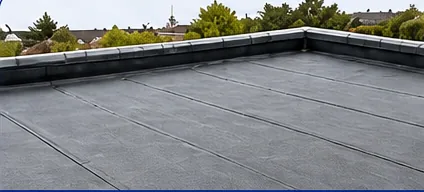
Ask three contractors what a commercial roof replacement costs and you will get three numbers, because the building is the variable. A 400 m² steel-framed unit with a failing sheet roof is a different job from a flat-roofed office block with a plant deck, and both differ again from a trading warehouse where the work has to happen around lorries and staff. This guide explains how the price is built, where the typical UK figures come from, and which items push a quote up or down, so that you can read a tender line by line and compare like with like.
What the typical rates are, and how far to trust them
Published commercial roofing prices are thinner on the ground than domestic ones. The only per-square-metre figure we can point to for stripping and replacing a commercial flat roof is an informal answer from a tradesperson on a consumer Q&A site, which quoted a spread starting at £90 per m² and running past £180 per m². Treat that as a low-confidence marker of the order of magnitude, not a benchmark. Older professional data exists as well: a 2016 cost table published by the architects' institute journal gave single-ply membrane with insulation at £75 to £95 per m². It is dated and prices have moved since, so it is useful only to show how systems compare with each other.
These are typical UK ranges from third-party sources, not Beacon prices, and a fixed quote for your building can only follow a survey of it. The width of the range tells you something on its own. A building at the bottom of it has a simple deck, easy access and a covering that comes off in large pieces. A building at the top has awkward falls, plant to lift and disconnect, a deck that needs repair, or insulation that has to be brought up to current standards. Nobody can place your roof within that span from a postcode and a floor area.
To make the arithmetic concrete, take a flat roof of 400 m². At the informal range above, a strip and replace would land somewhere between £36,000 and £72,000 before any extras. That is an illustration of scale, not an estimate, and the real figure depends on the items below.
The covering itself: what goes on matters less than what is under it
Commercial roofs fall into a few families, and each prices differently. Single-ply membranes (PVC, TPO or EPDM sheet, either mechanically fixed or adhered) are quick to lay over large areas and are often the lowest labour cost on a big flat deck. Built-up felt is several bonded layers of reinforced bitumen, and it takes longer on site but copes well with foot traffic and awkward details. Liquid-applied systems suit roofs with many penetrations. Profiled metal sheeting, the standard cover on industrial units, is a different trade again, with its own fixings, flashings and sealants. Our guide to commercial flat roof systems sets the families side by side, so this page stays on cost.
The covering is often less than half the story. Under it sits the deck (concrete, timber, profiled steel or plywood), then a vapour control layer, then insulation. If the old insulation is wet, as it commonly is under a roof that has leaked for years, it has to come out, and wet insulation is heavy and bulky to dispose of. A deck that has rotted, rusted or cracked needs repair before anything new is laid. These items are only visible once the old covering is off, which is why a competent surveyor probes and photographs the roof first and a good quote names an allowance and a rate for deck repair rather than ignoring it.
Insulation and the energy rules
A replacement roof is not just a new waterproof layer. Under the energy rules for existing non-domestic buildings (Approved Document L, volume 2), a roof counts as a thermal element, and renovating a significant part of it can bring an insulation upgrade into the job. The Planning Portal frames the test around the roof and the whole building envelope, and small re-covering jobs below its thresholds are normally left alone by building control. Go past them and the work needs approval, with better insulation possibly required across the entire roof. Our guide to building regulations for commercial roofs goes through how that plays out.
For cost, the consequence is simple. More insulation means thicker boards, longer fixings, higher upstands at every wall and rooflight, and sometimes taller flashings and new roof outlets. Tapered insulation, which builds the falls into the board so that water runs to the outlets, adds to the material cost but replaces the need to re-form a flat deck. A quote that shows an insulation specification and thickness is one you can compare. A quote that says only "new membrane" has left out the part that changes the price most.
Access, scaffold and working around a trading business
Getting people and materials onto a roof safely has a price of its own. A low-rise unit may need only a hoist and edge protection, while a taller building needs scaffold or a mobile tower, and a long roof edge over a loading yard needs a protected walkway for the people below. Edge protection and temporary guarding are a legal necessity for work at height, and the cost scales with the perimeter rather than the area. That is why a long thin roof can cost more per m² than a square one of the same size.
Trading adds more. Noise, hot work and dust may restrict the hours you can work, and bitumen fumes or solvent smells can limit the system you choose near offices or food production. If the roof has to be done in sections so that production can carry on under it, the contractor must dry-in each section every evening, which means more labour and more temporary protection. Staging a re-roof over several weekends rather than one continuous block can lower the disruption and raise the price. Both are valid choices, but it needs to be decided before tender, not after.
Hazards that add cost: fragile materials and asbestos
Many older industrial roofs include materials that make the work slower and more costly. Rooflights in fibre-cement or old plastic can be fragile, so they need covers, netting or staging before anyone walks the roof. Our guide to asbestos roofs on commercial buildings covers the next step: if the sheets are asbestos cement, careful removal without breaking them is non-licensed work according to the HSE, and it becomes notifiable non-licensed work if the material is going to be substantially broken up, for example by dropping the roof. A risk assessment, proper controls and trained workers are always required, and the disposal of the waste follows its own route. Overlaying is sometimes an alternative to removal, which can change the cost considerably.
We cannot quote for these items until the material has been identified, and in a non-domestic building the owner or manager has a legal duty to manage asbestos in the first place. If you already have an asbestos register or a survey, send it with your enquiry. If you do not, the HSE's guidance on non-licensed asbestos work explains the categories, and arranging an identification survey early prevents a stalled project later.
Replace, overclad or repair: the first big cost decision
The cheapest roof is the one you do not have to replace. A repair, a localised patch or a coating can extend a sound roof for years, and we say so when a roof has life left in it. Where a profiled metal roof is structurally fine but leaking at the laps and fixings, overcladding, which means fixing a new sheeted system over the old one, can avoid stripping altogether and keep the building watertight while you carry on trading. It is not always possible, because the structure has to carry the extra weight, and a covering that adds 15% or more to the load needs approval and may need strengthening. Our guide to whether to repair or replace a commercial roof gives the decision criteria, and a survey tells you which of them applies to your building.
| Cost driver | Pushes the price | What the quote should show |
|---|---|---|
| Deck condition | Up when boards or sheets need replacing | An allowance and a unit rate for repair |
| Insulation | Up with thickness and wet-insulation disposal | Product, thickness and falls design |
| Access | Up with height, perimeter and pedestrians below | Scaffold, edge protection and hoisting |
| Penetrations | Up with every rooflight, vent and plant base | Number of details and how each is formed |
| Asbestos or fragile sheets | Up with identification, controls and disposal | Survey status and the removal method |
| Trading hours | Up when work is phased or restricted | The phasing plan and temporary protection |
How to compare quotes properly
When tenders arrive, line them up by specification before price. Are they pricing the same insulation thickness, the same covering and the same number of rooflights? Do they say who pays for scaffold, skips and disposal? Is deck repair an allowance with a rate, or a vague exclusion? Does the quote list the warranty and who stands behind it? A cheap figure that leaves out wet-insulation removal or edge protection is not cheaper once the extras arrive.
It also helps to separate capital cost from running cost. A roof with a better insulation specification and fewer joints costs more on day one and less to heat, inspect and patch over the years. If the building is leased, check who carries the repair obligation, as landlords and tenants often split these items and the split affects who should be briefing the roofer.
What a Beacon quote looks like
We start with a free survey on the actual roof, with photographs of what we find, so the discussion is about your building rather than a general specification. If repair will do, that is what the report recommends. If replacement is the honest answer, you get a fixed written quote that lists the covering, the insulation, the access arrangements, the deck repair allowance and the disposal of waste, and our workmanship is guaranteed for 10 years, with the certificate in writing. Any building control application the job needs is dealt with by us. To start, see our commercial roofing in Basingstoke page, or ring 01256 213956, or message us on WhatsApp with some photos and a rough roof area.
